
Listen to this Post
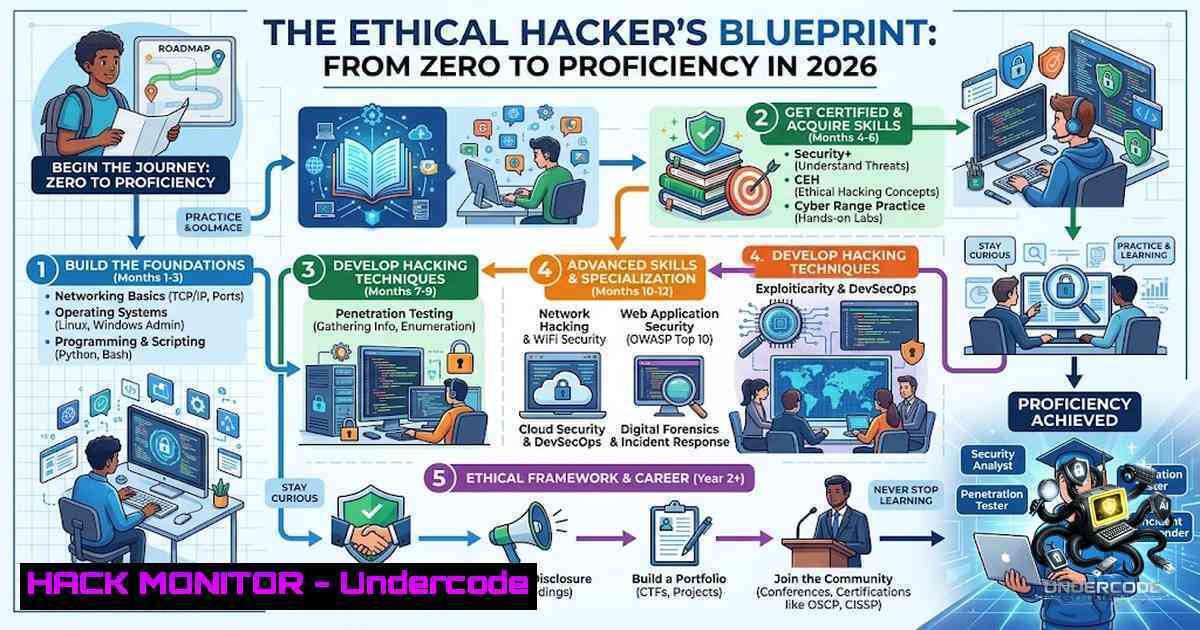
Introduction:
The cybersecurity industry faces a paradoxical skills gap: while organizations scramble for talent, the entry barrier for ethical hacking has never been lower. However, the conventional wisdom of “learn to hack in 30 days” through expensive tool suites is fundamentally flawed. A sustainable career in offensive security is built not on memorizing Metasploit modules, but on mastering the foundational triad of networking, operating systems, and application logic. This approach transforms a novice into a security professional who understands why a vulnerability exists, rather than just how to press a button.
Learning Objectives & Secrets:
- Objective 1: Master the Foundational Tech Stack. Before executing a single attack, you must understand how data moves. This means grasping TCP/IP, DNS, HTTP/S, and the Linux filesystem hierarchy. Secret Tip: Start by configuring a static IP on a Linux VM using `/etc/netplan/` without a GUI. If you can troubleshoot connectivity issues via the command line, you have surpassed 80% of beginners.
- Objective 2: Transition from Theory to Tactical Application. Moving from a textbook to a live environment is the hardest step. Use platforms like TryHackMe not as a walkthrough to copy-paste, but as a lab to test hypotheses. Secret Tip: After completing a room, close the browser and attempt to replicate the attack locally using a virtual network (VirtualBox Host-Only) to ensure you understand the underlying exploit mechanism, not just the syntax.
- Objective 3: Develop a Specialized Methodology. Ethical hacking is too vast to master all at once. Focus on one domain—web penetration, network security, or cloud. Secret Tip: Set a goal to find a low-severity bug in a bug bounty program (like a missing security header) within the first 90 days. This teaches you reconnaissance and report writing, which are more valued than tool proficiency.
You Should Know:
- Setting Up a Safe Cyber Range with Virtualization
A secure lab is the cornerstone of ethical hacking practice. You need to contain your activities to avoid accidental network disruption and to allow for snapshots to revert to a clean state.
- Windows Hosts: Download and install VMware Workstation Player or VirtualBox. For Windows, ensure Hyper-V is disabled to avoid conflicts.
- Linux Hosts: Use `sudo apt-get install virtualbox` or `sudo snap install vmware-workstation-player` for a lightweight setup.
- Configuration: Create a “Host-Only” network adapter to isolate the VMs from your main network. This creates a private subnet where you can safely scan and exploit targets without affecting household devices.
Step‑by‑step:
- Download the Kali Linux ISO and a vulnerable target image (like Metasploitable 2).
- In VirtualBox, go to File > Host Network Manager and create a new adapter (e.g.,
vboxnet0). - Set the network adapter for both VMs to “Host-Only” adapter.
- Boot both machines. On Kali, run `sudo ip addr` to find its IP (e.g.,
192.168.56.101). On the target, run `ifconfig` (usually192.168.56.102). - Test connectivity: `ping 192.168.56.102` from Kali. If it replies, your safe lab is ready for discovery.
2. Reconnaissance and Network Mapping
Before exploiting, you must understand the attack surface. This is where tools like Nmap shine, but only if you understand the flags you are using.
- Quick Scan: `nmap -T4 -F 192.168.56.102` (Fast scan for top 100 ports).
- Service Detection: `nmap -sV -p 22,80,443 192.168.56.102` (This is crucial to identify software versions to match against potential exploits).
- Operating System Detection: `nmap -O 192.168.56.102` (Requires root privileges).
Step‑by‑step:
- Use `netstat -tulpn` on the target (if Linux) to see what services are listening locally.
- Compare this with the Nmap scan results to understand visibility.
- For web, use `whatweb http://192.168.56.102` to identify technologies like PHP, Ruby on Rails, or specific web servers that might have known configuration flaws. Secret: Focus on identifying “outdated” services, as they are the low-hanging fruit for a novice.
3. Web Application Fundamentals with Burp Suite and Curl
Web application hacking requires an understanding of the client-server request/response cycle. The browser shows you the rendered page, but the real action is in the headers and parameters.– Intercepting Requests: Configure your browser (Firefox) to route traffic through Burp Suite (Localhost:8080). Install the FoxyProxy extension for quick switching.
– Command-line Alternative (Curl): For simple parameter fuzzing, use Curl. This is often faster than a GUI.Step‑by‑step:
1. Viewing Headers: `curl -I http://192.168.56.102` (Shows server headers, checking for missing security headers like
X-Content-Type-Options). - Parameter Manipulation: `curl -X POST -d “username=admin&password=test” http://192.168.56.102/login.php`
3. Modifying Headers: `curl -H “User-Agent: Hack” -H “X-Forwarded-For: 127.0.0.1” http://192.168.56.102/admin` (Testing for IP Bypass and proxy headers). - In Burp, send the request to Repeater. Change the `Referer` or `User-Agent` headers to see if the server behaves differently. This is where you discover logic flaws.
4. Linux Privilege Escalation (Enumeration)
Once you gain initial access, the game changes from “getting in” to “getting higher.” This is where Linux system administration knowledge shines.
- Kernel Exploits: Check the kernel version:
uname -a. Search for public exploits (e.g.,searchsploit linux kernel 5.4). Warning: Kernel exploits often crash systems; use only in a lab. - SUID Binaries:
find / -perm -4000 -type f 2>/dev/null. This lists executables that run with the owner’s privileges. - Writable Files:
find / -writable 2>/dev/null | grep -v /proc/. Look for cron jobs or `.bash_history` files containing passwords.
Step‑by‑step:
- Manual Check: Run `whoami` and `id` to see your groups.
- Check Sudo: `sudo -l` (This reveals what commands you can run as root without a password).
- Automation: Use `linpeas.sh` (download it via `wget` and run) to automate the enumeration. It highlights high-risk paths. The secret is to read the output rather than just running the script; understand why a file is flagged as critical.
5. Windows Active Directory Fundamentals
Many corporate environments rely on Active Directory. Hacking AD isn’t just about NTLM hashes; it’s about understanding trust relationships and Kerberos.
- Enumeration: Use tools like `BloodHound` to map the domain structure. On Windows, `net user /domain` lists users. On Linux, `crackmapexec smb` is invaluable.
- Command Example (Linux): `crackmapexec smb 192.168.1.10 -u ‘Administrator’ -p ‘Password123’ –shares` (This tries to enumerate network shares).
- Kerberoasting: `GetUserSPNs.py domain.local/username:password -request` (Extracts service account passwords that can be cracked offline).
Step‑by‑step:
- Set up a Windows Server VM with AD DS and a Windows 10 client joined to the domain.
2. Simulate a low-privilege domain user.
- Use `PowerShell` on the client to run
Get-ADUser -Filter -Properties. - Attempt to authenticate to the Domain Controller via SMB. If the SMB signing is disabled, you might be able to relay the hash (an advanced topic).
6. API Security Testing (The Modern Attack Surface)
AI and modern web applications rely heavily on APIs. JSON Web Tokens (JWT) are commonly used for authentication.
- JWT Weakness: If an API uses a weak secret, you can forge a token.
- Testing with
jwt_tool: `sudo apt install jwt-tool` (orpip3 install pyjwt). - Exploitation: `jwt_tool
-d` (Decodes). `jwt_tool -X a` (Tests for “alg: none” vulnerability). - Brute Force: `jwt_tool
-C -d /usr/share/wordlists/rockyou.txt` (Tries to guess the secret).
Step‑by‑step:
- Find an API endpoint via Burp (e.g.,
/api/v1/user). - Capture the JWT in the `Authorization: Bearer` header.
- Analyze the `aud` (audience) and `exp` (expiration) claims.
- If the “alg” is “HS256” and you crack the secret, you can modify the “user” claim to “admin” and resign the token, effectively becoming the administrator without needing a password.
7. Cloud Security Essentials (AWS/Azure)
As infrastructure moves to the cloud, misconfigurations become critical vulnerabilities. The most common issue is overly permissive S3 buckets (AWS) or Blob Storage (Azure).
- Check for Public Buckets:
- AWS CLI: `aws s3 ls s3://bucket-1ame –1o-sign-request` (If this works, the bucket is public).
- Azure CLI: `az storage blob list –container-1ame container-1ame –account-1ame accountname` (Check permissions).
- Misconfiguration in IAM: If a role allows “sts:AssumeRole” from any principle, it’s a privilege escalation risk.
- Tools: Use `ScoutSuite` for a comprehensive cloud security audit.
Step‑by‑step:
- Setup: Install AWS CLI and configure credentials (
aws configure).
2. Enumerate: `aws s3 ls` (List owned buckets).
- Test Public Access: Attempt to read a known file:
aws s3 cp s3://example-bucket/config.json .. - If it downloads, the bucket is vulnerable. Recommendation: Always enable “Block Public Access” settings unless absolutely necessary.
What Undercode Say:
- Key Takeaway 1: Resilience is the product of curiosity. The journey to proficiency involves constant failure. The command line will scream errors, exploits will fail, and services will crash. This is not a sign of incompetence, but of engagement. The successful hacker documents these failures meticulously, turning each “broken” command into a learning opportunity for system internals.
- Key Takeaway 2: The “Specialist” wins the marathon. While broad knowledge is necessary, depth is marketable. A professional who understands the intricacies of OAuth 2.0 flows or the specific vulnerabilities of Kubernetes RBAC is worth more than someone who knows a surface-level scan of every domain.
Analysis: The cybersecurity narrative often revolves around “expertise,” but expertise is merely the byproduct of solving complex, context-specific problems. The move away from expensive boot camps toward self-directed labs signals a maturing industry where practical aptitude outweighs certification fluff. As AI tools become more prevalent, the core skill of understanding the underlying logic becomes more critical, as AI is only as good as the query; a hacker must know what to ask. The “zero to hero” pipeline is brutal, but those who respect the fundamentals build a foundation that weathers any technological shift.
Prediction:
- -1 The “Tool-Literate” generation will face a bottleneck in 2026. As automated penetration testing services improve, companies will prioritize individuals who can interpret results and provide strategic remediation over those who can simply run an automated scanner. The demand for foundational understanding will increase, leaving those who skipped the basics obsolete.
- +1 Specialized Cloud and AI Security roles will see a 40% demand surge. The proliferation of Serverless architectures will create a new category of “DevSecOps” roles requiring the exact intersection of Linux, scripting, and web knowledge outlined in this guide, with salaries outpacing traditional network security positions.
- -1 The reliance on off-the-shelf exploitation frameworks (like Metasploit) will decrease as custom-built tools and zero-day research gain prestige. This will widen the gap between “script kiddies” and “professionals,” punishing those who never learned to code Python or Bash.
- +1 Platforms like TryHackMe and HackTheBox are revolutionizing talent acquisition. We will likely see a shift where practical lab scores hold more weight than years of experience on a resume, democratizing access to high-level security jobs based purely on demonstrable skill.
- -1 Complacency in cloud configurations will persist. As startups deploy rapidly, the misconfiguration of S3 buckets and IAM roles will remain the 1 cause of data breaches, proving that the basics of “least privilege access” are still ignored by the masses.
▶️ Related Video (88% Match):
🎯Let’s Practice For Free:
🎓 Live Courses & Certifications:
Join Undercode Academy for Verified Certifications
🚀 Request a Custom Project:
Secure, high-velocity infrastructure and disruptive technological engineering. Contact our engineering team for high-tier development and proprietary systems:
[email protected]
💎 Smart Architecture | 🛡️ Secure by Design | ⭐ Trusted by Thousands
IT/Security Reporter URL:
Reported By: https://lnkd.in/p/e4pTJNVH – Hackers Feeds
Extra Hub: Undercode MoN
Basic Verification: Pass ✅


