
Listen to this Post
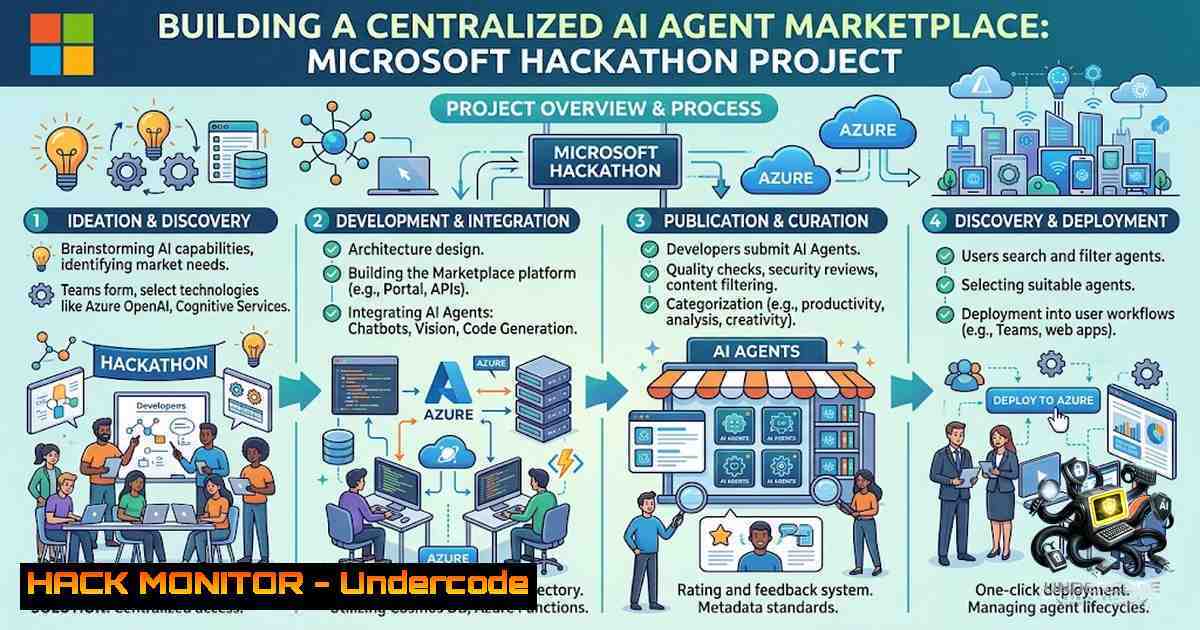
Introduction:
As enterprises rapidly adopt generative AI, a new challenge emerges: the proliferation of custom-built AI agents across departments, leading to redundancy, inconsistent quality, and a lack of governance. The solution lies in creating an internal marketplace that not only catalogs these agents but also ranks them using standardized Key Performance Indicators (KPIs), enabling employees to consistently deploy the most effective tools for their tasks.
Learning Objectives & Secrets:
- Objective 1: Understand the architecture of an internal AI agent marketplace, focusing on centralized discovery and standardized benchmarking.
- Objective 2 (Secret Tip): To ensure accurate ranking, implement a dynamic benchmarking sandbox that isolates agent execution, preventing one agent’s resource consumption from affecting another’s performance metrics.
- Objective 3 (Secret Tip): Utilize a “blue/green” deployment strategy for new agent versions, allowing the platform to test and rank a new version against the current champion before it is made available to the wider employee base.
You Should Know:
- Setting Up the Centralized Agent Registry (GitHub & CI/CD)
The core of the marketplace is a central repository where agent code and metadata are stored. Using GitHub as the source of truth allows for version control and automated testing. When an agent is uploaded, a GitHub Action or similar CI/CD pipeline is triggered to initiate the benchmarking process.
Step‑by‑step guide explaining what this does and how to use it:
1. Create a Repository: Establish a GitHub repository to host agent manifests (e.g., agent-manifest.json) and the core benchmarking scripts.
2. Define a Manifest: Structure a JSON file containing the agent’s name, description, category, and entry point.
{
"name": "CustomerSupportBot",
"version": "1.0.0",
"category": "Support",
"entry_point": "main.py",
"author": "team-alpha"
}
3. Implement Validation: In your CI pipeline, add a step to validate the manifest structure before running the benchmark.
4. Automate Deployment: Upon a successful push to the main branch, automatically trigger a webhook to your dashboard backend to update the list of available agents.
2. Building the Benchmarking Dashboard (Python & Flask)
A lightweight dashboard acts as the frontend for employees to discover agents. This Flask application will query a database containing agent metadata and their latest performance scores. The dashboard should offer filtering by category and sorting by the “Performance Score.”
Step‑by‑step guide explaining what this does and how to use it:
1. Initialize Flask App: Set up a basic Flask project with routes for the main dashboard and an API endpoint for fetching agent data.
from flask import Flask, render_template, jsonify

app = Flask(<strong>name</strong>)

@app.route('/')
def dashboard():
return render_template('dashboard.html')
2. Integrate Database: Connect to a SQLite or PostgreSQL database to store agent results. Create a table for agents and a table for benchmark results.
3. Develop Ranking Logic: Write a Python function to calculate a composite score based on KPIs (e.g., accuracy, speed, cost). This function should be called after a benchmark run.
4. Render Visualizations: Use a JavaScript charting library (e.g., Chart.js) to display performance comparisons and trends over time.
3. Implementing the KPI-Driven Benchmarking Sandbox
To ensure fair ranking, agents must be tested in a controlled, consistent environment. Containerization using Docker is essential for this. The platform spins up a new container for each agent, runs a standardized test suite, and collects performance data. This isolates the agent from external variables and prevents security risks.
Step‑by‑step guide explaining what this does and how to use it:
1. Containerize the Test Harness: Create a Docker image that contains a Python environment, a test dataset, and a script to interface with the agent.
2. Security Hardening: Run containers with read-only root filesystems and drop all unnecessary Linux capabilities (e.g., --cap-drop=ALL) to prevent privilege escalation.
3. Execute Benchmark: Use the Docker SDK for Python to programmatically run the container, passing the agent’s details as environment variables.
import docker
client = docker.from_env()
container = client.containers.run(
"benchmark-harness:latest",
environment={"AGENT_NAME": "CustomerSupportBot"},
remove=True,
network_disabled=True
)
4. Collect and Ingest Logs: Capture stdout/stderr and parse the logs to extract KPI values, storing them in the database for ranking.
4. Standardized KPI Definition and Scoring System
The objectivity of the marketplace relies on the chosen KPIs. For a general-purpose AI agent, common metrics include response latency (in milliseconds), task completion accuracy (percentage), and cost-per-request (in API calls). A weighted scoring model allows companies to prioritize what matters most to them.
Step‑by‑step guide explaining what this does and how to use it:
1. Define KPIs: Create a configuration file (config.yaml) that lists the KPIs and their weights (e.g., Accuracy: 50%, Latency: 30%, Cost: 20%).
2. Normalize Scores: Since KPIs are on different scales, implement a Min-Max normalization function to bring all values to a 0-1 range.
3. Calculate Composite Score: Write a script to multiply each normalized KPI by its weight and sum the results to get the final performance score.
4. Automate Re-Benchmarking: To handle agent drift or dataset updates, schedule a cron job or use a scheduler to re-run benchmarks on a monthly basis.
5. Cloud and API Security for the Marketplace
Hosting an internal AI agent marketplace introduces security risks, particularly concerning API keys and data exfiltration. All secrets used by the agents must be stored in a vault (e.g., HashiCorp Vault or Azure Key Vault) rather than environment variables. The platform should also enforce strict network policies to allow only outbound API calls to trusted endpoints.
Step‑by‑step guide explaining what this does and how to use it:
1. Integrate Secret Management: Modify the container startup logic to fetch secrets from the vault dynamically via the agent’s metadata.
2. Enforce Zero-Trust Networking: Use a firewall or network policy (e.g., `iptables` on Linux) to block all egress traffic except to a predefined list of internal or approved external APIs.
 Example Linux iptables rules
iptables -A OUTPUT -d 192.168.0.0/16 -j ACCEPT
iptables -A OUTPUT -d trusted-api.com -j ACCEPT
iptables -A OUTPUT -j DROP
3. Implement Audit Logging: Create a mechanism to log every interaction the agent has, storing inputs and outputs for compliance and forensic analysis.
What Undercode Say:
- Key Takeaway 1: The project effectively tackles the “Shadow AI” problem by bringing governance and visibility to the development of custom agents. By centralizing discovery and ranking, the prototype prevents wasted engineering effort and ensures that the best-performing solution is used company-wide.
- Key Takeaway 2: The shift from building to orchestrating is a major trend in enterprise AI. Companies will increasingly focus on platform engineering and benchmarking frameworks like this to maximize the value derived from their AI investments. This approach is a practical step towards true MLOps maturity.
Expected Output:
The described prototype is a blueprint for future enterprise AI management. By combining containerization, CI/CD, and standardized KPIs, Microsoft’s hackathon project provides a solid foundation for democratizing AI access while maintaining security and quality control.
Prediction:
- +1 In the next 12 months, we will see a surge in commercial “AI Agent Hubs” from major cloud providers, largely mirroring the architecture of this prototype. This will accelerate the adoption of AI by democratizing access to specialized, peer-reviewed tools.
- +1 The open-source community will likely produce frameworks specifically for KPI-based agent ranking, further standardizing how we evaluate model performance in production environments.
- -1 However, a significant negative impact will be the increased attack surface. As these marketplaces grow, they become prime targets for supply chain attacks where a malicious agent could compromise the entire benchmarking environment.
- -1 Companies that rush to deploy such systems without robust secret management and network isolation will be vulnerable to credential theft. The complexity of securing these “systems of systems” will lead to a need for specialized security roles.
▶️ Related Video (90% Match):
🎯Let’s Practice For Free:
🎓 Live Courses & Certifications:
Join Undercode Academy for Verified Certifications
🚀 Request a Custom Project:
Secure, high-velocity infrastructure and disruptive technological engineering. Contact our engineering team for high-tier development and proprietary systems:
[email protected]
💎 Smart Architecture | 🛡️ Secure by Design | ⭐ Trusted by Thousands
IT/Security Reporter URL:
Reported By: https://lnkd.in/p/erKBU4z8 – Hackers Feeds
Extra Hub: Undercode MoN
Basic Verification: Pass ✅


