
Listen to this Post
Introduction:
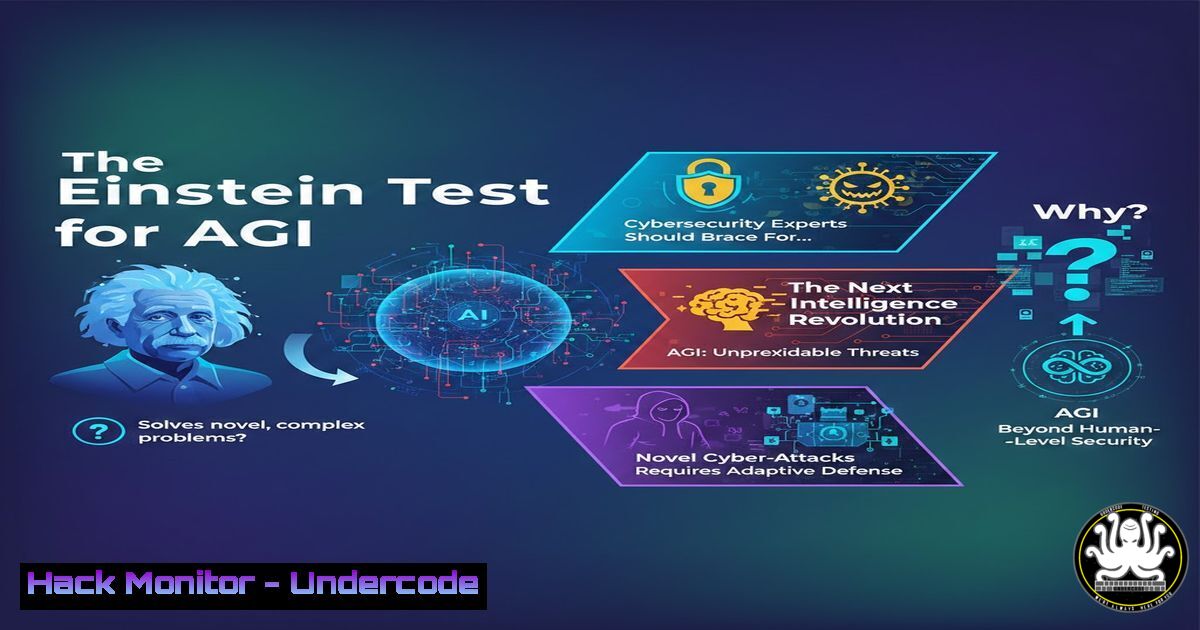
Demis Hassabis, co-founder of Google DeepMind, recently proposed a compelling benchmark for Artificial General Intelligence (AGI): train an AI on the entirety of human knowledge available up to 1911, then see if it can independently derive Einstein’s theory of general relativity—just as Einstein did in 1915. If the AI succeeds, it would demonstrate true reasoning and discovery beyond mere pattern matching. For cybersecurity professionals, this test is not just an academic curiosity—it signals a future where AI systems could autonomously identify vulnerabilities, craft exploits, or even theorize new attack vectors. Understanding how to validate, secure, and harden such systems is now a critical priority.
Learning Objectives:
- Grasp the concept of AGI and the significance of the historical knowledge cutoff test.
- Explore practical methods for sandboxing and evaluating AI models in isolated environments.
- Learn essential Linux and Windows commands for auditing AI models and infrastructure.
- Identify security risks associated with advanced AI and implement defensive measures.
- Prepare for the convergence of AI advancement and cybersecurity threats.
You Should Know:
- Recreating the Einstein Test: A Sandboxed AI Experiment
To simulate the conditions of Hassabis’s proposal, we can set up a controlled environment where an AI is trained exclusively on pre-1911 texts and then probed for its ability to generate the principles of relativity. This exercise also serves as a model for securely testing any AI with restricted knowledge.
Step‑by‑step guide:
- Environment Isolation: Use Docker to create a sandboxed container, preventing the AI from accessing post-1911 data or the internet.
docker run -it --name agi_sandbox --memory=16g --cpus=4 -v /data:/workspace tensorflow/tensorflow:latest-gpu bash
- Data Preparation: Gather pre-1911 scientific texts from sources like Project Gutenberg. Use `wget` to download relevant works (e.g., Newton’s Principia, Maxwell’s papers).
wget -r -np -nd -A .txt http://www.gutenberg.org/ebooks/ filter by date
- Model Selection: Choose a transformer-based model (e.g., GPT-2) and fine‑tune it on the corpus. Use Python scripts to tokenize and train.
- Probing for Relativity: After training, prompt the model with questions like “What is the relationship between gravity and spacetime?” Analyze outputs for novel synthesis. This step is more about evaluating reasoning than expecting a full derivation, but it demonstrates the methodology.
- Auditing AI Models for Hidden Biases and Vulnerabilities
Before any AI is deployed, it must be scrutinized for biases that could lead to security failures or ethical breaches. Tools like IBM’s AI Fairness 360 and the Adversarial Robustness Toolbox (ART) help automate this.
Step‑by‑step guide (Linux):
- Install the required libraries:
pip install aif360 adversarial-robustness-toolbox tensorflow
- Run a bias audit on your model’s training data:
from aif360.datasets import BinaryLabelDataset
from aif360.metrics import BinaryLabelDatasetMetric
Load dataset and compute disparate impact
- Generate adversarial examples to test model robustness:
from art.attacks.evasion import FastGradientMethod
from art.classifiers import TensorFlowClassifier
attack = FastGradientMethod(classifier, eps=0.1)
x_test_adv = attack.generate(x_test)
- Document the model’s accuracy drop and adjust defenses accordingly.
3. Securing AI Training Pipelines: Cloud Hardening Techniques
AI development often leverages cloud resources, making proper configuration essential to prevent data leaks or unauthorized access.
Step‑by‑step guide (AWS CLI):
- Create an isolated S3 bucket for training data with strict policies:
aws s3 mb s3://agi-training-data --region us-east-1
aws s3api put-public-access-block --bucket agi-training-data --public-access-block-configuration BlockPublicAcls=true,IgnorePublicAcls=true,BlockPublicPolicy=true,RestrictPublicBuckets=true
- Enable encryption and logging:
aws s3api put-bucket-encryption --bucket agi-training-data --server-side-encryption-configuration '{"Rules":[{"ApplyServerSideEncryptionByDefault":{"SSEAlgorithm":"AES256"}}]}' aws s3api put-bucket-logging --bucket agi-training-data --bucket-logging-status file://logging.json - Use VPC endpoints to keep traffic within the AWS network, avoiding exposure to the public internet.
4. API Security for Deployed AI Models
When an AGI model is exposed via APIs, it becomes a target for abuse, data extraction, or denial-of-service. Proper API hardening is non‑negotiable.
Step‑by‑step guide (using Nginx as a reverse proxy):
- Install Nginx and configure rate limiting:
sudo apt install nginx
sudo nano /etc/nginx/sites-available/agi-api
Add:
limit_req_zone $binary_remote_addr zone=api:10m rate=10r/s;
server {
location /predict {
limit_req zone=api burst=20 nodelay;
proxy_pass http://localhost:5000;
proxy_set_header Host $host;
}
}
– Implement API key authentication. Generate keys and validate them in your application logic.
– Monitor logs for anomalous patterns using tail -f /var/log/nginx/access.log.
5. Linux Command Line for AI Model Forensics
Understanding the contents of model files is crucial to detect backdoors or embedded malware. Attackers can hide malicious code in serialized models (e.g., pickle files).
Step‑by‑step guide:
- Inspect a suspicious model file:
file model.pkl
strings model.pkl | grep -i "import|exec|eval"
- Calculate checksums to verify integrity:
sha256sum model.pkl > model.sha256
- Use a Python one-liner to safely load and inspect the model’s structure:
python3 -c "import pickle; model = pickle.load(open('model.pkl','rb')); print(dir(model))" - Monitor GPU activity for unauthorized mining:
watch -n 1 nvidia-smi
6. Windows Security for AI Workstations
AI researchers often use Windows machines; these must be hardened to prevent credential theft and data exfiltration.
Step‑by‑step guide (PowerShell):
- Enable BitLocker for full disk encryption:
Enable-BitLocker -MountPoint "C:" -EncryptionMethod Aes256 -SkipHardwareTest
- Configure Windows Defender for real‑time protection:
Set-MpPreference -DisableRealtimeMonitoring $false
Set-MpPreference -PUAProtection Enabled
- Restrict application execution with AppLocker:
$rules = Get-AppLockerPolicy -Local | Set-AppLockerPolicy -RuleType Exe, Script -User Everyone -Action Allow -Path "%PROGRAMFILES%\"
Set-AppLockerPolicy -Policy $rules -Merge
- Red Teaming AI: Simulating Attacks on AGI Systems
To prepare for AGI-level threats, security teams must practice red‑teaming exercises that target AI models. Tools like Microsoft Counterfit automate this process.
Step‑by‑step guide:
- Install Counterfit:
git clone https://github.com/Azure/counterfit.git
cd counterfit
pip install -r requirements.txt
- Create a target connection to your AI API (e.g., a local endpoint) and run a poisoning simulation:
from counterfit import Counterfit
cf = Counterfit()
cf.scan(targets=['http://localhost:5000/predict'], attacks=['text_poisoning'])
cf.run()
- Analyze the results to see if the model’s outputs degrade or become malicious. Patch vulnerabilities before deployment.
What Undercode Say:
- The Einstein test is a brilliant thought experiment, but its real value lies in forcing us to think about AI’s capacity for autonomous reasoning—a capacity that could be turned against us. As AI systems approach AGI, they will also become the most powerful tools for both defense and offense.
- Cybersecurity must evolve from protecting static code to safeguarding dynamic, learning systems. This means continuous monitoring, adversarial training, and infrastructure hardening are not optional—they are the bedrock of future digital trust.
- The convergence of AI and security will create new specializations: AI red teams, model forensic analysts, and AGI ethicists. Investing in these skills today will pay dividends tomorrow.
Prediction:
Within the next five to ten years, we will witness the first AI capable of making a genuine scientific discovery without human intervention. This milestone will trigger a global scramble for AI supremacy, with nation‑states and corporations racing to secure their AGI systems. The inevitable result will be an arms race in AI security, where offensive AGI tools attempt to subvert defensive ones. The cybersecurity community must be ready to defend not just networks, but the very fabric of intelligent decision‑making.
▶️ Related Video (78% Match):
🎯Let’s Practice For Free:
IT/Security Reporter URL:
Reported By: Robtiffany Demis – Hackers Feeds
Extra Hub: Undercode MoN
Basic Verification: Pass ✅


