Listen to this Post
Introduction:
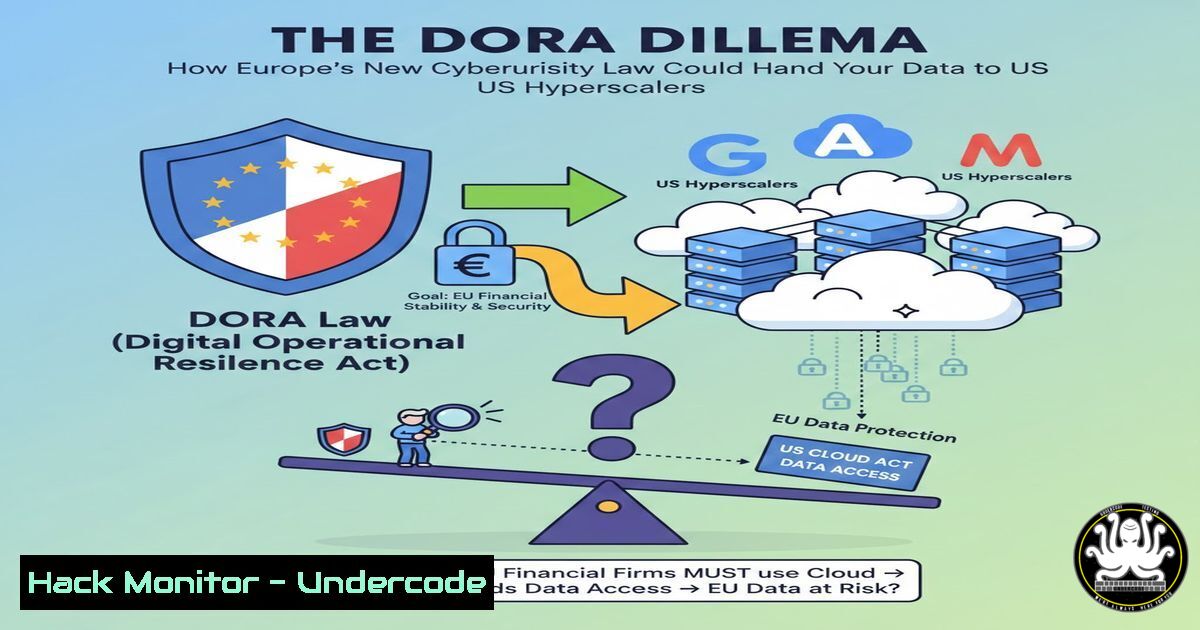
The Digital Operational Resilience Act (DORA) represents the European Union’s ambitious framework to fortify the financial sector against cyber threats. However, the recent designation of Critical ICT Third-Party Providers (CTPPs) reveals a concerning reality: Europe’s financial resilience is overwhelmingly dependent on US-based cloud providers subject to extraterritorial legislation like the CLOUD Act. This creates a fundamental conflict between regulatory compliance and digital sovereignty that every financial institution must now navigate.
Learning Objectives:
- Understand the geopolitical risks embedded within DORA’s CTPP designations
- Develop technical strategies to mitigate US CLOUD Act exposure for European financial data
- Evaluate and implement European cloud alternatives for critical financial workloads
You Should Know:
1. The Geopolitical Threat Landscape Under DORA
The designation of predominantly US-based CTPPs creates immediate jurisdictional conflicts. Under the US CLOUD Act, American authorities can compel these providers to disclose data regardless of its physical location or EU data protection laws. This creates inherent vulnerabilities in Europe’s financial infrastructure that cannot be mitigated through technical controls alone.
Step-by-step guide to understanding your exposure:
- Map all data flows to designated CTPPs using data lineage tools
- Classify data by sensitivity and regulatory requirements (GDPR, PSD2)
- Identify which workloads contain data subject to EU localization requirements
- Document the legal conflict points between CLOUD Act and GDPR 48
- Establish continuous monitoring for CTPP policy changes and new designations
2. Technical Implementation of Data Sovereignty Controls
European alternatives like OVHcloud, Scaleway, and Hetzner provide infrastructure that remains under European legal jurisdiction. Migrating sensitive workloads requires careful architecture planning and implementation of sovereignty-enhancing technologies.
Step-by-step migration strategy:
- Conduct dependency mapping for applications currently on US clouds:
Cloud dependency analysis script framework
aws ec2 describe-instances --region eu-central-1 --query 'Reservations[].Instances[].{ID:InstanceId,Type:InstanceType,Platform:Platform,VPC:VpcId,SG:SecurityGroups}' --output table
Similar Azure/GCP commands to inventory resources
2. Implement encryption with sovereign key management:
 Generate and manage keys within EU jurisdiction
openssl genrsa -aes256 -out eu-sovereign-key.pem 4096
openssl rsa -in eu-sovereign-key.pem -pubout -out eu-sovereign-key.pub
3. Deploy sovereign cloud proof-of-concept using Terraform:
 Example Terraform configuration for European provider
resource "ovh_publiccloud_private_network" "financial_vlan" {
project_id = var.ovh_project
name = "financial-processing"
regions = ["WAW", "DE", "UK"]
}
3. Building CLOUD-Act Resistant Architectures
Technical architectures can be designed to minimize exposure to foreign jurisdiction while maintaining operational resilience. This involves distributed systems design and cryptographic verification of data handling.
Step-by-step implementation:
1. Implement data sharding across jurisdictions:
 Pseudocode for jurisdictional data sharding
def store_sensitive_data(record, eu_cloud, us_cloud):
non_sensitive_metadata = extract_metadata(record)
sensitive_payload = encrypt_with_eu_key(record)

Store metadata in US cloud for performance
us_cloud.store(non_sensitive_metadata)
 Store encrypted payload in EU jurisdiction
eu_cloud.store(sensitive_payload)
return composite_reference
2. Deploy confidential computing enclaves:
 Dockerfile for SGX-enabled applications
FROM ubuntu:20.04
RUN apt-get update && apt-get install -y \
az-dcap-client \
sgx-aesm-service
COPY --chmod=755 sgx_application /app/
ENTRYPOINT ["/app/sgx_application"]
4. Operational Resilience Through Multi-Cloud Deployment
DORA requires operational resilience that can withstand provider-level outages or geopolitical disruptions. A actively-active multi-cloud strategy using European providers ensures continuity while maintaining sovereignty.
Step-by-step deployment:
1. Implement cloud-agnostic Kubernetes federation:
 Deploy Cluster API across multiple European providers
clusterctl init --infrastructure=openstack:magnum,ovhcloud-machine
kubectl apply -f cluster-federation.yaml
2. Configure cross-cloud load balancing and failover:
apiVersion: networking.istio.io/v1alpha3
kind: ServiceEntry
metadata:
name: multi-cloud-financial-api
spec:
hosts:
- financial-api.bank.com
ports:
- number: 443
name: https
protocol: HTTPS
resolution: DNS
location: MESH_EXTERNAL
endpoints:
- address: eu-primary.ovh.cloud
ports:
https: 443
- address: eu-backup.scaleway.com
ports:
https: 443
5. Compliance Monitoring and Regulatory Reporting
Continuous compliance monitoring ensures that financial institutions can demonstrate DORA compliance while managing the risks of using designated CTPPs. Automated auditing and reporting are essential.
Step-by-step implementation:
1. Deploy compliance-as-code framework:
 Compliance rule checking for data sovereignty
def check_dora_compliance():
violations = []

Check data location compliance
if not verify_data_localization('customer_data', 'EU'):
violations.append('Data localization breach')

Check encryption key sovereignty
if not verify_key_management('eu_kms_provider'):
violations.append('Key management sovereignty breach')

return generate_dora_report(violations)
2. Implement automated regulatory reporting:
!/bin/bash
 DORA compliance reporting automation
generate_compliance_report() {
echo "Generating DORA 14 compliance report..."
kubectl get cm dora-compliance-config -o json | jq '.data'
az storage blob download --account-name eucompliance --container-name dora-reports
}
6. Incident Response Planning for Jurisdictional Conflicts
Financial institutions must prepare for scenarios where US and EU authorities issue conflicting legal demands for data. This requires specialized incident response playbooks and technical countermeasures.
Step-by-step preparation:
1. Develop jurisdictional conflict playbook:
 Incident response automation for legal conflicts
def handle_jurisdictional_conflict(provider, legal_demand):
if legal_demand.origin == "US" and provider in DESIGNATED_CTPPS:
 Trigger data protection protocols
initiate_data_minimization(affected_datasets)
notify_eu_dpa(legal_demand)
activate_secondary_eu_providers()
return "CONFLICT_ESCALATION"
2. Implement legal hold technical controls:
-- Database triggers for legal conflict scenarios
CREATE TRIGGER prevent_data_transfer
BEFORE UPDATE OR DELETE ON sensitive_financial_records
FOR EACH ROW
WHEN (current_setting('legal_hold.active') = 'true')
EXECUTE FUNCTION reject_operation();
7. Strategic Migration to European Cloud Stack
A phased migration to European cloud providers reduces dependency on designated CTPPs while maintaining operational resilience. This requires careful planning and execution.
Step-by-step migration framework:
1. Conduct application portfolio assessment:
 Cloud migration assessment tool
!/bin/bash
for app in $(cat applications.list); do
complexity=$(assess_migration_complexity "$app")
data_sensitivity=$(classify_data_sensitivity "$app")
echo "$app,$complexity,$data_sensitivity" >> migration_priority.csv
done
2. Execute phased migration with resilience testing:
 Blue-green deployment to European cloud
module "eu_cloud_deployment" {
source = "git::https://github.com/eu-cloud/terraform-financial-app"

environment = "production"
region = "europe-west"
capacity = var.production_capacity
}

resource "null_resource" "resilience_testing" {
triggers = {
deployment_id = module.eu_cloud_deployment.deployment_id
}

provisioner "local-exec" {
command = "python resilience_tests.py --deployment ${module.eu_cloud_deployment.endpoint}"
}
}
What Undercode Say:
- The DORA CTPP designation creates a regulatory paradox where compliance requires dependence on providers that fundamentally undermine digital sovereignty
- Financial institutions must implement technical sovereignty controls immediately, as legal protections alone are insufficient against extraterritorial legislation
- The absence of European cloud providers from the critical list reflects market reality but should trigger urgent investment in sovereign alternatives
The fundamental challenge lies in the technical implementation of sovereignty in a globally interconnected cloud ecosystem. While DORA aims to create resilience, its current implementation may achieve the opposite by consolidating critical infrastructure under foreign jurisdiction. Financial institutions face the immediate task of building technical workarounds to legal vulnerabilities that cannot be resolved through compliance alone. The solution requires both architectural innovation and strategic investment in European cloud capabilities.
Prediction:
Within 2-3 years, we will see the first major financial incident triggered by jurisdictional conflict between US and EU authorities, leading to either massive fines under DORA for inadequate resilience planning or catastrophic service disruption when data access is blocked by conflicting legal demands. This will accelerate investment in truly sovereign European cloud infrastructure and catalyze the development of jurisdictional-aware distributed systems that can technically enforce data sovereignty boundaries. The financial sector’s migration to European providers will become a strategic imperative rather than a compliance exercise.
🎯Let’s Practice For Free:
IT/Security Reporter URL:
Reported By: Sybe Rispens – Hackers Feeds
Extra Hub: Undercode MoN
Basic Verification: Pass ✅


