Listen to this Post
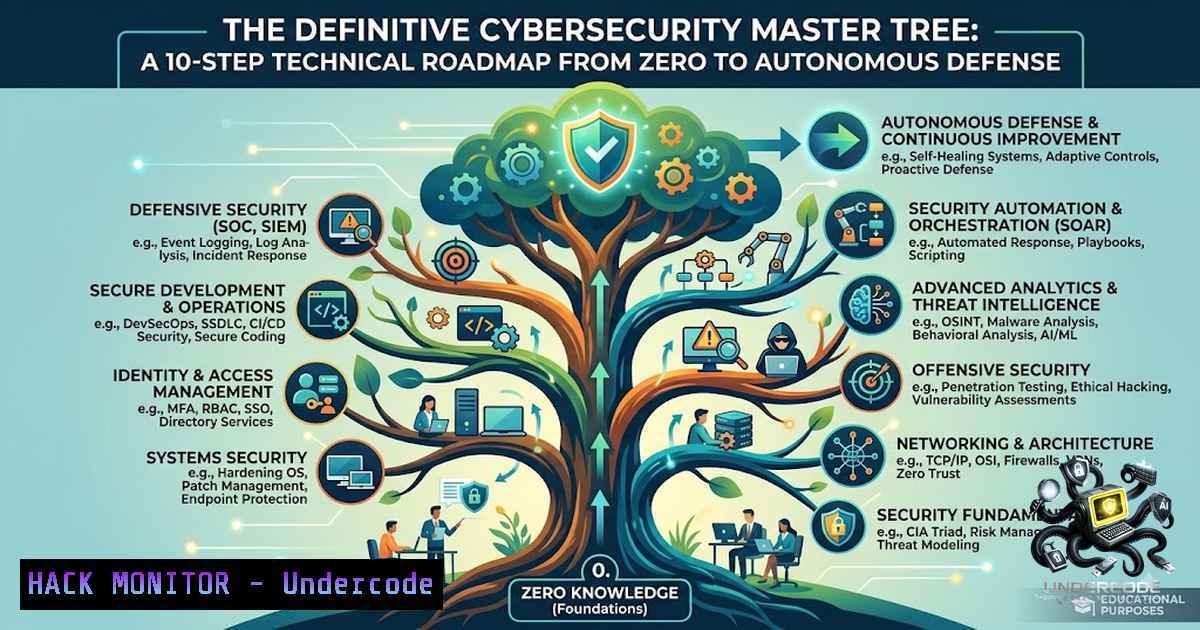
Introduction:
The modern cybersecurity landscape is a sprawling ecosystem of interconnected technologies, attack vectors, and defensive frameworks. For professionals navigating this domain, the challenge often lies not in the availability of resources, but in structuring the chaotic influx of tools and theories into a coherent, actionable skillset. This article deconstructs a comprehensive, ten-step roadmap that transitions a learner from foundational networking principles to the cutting-edge frontiers of AI-driven threat hunting and quantum-resistant cryptography.
Learning Objectives:
- Understand the core architectural pillars of network, web, and cloud security.
- Master the practical application of industry-standard offensive and defensive security tools.
- Develop a process-driven mindset for incident response, compliance, and continuous security operations.
You Should Know:
1. Foundational Infrastructure: Networking and Linux Hardening
The bedrock of any security career lies in understanding how data traverses networks and how operating systems govern access. Without this, advanced exploitation and defense are impossible. The roadmap begins with networking basics (TCP/IP, DNS, Firewalls, VPNs) and Linux systems management (CLI, Permissions, SSH, User Management). To truly master this, you must move beyond theory and interact with the command line.
A critical skill is the ability to query and manipulate network configurations. For instance, understanding how DNS resolution works is fundamental to identifying phishing or domain generation algorithms (DGAs). Use the following commands to analyze network behavior from both Linux and Windows environments.
Step-by-step guide for Network Reconnaissance and Linux Access Control:
1. Querying DNS Records: To resolve a domain and see its IP addresses, use the `dig` command on Linux. This helps verify if a domain resolves to a legitimate IP range.
dig +short google.com
On Windows, the equivalent is `nslookup`:
nslookup google.com
2. Analyzing Ports and Services: To see listening ports and active connections on a Linux machine, combine `netstat` with `grep` to filter specific ports.
sudo netstat -tulpn | grep LISTEN
This helps identify unauthorized services running on a compromised host.
3. Linux Permission Hardening: The principle of least privilege is enforced via file permissions. To set a file so that only the owner can read and write it, use chmod 600.
chmod 600 /etc/ssh/ssh_host_rsa_key
4. Managing SSH Key Authentication: To secure remote access, generate an SSH key pair. This replaces password-based authentication, which is vulnerable to brute-force attacks.
ssh-keygen -t rsa -b 4096 -C "[email protected]"
Then, copy the public key to the server: ssh-copy-id user@server_ip.
2. Web Application Security and Exploitation Frameworks
The focus shifts to the OWASP Top 10 vulnerabilities, specifically SQL Injection (SQLi), Cross-Site Scripting (XSS), and Cross-Site Request Forgery (CSRF). The goal is to understand how to detect these flaws and how to leverage them in controlled environments. The roadmap emphasizes using tools like Burp Suite and Metasploit.
Step-by-step guide for SQL Injection Detection and Mitigation:
- Manual Testing for SQLi: Use a single quote (
') in a URL parameter (e.g.,http://example.com/page?id=1'). If the application returns a database error, it is likely vulnerable to injection. - Exploitation with
sqlmap: Automate the detection and exploitation process. While many use automated scanners, a manual understanding is crucial for bypassing Web Application Firewalls (WAFs).sqlmap -u "http://example.com/page?id=1" --dbs --batch
- Analyzing XSS Payloads: In Burp Suite, intercept a POST request and inject a simple script into a form field:
<script>alert('XSS')</script>If the alert box appears, the application reflects unsanitized input. To mitigate this, ensure output encoding is implemented. In a Java-based application, you should use
StringEscapeUtils.escapeHtml4(userInput). - Metasploit Framework: To simulate a post-exploitation scenario, use Metasploit to gain a foothold on a target machine (in a lab environment). Start the console and search for an exploit, such as a common Apache vulnerability.
msfconsole
search apache
use exploit/multi/http/apache_mod_cgi_bash_env_exec
set RHOSTS target_ip
run
3. Cloud Security and Zero Trust Architecture
As organizations migrate to the cloud, mastering AWS, IAM, and Kubernetes is no longer optional. The roadmap correctly identifies Zero Trust as a critical concept. Zero Trust relies on strict identity verification, micro-segmentation, and least-privilege access, making cloud identity and access management (IAM) the most crucial component.
Step-by-step guide for AWS IAM Hardening and Kubernetes RBAC:
1. AWS IAM Policy Analysis: To audit permissions, use the IAM Policy Simulator or the CLI to check for overly permissive policies. To list all users and their attached policies, use:
aws iam list-users
aws iam list-attached-user-policies --user-1ame username
2. Enforcing MFA: Require Multi-Factor Authentication for all users. Implement a policy that denies any action unless MFA is present.
{
"Version": "2012-10-17",
"Statement": [
{
"Effect": "Deny",
"Action": "",
"Resource": "",
"Condition": {"BoolIfExists": {"aws:MultiFactorAuthPresent": false}}
}
]
}
3. Kubernetes Role-Based Access Control (RBAC): In Kubernetes, define a Role that grants read access to pods in a specific namespace.
apiVersion: rbac.authorization.k8s.io/v1
kind: Role
metadata:
namespace: default
name: pod-reader
rules:
- apiGroups: [""]
resources: ["pods"]
verbs: ["get", "list"]
Apply this with kubectl apply -f role.yaml. This ensures a developer cannot accidentally delete a production service.
4. Container Image Scanning: To prevent vulnerabilities from entering the cluster, scan images for known CVEs using trivy.
trivy image python:3.4-alpine
4. Detection, Monitoring, and Cryptography
Security Operations (SecOps) relies on SIEMs, SOC processes, and Threat Intelligence. To understand detection, one must understand hashing, SSL/TLS, and Public Key Infrastructure (PKI). Malware analysis often involves breaking down the encryption used by attackers to exfiltrate data.
Step-by-step guide for Hashing and Certificate Validation:
- File Integrity Monitoring: To ensure a binary hasn’t been tampered with, generate a cryptographic hash of the file.
sha256sum /usr/bin/ls
Store this hash securely. If the hash changes, an integrity breach may have occurred.
- SSL/TLS Certificate Inspection: To verify the validity and details of a remote server’s certificate, use
openssl.openssl s_client -connect google.com:443 -servername google.com
This command reveals the certificate chain, expiration date, and issuer, which is essential for identifying man-in-the-middle attacks.
- Encrypting Files with GPG: To protect sensitive data at rest, use GNU Privacy Guard (GPG).
gpg -c sensitive-file.txt
This prompts for a passphrase and creates an encrypted file (
.gpg).
5. Incident Response and Compliance Audits
When a breach occurs, having a structured incident response (IR) plan is vital. This phase involves containment, eradication, and recovery. Compliance standards like GDPR and HIPAA dictate how data breaches are reported.
Step-by-step guide for Linux Forensic Collection:
- Acquiring Memory Image: In the event of a breach, the first step is to capture the volatile memory (RAM) to analyze running processes.
sudo dd if=/dev/mem of=/tmp/memory.img bs=1024
(Note: In production, you would use tools like LiME or Volatility for structured acquisition).
- Collecting Log Files: Gather authentication logs and system logs.
tar -czf logs.tar.gz /var/log/auth.log /var/log/syslog
- Checking Scheduled Tasks: Attackers often create cron jobs for persistence. To check for hidden jobs on a Linux system:
crontab -l
cat /etc/crontab
- Windows Registry Forensics: On a Windows machine, use `reg query` to check for suspicious entries in the “Run” keys.
reg query HKLM\Software\Microsoft\Windows\CurrentVersion\Run
What Undercode Say:
- Security is an infinite loop, not a static installation; continuous practice and adaptation to the evolving threat landscape are non-1egotiable.
- The journey from a “tool user” to a “security architect” requires bridging the gap between understanding the vulnerability (SQLi) and implementing the mitigation (WAF rules, input validation).
The proposed roadmap is a succinct, effective guide that strikes a balance between the offensive (Ethical Hacking) and defensive (Detection & Monitoring) sides of the house. By placing Linux and Networking at the beginning, the roadmap ensures a solid foundation. The inclusion of Kubernetes and Zero Trust demonstrates an awareness of modern infrastructure, moving beyond traditional perimeter-based security. It correctly identifies “Future of Security” as a field requiring attention to AI and Quantum Crypto, which are quickly moving from theoretical to practical. The crucial gap this roadmap fills is the transition from siloed knowledge (e.g., just knowing how to use Nmap) to contextual integration (using Nmap results to formulate a compliance audit or a SIEM rule).
Prediction:
- +1 The integration of AI into SIEM platforms will drastically reduce mean time to detection (MTTD) by automating log analysis and identifying subtle anomalies that human analysts miss.
- -1 The rise of autonomous defense systems will lead to an increase in “black-box” attacks, where AI algorithms exploit vulnerabilities at speeds unattainable by human hackers, changing the nature of penetration testing.
- +1 Quantum-resistant cryptographic algorithms will standardize within the next decade, creating a massive demand for professionals skilled in post-quantum cryptography implementation.
- -1 The skills gap in cloud security (particularly Kubernetes and IAM) will lead to a surge in misconfigurations, making misconfigured S3 buckets and exposed APIs the primary vector for data breaches.
- +1 Automated security patching and DevSecOps pipelines will significantly reduce the window of exposure for zero-day exploits.
▶️ Related Video (80% Match):
🎯Let’s Practice For Free:
🎓 Live Courses & Certifications:
Join Undercode Academy for Verified Certifications
🚀 Request a Custom Project:
Secure, high-velocity infrastructure and disruptive technological engineering. Contact our engineering team for high-tier development and proprietary systems:
[email protected]
💎 Smart Architecture | 🛡️ Secure by Design | ⭐ Trusted by Thousands
IT/Security Reporter URL:
Reported By: https://lnkd.in/p/ehziw9-d – Hackers Feeds
Extra Hub: Undercode MoN
Basic Verification: Pass ✅


