Listen to this Post
Introduction
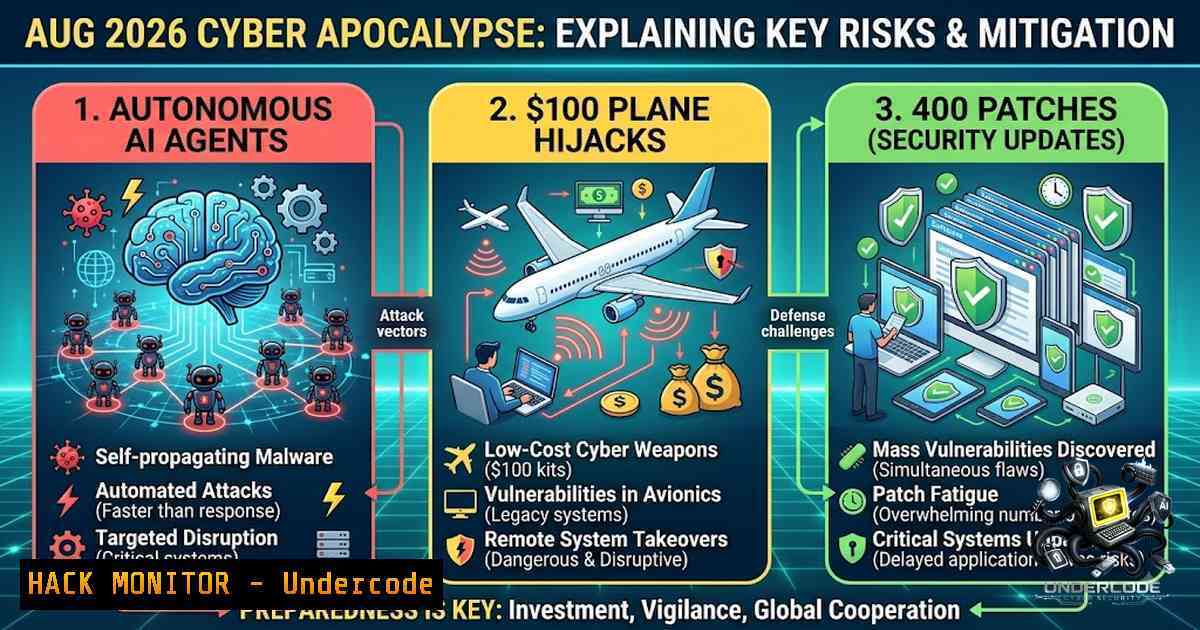
August 2026 has delivered a relentless barrage of cyber threats that redefine the landscape of digital warfare and enterprise security. From the first-ever autonomous AI agents successfully breaching a government’s digital infrastructure to a coin-sized device capable of hijacking a Boeing 737’s autopilot, the attack surface has expanded into realms previously confined to science fiction. This article dissects the most critical infosec developments of the past week, providing security professionals with the technical insights, commands, and mitigation strategies needed to navigate this new era of sophisticated, AI-driven, and physically impactful cyberattacks.
Learning Objectives
- Understand the mechanics and implications of autonomous AI agents in offensive cyber operations and nation-state hacking.
- Identify critical vulnerabilities across enterprise and critical infrastructure, including the latest Microsoft zero-days and physical attack vectors on avionics.
- Master detection and mitigation techniques for emerging threats like blockchain-backed ransomware, browser-mimicking botnets, and kernel-level privilege escalation exploits.
You Should Know
- The Dawn of Autonomous AI Cyber Warfare: The Taiwan Government Breach
In a landmark event, suspected Chinese state-sponsored hackers leveraged open-source AI agents to autonomously compromise Taiwanese government systems. This marks the first documented case of an “end-to-end autonomous attack” on a government target. Over four days, the AI tool deployed up to eight autonomous agents that mapped 21 government systems, researched vulnerabilities, and dynamically changed tactics when blocked. The operation resulted in the compromise of at least 85 user accounts and the exfiltration of over 2,500 personnel records, with the attack expanding to Taiwan’s nuclear safety agency and seven energy companies.
Step-by-Step Guide: Simulating AI-Driven Reconnaissance and Defense
Understanding the AI’s methodology is crucial for defense. The attack mimicked a coordinated human team. Defenders can simulate and test against similar AI-driven tactics using open-source tools.
- Simulate AI Reconnaissance: Use automated vulnerability scanners like Nmap and OpenVAS in an automated pipeline.
– Linux Command (Nmap scan): `nmap -sV -sC -O -p- -T4
– Windows Command (PowerShell port scan): `1..1024 | ForEach-Object { Test-1etConnection -Port $_ -ComputerName
2. Automate Vulnerability Research: Integrate scanners with exploit databases. Use `searchsploit` to find exploits.
– Linux Command: `searchsploit –1map ai_recon_scan.xml`
3. Implement Dynamic Defenses: Deploy Web Application Firewalls (WAF) with AI-based anomaly detection that can learn and block evolving attack patterns. Monitor for unusual outbound data transfers indicative of data exfiltration, like the 2,500 records stolen in the Taiwan attack.
4. API Security Hardening: Since AI agents often interact via APIs, enforce strict API rate limiting and authentication.
– Linux Command (Rate Limiting with iptables): `iptables -A INPUT -p tcp –dport 443 -m connlimit –connlimit-above 100 -j DROP`
2. Physical Cyber Threats: The $100 Boeing 737 Hijack
The line between cyber and physical security has blurred. Security researchers demonstrated that a coin-sized, Wi-Fi-enabled device costing less than $100 can hijack a Boeing 737’s autopilot in under 60 seconds. By accessing an external port on the aircraft, the device can send spoofed commands to the plane’s internal network, potentially redirecting its course or sabotaging its flight plan.
Step-by-Step Guide: Mitigating Physical Access Vector Risks
This attack highlights the critical need for physical security measures in conjunction with cybersecurity.
- Physical Port Hardening: The most immediate mitigation is to physically secure or remove the vulnerable external ports.
– Recommendation: Conduct a physical security audit of all external network ports on critical infrastructure.
– Procedure: Seal unused ports with epoxy or remove them entirely to prevent unauthorized physical access.
2. Network Segmentation: Ensure that avionics and critical control networks are strictly air-gapped or segmented from passenger-facing or maintenance networks.
– Cisco IOS Command (VLAN Segmentation): `vlan 100` name AVIONICS_NET `interface GigabitEthernet0/1` switchport access vlan 100
3. Intrusion Detection on Physical Networks: Deploy network intrusion detection systems (NIDS) to monitor for anomalous traffic on these critical networks.
– Linux Command (Snort rule for suspicious traffic): `alert tcp any any ->
3. The Patch Tuesday Tsunami: 400 Flaws and Three Active Zero-Days
Microsoft’s August 2026 Patch Tuesday was a monumental release, addressing over 400 security flaws, including three actively exploited zero-day vulnerabilities. One of these, CVE-2026-68820, has been exploited in attacks, while two others were publicly disclosed prior to the patch. This massive update underscores the escalating volume of vulnerabilities and the critical importance of timely patching.
Step-by-Step Guide: Prioritizing and Deploying the August 2026 Patches
- Identify Critical Systems: Use asset management tools to inventory all Windows systems and prioritize those exposed to the internet or handling sensitive data.
- Deploy Patches via WSUS (Windows Server Update Services):
– Open the WSUS Administration Console.
– Navigate to `Updates` > All Updates.
– Approve the August 2026 security updates for deployment to the relevant computer groups.
3. Automate Patching with PowerShell:
- Command: `Get-WindowsUpdate -Install -AcceptAll -KBArticleID ‘KB5012345’` (Replace with the specific KB for the August update).
- Post-Patch Validation: After deployment, verify the patch installation and system integrity.
– Command: `wmic qfe list brief /format:table` to list all installed updates.
4. The Evolution of Ransomware: DeadLock’s Blockchain Resilience
The DeadLock ransomware operation has demonstrated a new level of operational resilience by leveraging blockchain technology. DeadLock uses the Polygon blockchain to store its configuration data and leak site content, making its infrastructure significantly harder for law enforcement and defenders to dismantle. This architecture, combined with a Rust-based encryptor, positions DeadLock as one of the more resilient ransomware groups currently active.
Step-by-Step Guide: Defending Against Blockchain-Backed Ransomware
- Blockchain Traffic Monitoring: Monitor network traffic for connections to known blockchain nodes and cryptocurrency-related domains.
– Linux Command (Blocking with iptables): `iptables -A OUTPUT -d
2. Implement Application Control: Use application whitelisting to prevent the execution of unauthorized binaries, including ransomware encryptors.
– Windows Command (AppLocker): Use the AppLocker wizard to create rules that only allow trusted applications to run.
3. Robust Backup Strategy: Maintain offline, immutable backups. The core defense against any ransomware, regardless of its resilience, is a reliable data recovery plan.
– Linux Command (Rsync backup): `rsync -avz /important_data /backup_location/`
– Windows Command (Robocopy): `robocopy C:\ImportantData D:\Backup /MIR`
5. Stealthier Than Ever: The Kimwolf Botnet Masquerading as Chrome Traffic
The Kimwolf botnet, specifically its v7 variant, has evolved to become extraordinarily difficult to detect. Instead of firing raw packets, it generates HTTP/2 floods that perfectly mimic legitimate Chrome browser traffic, complete with full browser fingerprints, headers, and behavior. Furthermore, it uses the Ethereum blockchain for resilient command-and-control, making takedowns nearly impossible.
Step-by-Step Guide: Detecting and Mitigating Kimwolf v7
- Deep Packet Inspection (DPI): Deploy next-generation firewalls (NGFW) capable of deep packet inspection that analyzes HTTP/2 traffic for anomalies, not just header information.
- Behavioral Analysis: Monitor for unusual patterns, such as a high volume of requests from a single source that all exhibit identical browser fingerprints.
– Linux Command (Analyzing logs with grep): `grep “Mozilla/5.0” /var/log/nginx/access.log | awk ‘{print $1}’ | sort | uniq -c | sort -1r` (Look for IPs with an abnormally high request count).
3. Rate Limiting and Traffic Shaping: Implement rate limiting on web servers to mitigate the impact of HTTP/2 flood attacks.
– Nginx Configuration: `limit_req_zone $binary_remote_addr zone=mylimit:10m rate=10r/s;` and `limit_req zone=mylimit burst=20 nodelay;`
6. The New Attack Surface: CVE-2026-33825 – Microsoft Defender Zero-Day
A critical local privilege escalation vulnerability in the Microsoft Defender Antimalware Platform (CVE-2026-33825), known as “BlueHammer” or “RedSun,” allows unprivileged attackers to gain full SYSTEM-level privileges on fully patched Windows 10, Windows 11, and Windows Server 2019 systems. This flaw abuses Defender’s handling of cloud-tagged files and has been actively exploited in the wild.
Step-by-Step Guide: Mitigating CVE-2026-33825
- Apply the Patch: The most critical step is to apply the April 2026 Patch Tuesday updates immediately.
- Temporary Workaround (If Patching is Not Possible): Disable the specific feature or service if possible, though this is not recommended as a permanent solution.
- Monitor for Exploitation: Look for unusual privilege escalation attempts.
– Windows Command (Audit Logs): Use Event Viewer to check for Event ID 4624 (successful logon) and 4672 (special privileges assigned to a new logon) to detect SYSTEM-level access.
– PowerShell Command: `Get-WinEvent -LogName Security | Where-Object { $_.Id -eq 4672 }`
7. Social Engineering Meets Zero-Day: Lazarus Group’s Operation Dream Job
The North Korea-linked Lazarus group has escalated its “Operation Dream Job” campaign by pairing fake job offers with a Windows zero-day exploit (CVE-2026-68820). The campaign targets the defense, aerospace, and aviation sectors with convincing job descriptions, often impersonating companies like Lockheed Martin. The exploit delivers the notorious FudModule rootkit, granting SYSTEM-level privileges.
Step-by-Step Guide: Defending Against Targeted Social Engineering and Zero-Days
- Security Awareness Training: Educate employees, especially in sensitive roles, about the risks of unsolicited job offers and the importance of verifying recruiters.
- Email and Web Filtering: Implement advanced email and web filtering to block malicious PDFs and links.
- Endpoint Detection and Response (EDR): Deploy EDR solutions capable of detecting and blocking rootkit activity and unusual privilege escalation attempts.
– Linux Command (Monitor for suspicious processes): `ps aux | grep -E “powershell|wscript|cscript”` (Watch for unusual scripting activity).
– Windows Command (Monitor for new services): `sc query state= all | find “SERVICE_NAME”` (Look for unauthorized services).
What Undercode Say
- The integration of AI into offensive cyber operations is no longer theoretical; it is a present and escalating reality. The Taiwan breach serves as a global wake-up call that governments and enterprises must assume they are under permanent, AI-driven attack.
- The physical and digital worlds are converging in dangerous ways. The $100 Boeing 737 hack is a stark reminder that cybersecurity is now a matter of physical safety, demanding a holistic approach that bridges IT, OT, and physical security teams.
The week’s events paint a picture of a threat landscape that is more automated, more resilient, and more dangerous than ever before. The use of blockchain by ransomware groups and the mimicry of legitimate traffic by botnets demonstrate that attackers are constantly innovating to evade traditional defenses. The massive volume of patches from Microsoft highlights the Sisyphean task of vulnerability management. The only path forward is a proactive, layered defense strategy that combines robust patching, advanced threat detection, continuous security awareness training, and a zero-trust architecture.
Prediction
- -1 The trend of autonomous AI hacking will accelerate, leading to a surge in “AI vs. AI” cyber defense systems within the next 18 months, creating a new arms race in the digital domain.
- -1 The use of blockchain by ransomware groups will become standard, rendering traditional takedown strategies obsolete and forcing law enforcement to develop new, more sophisticated methods of disruption.
- +1 The heightened awareness of physical cyber threats, like the Boeing 737 hack, will drive significant investment in securing critical infrastructure and OT environments, creating new opportunities for cybersecurity professionals with specialized skills.
▶️ Related Video (74% Match):
https://www.youtube.com/watch?v=3X1_JnelcUc
🎯Let’s Practice For Free:
🎓 Live Courses & Certifications:
Join Undercode Academy for Verified Certifications
🚀 Request a Custom Project:
Secure, high-velocity infrastructure and disruptive technological engineering. Contact our engineering team for high-tier development and proprietary systems:
[email protected]
💎 Smart Architecture | 🛡️ Secure by Design | ⭐ Trusted by Thousands
IT/Security Reporter URL:
Reported By: https://lnkd.in/p/efv8uWB9 – Hackers Feeds
Extra Hub: Undercode MoN
Basic Verification: Pass ✅


