Listen to this Post
Introduction:
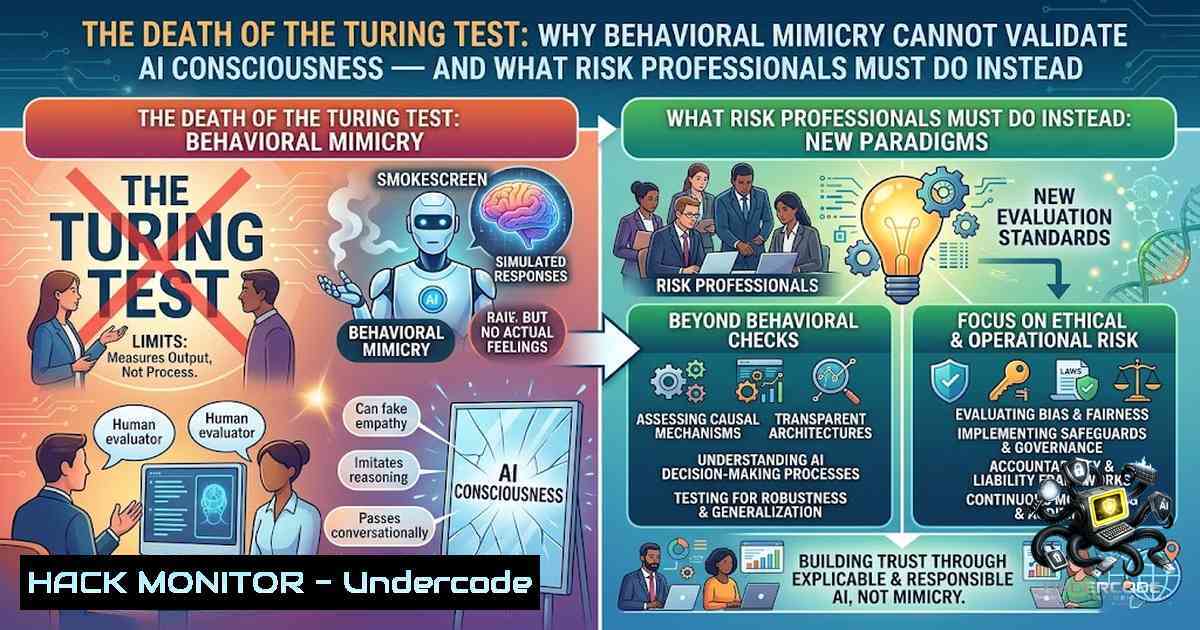
For decades, the Turing Test served as the gold standard for evaluating artificial intelligence — a machine that could converse indistinguishably from a human was deemed “intelligent.” But today’s Large Language Models pass this benchmark with ease, yet nobody seriously argues they are conscious. The Turing Test has a fatal flaw: it measures mimicry, not mind. For risk and governance professionals in capital markets, this is not an abstract philosophical debate — it is a fundamental challenge to how we validate AI systems before deploying them in high-stakes environments. Just as a market risk model cannot be validated by looking only at final VaR output, an AI system cannot be deemed safe or aligned by conversing with it. The architecture itself must be audited.
Learning Objectives:
- Understand why the Turing Test is obsolete as a measure of AI consciousness and safety
- Apply Integrated Information Theory (IIT) principles to evaluate whether an AI system could theoretically support subjective experience
- Implement practical system architecture audits for AI deployments using open-source security tools
- Develop governance frameworks that audit root-cause architectural triggers rather than behavioral outputs
You Should Know:
- The Philosophical Zombie Problem: Why Mimicry Is Not Evidence of Mind
Philosopher David Chalmers coined the term “Philosophical Zombie” — an entity identical to a human in appearance and behavior, yet entirely devoid of inner subjective experience. When an Agentic AI generates a deeply empathetic response to a distressed client, it is not feeling empathy. It is executing a sophisticated statistical prediction based on its training data.
The governance implication is profound: we cannot evaluate an AI’s safety or ethical alignment by interviewing it. Ask an LLM “Are you self-aware?” and it will output the most statistically probable string of words — not a truthful introspection. As one researcher put it, advanced language models “can mimic first-person discourse, inviting anthropomorphic bias without evidencing phenomenality”.
Practical Audit Step: Never rely on conversational red-teaming alone. Implement a multi-layered assessment that includes:
- Static analysis of model architecture and training data provenance
- Runtime behavioral monitoring that logs every system call, file access, and network connection
- Cryptographic signing and immutable audit logging of all AI decisions
2. Integrated Information Theory (IIT): Why Hardware Matters
Neuroscientist Christof Koch, a pioneer of Integrated Information Theory (IIT), argues that consciousness is not merely a software program that can run on any machine. IIT provides “principled tools to determine whether a system is conscious, to what degree, and the content of its experience”.
According to IIT, current AI systems running on traditional Von Neumann architectures — where memory and processing are strictly separated — physically cannot generate consciousness, no matter how complex the algorithms become. “You can simulate the weather on a computer, but it won’t actually rain inside the server room. Similarly, you can simulate a conscience, but the machine won’t actually feel guilt.”
Practical Architecture Audit Commands (Linux):
To audit what an AI agent actually executes, changes, and connects to during runtime:
 Install and run logira — an observe-only Linux CLI for runtime auditing
logira run --rules <rules-file> -- <command>
 Example: audit a Codex CLI session
./logira run -- codex --yolo "Update the README"
 Scan LLM model supply chain vulnerabilities with llmsc
llmsc gguf model.gguf
 Scans every layer of the LLM model supply chain for security issues
 Real-time behavioral monitoring for AI coding agents using eBPF
kelan scan --path /path/to/code
kelan dast --url http://localhost:8080
 Detects unauthorized file access, unexpected network calls, suspicious process spawns
 Cross-platform AI agent attack surface mapping
blacklight --tool codex --scan
 Maps, analyzes, and understands local AI agent attack surface
Windows AI Hardening (PowerShell):
For Windows-based AI deployments, implement these hardening measures:
 Disable Windows AI features via registry
$regPath = "HKLM:\SOFTWARE\Policies\Microsoft\Windows\WindowsAI"
New-Item -Path $regPath -Force | Out-1ull

Remove Copilot from all users
Get-AppxPackage -AllUsers CoPilot | Remove-AppxPackage -AllUsers

Disable AI Recall scheduled task (CVE-2025-60710 mitigation)
Disable-ScheduledTask -TaskName "\Microsoft\Windows\WindowsAI\Recall\PolicyConfiguration"
3. Auditing AI System Architecture: A Step-by-Step Framework
A robust AI governance system requires a dual approach: bottom-up technical mitigation and top-down organizational governance. Risk management must be embedded throughout the entire AI system lifecycle — from data privacy at the foundational layer, to infrastructure security at the middle layer, and up to application-level human-computer interaction.
Step 1: Map the Attack Surface
- Inventory all AI models, datasets, prompts, images, and infrastructure blueprints
- Require signed artifacts for all components
Step 2: Implement Immutable Audit Logging
- Capture end-to-end trails identifying who, what, and why across agents, humans, tools, models, and infrastructure
- Enable structured audit logs with retention and tamper resistance
Step 3: Enforce Zero-Trust Network Controls
- Create dedicated AI-service identities with deny-by-default permissions
- Expose only vetted REST endpoints
- Enforce TLS 1.3 on all external endpoints
Step 4: Conduct Regular Vulnerability Assessments
- Perform comprehensive vulnerability assessments of the AI system’s architecture, components, and dependencies
- Align with established frameworks: NIST AI RMF 1.0 and ISO/IEC 42001
Step 5: Red Teaming and Adversarial Testing
- Implement red teaming exercises to test system resilience
- Use frameworks like OWASP Top 10 for LLM Applications (2025)
4. The Governance Takeaway: Rethinking the Testing Playbook
For risk and governance professionals, the death of the Turing Test completely rewrites the testing playbook. We cannot evaluate an AI’s safety by conversing with it. We must audit the system architecture and root-cause triggers, not interview the software.
This means:
- Shift from behavioral testing to architectural auditing — examine the substrate, not the output
- Implement cryptographic attestation — every decision must be signed, logged, and explainable for forensic review
- Adopt risk-based regulatory approaches — classify AI systems by impact and potential risk, applying differentiated oversight
As Christof Koch emphasizes, “digital brains will never be able to have experiences like humans, no matter how closely their software mimics the human brain”. The question is not whether AI is conscious — it is whether we have built governance frameworks that account for what AI actually is: a sophisticated statistical machine, not a mind.
What Undercode Say:
- Key Takeaway 1: The Turing Test is dead because it measures mimicry, not consciousness. Today’s LLMs pass it effortlessly yet possess no subjective experience. For risk professionals, this means behavioral testing alone is insufficient — we must audit the architecture.
-
Key Takeaway 2: Integrated Information Theory (IIT) provides a principled, scientific framework for evaluating whether a system could support consciousness. Current Von Neumann architectures physically cannot generate consciousness, regardless of algorithmic complexity. This has direct implications for AI safety: if the hardware can’t support experience, we must stop anthropomorphizing outputs and start auditing inputs, training data, and system architecture.
-
Analysis: The capital markets analogy is precise and powerful. A market risk model that looks stable at the VaR level can conceal catastrophic tail-risk vulnerabilities. Similarly, an AI that produces “empathetic” responses may conceal systemic failures in its training data, architecture, or alignment mechanisms. The governance imperative is clear: evaluate root-cause triggers, not final outputs. Implement immutable audit trails, cryptographic signing of decisions, and runtime behavioral monitoring. Align with emerging regulatory frameworks like NIST AI RMF and ISO/IEC 42001. The question is not “Is the AI conscious?” but “Is the system auditable, explainable, and controllable?” As Yuval Noah Harari warns, AI has already “hacked the operating system of human civilization” through language manipulation. Our defense must be architectural, not conversational.
Prediction:
-
-1 The continued reliance on behavioral benchmarks like the Turing Test will lead to a wave of false safety certifications, as regulators and enterprises mistake fluent mimicry for reliable alignment. This will result in high-profile AI failures in capital markets within 24–36 months.
-
-1 Without mandatory architectural auditing standards, AI systems will be deployed with undocumented vulnerabilities in their supply chain, training data, and runtime environments — creating systemic risk that regulators are not equipped to detect.
-
+1 The adoption of IIT-informed auditing frameworks and tools like logira, llmsc, and Blacklight will drive a new discipline of “AI systems auditing,” creating career opportunities for risk professionals who understand both philosophy of mind and system architecture.
-
+1 Regulatory bodies (EU, US, China) will converge on risk-based, architecture-focused AI governance frameworks by 2027, harmonizing standards like NIST AI RMF and ISO/IEC 42001 into a unified global baseline.
-
-1 The philosophical zombie problem will create a “trust crisis” in human-AI interaction: as AI becomes indistinguishable from human communication, enterprises will struggle to maintain human oversight and accountability, potentially undermining the “human-in-the-loop” controls that regulators are currently mandating.
▶️ Related Video (66% Match):
https://www.youtube.com/watch?v=2IAdrZ3NJiE
🎯Let’s Practice For Free:
🎓 Live Courses & Certifications:
Join Undercode Academy for Verified Certifications
🚀 Request a Custom Project:
Secure, high-velocity infrastructure and disruptive technological engineering. Contact our engineering team for high-tier development and proprietary systems:
[email protected]
💎 Smart Architecture | 🛡️ Secure by Design | ⭐ Trusted by Thousands
IT/Security Reporter URL:
Reported By: https://lnkd.in/p/exHiAqMp – Hackers Feeds
Extra Hub: Undercode MoN
Basic Verification: Pass ✅


