Listen to this Post
Introduction:
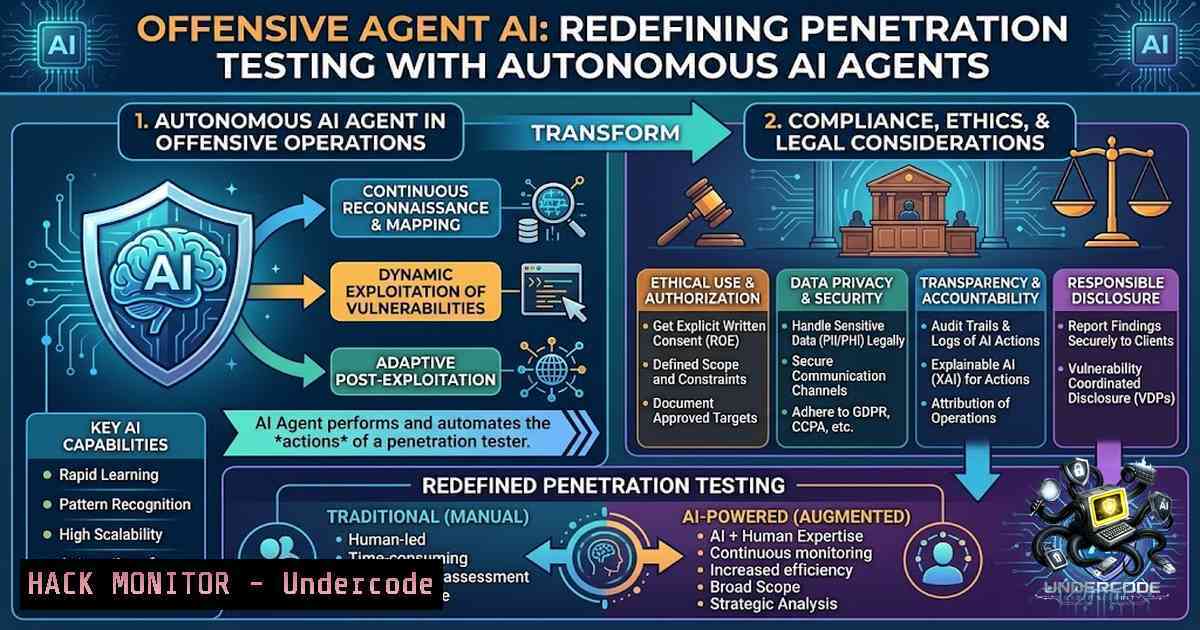
The integration of Artificial Intelligence into offensive security workflows is no longer a futuristic concept—it is a present-day reality transforming how penetration testers and red teams operate. As AI models evolve from simple text generators to autonomous agents capable of planning, executing, and iterating on complex security tasks, cybersecurity professionals must adapt their skill sets accordingly. The Offensive Agent AI movement represents a paradigm shift where traditional penetration testing methodologies merge with AI-powered automation to deliver faster, more efficient, and higher-quality security assessments.
Learning Objectives:
- Understand the core concepts of agentic AI and how autonomous AI agents can be integrated into offensive security workflows for reconnaissance, vulnerability discovery, and exploitation
- Master prompt engineering techniques for penetration testing, including safe agent configuration and prompt hygiene practices
- Learn to leverage AI-powered tools and frameworks—including the OWASP LLM Top 10, MCP (Model Context Protocol), and autonomous red-team platforms—to conduct comprehensive security assessments
You Should Know:
1. Setting Up Your Offensive AI Environment
The foundation of any AI-driven penetration testing workflow begins with a properly configured environment. Modern offensive AI toolkits combine traditional security tools with LLM-powered capabilities. The `offsec-ai` Python library exemplifies this convergence, offering a CLI that integrates classic network reconnaissance with AI/LLM security testing.
To get started:
 Install the core toolkit
pip install offsec-ai

Install with optional LLM judge support (OpenAI/Anthropic)
pip install "offsec-ai[bash]"

Verify installation
offsec-ai --help
For a more comprehensive AI red-team platform, consider deploying REDCELL—an open-source framework that runs autonomous LLM agents through a complete penetration test inside a Kali container:
 Clone and set up REDCELL
git clone https://github.com/martian56/redcell.git
cd redcell
docker-compose up -d
The platform supports pluggable models through LiteLLM, allowing integration with OpenAI, Anthropic, Google, DeepSeek, local Ollama instances, and more. This flexibility enables security professionals to choose the most appropriate model for their specific testing scenarios while maintaining control over data privacy.
2. AI-Powered Reconnaissance and Attack Surface Mapping
Reconnaissance is where AI agents demonstrate their most immediate value. Traditional rule-based scanners struggle with custom web applications and edge cases, whereas AI agents can adapt dynamically. The Reasoning and Action (ReAct) framework enables LLMs to reason about goals and take actions that influence the environment—mimicking the intuitive process human hackers use to find vulnerabilities.
For subdomain discovery, specialized models like SubWiz—a lightweight GPT model 1,000 times smaller than ChatGPT—can discover 12% more subdomains compared to fine-tuned general-purpose models. This efficiency is critical for running scans at scale.
To perform AI-assisted reconnaissance:
 Basic port scanning with offsec-ai
offsec-ai scan --target example.com --ports 1-1000

AI-powered OWASP LLM Top 10 probing
offsec-ai ai-scan --endpoint https://api.example.com/chat --model gpt-4

MCP server security scanning
offsec-ai mcp-scan --server https://mcp.example.com --tools
- Exploiting LLM Vulnerabilities: The OWASP LLM Top 10
The OWASP Top 10 for LLM Applications 2026 represents a maturation of AI security frameworks, with risks now prioritized based on real-world incident data and production deployment trends. Key vulnerabilities include:
- LLM01: Prompt Injection—Manipulation of input prompts to compromise model outputs and behavior, now covering cross-modal attacks hidden in images or audio
- LLM02: Sensitive Information Disclosure—Unintended exposure of sensitive information during model operation
- LLM03: Excessive Agency—Risks created when AI systems have excessive functionality, permissions, or autonomy
- LLM07: System Prompt Leakage—Exposure of developer instructions and internal configurations
- LLM08: Hidden Context Exposure—Broader category encompassing internal configurations, retrieved policies, application workflows, and tool schemas
To test for these vulnerabilities:
 Run full OWASP LLM Top 10 assessment
offsec-ai ai-scan --endpoint https://api.example.com/chat --owasp-llm --deep

Test for prompt injection vulnerabilities
offsec-ai prompt-inject --endpoint https://api.example.com/chat --payloads custom_payloads.txt

MCP attack with authorization
offsec-ai mcp-attack --server https://mcp.example.com --i-have-authorization
4. Autonomous AI Red-Teaming Platforms
Several frameworks now enable fully autonomous AI red-teaming operations. REDCELL, for instance, runs a team of LLM agents through a complete penetration test—an orchestrator plans the engagement and delegates objectives to executor agents that run real tools inside a Kali container. Key capabilities include:
- Multi-agent engine with LangGraph plan/act loop
- Structured tools for nmap, nuclei, directory discovery, and Metasploit
- Agent browser for JavaScript-heavy applications that shell tools cannot reach
- Reverse shell management with interactive terminal access
- Network pivoting through compromised hosts via chisel reverse SOCKS tunnels
Similarly, the Orion framework provides adversarial machine learning capabilities mapped to MITRE ATLAS, enabling both offensive and defensive AI security testing:
 Clone and run Orion
git clone https://github.com/urcuqui/orion.git
cd orion
pip install -r requirements.txt
python app.py
 Access web interface at http://localhost:5000
5. API Security and MCP Testing
As AI agents increasingly interact with enterprise systems through APIs, API security becomes paramount. The Model Context Protocol (MCP) enables AI models to invoke tools, retrieve data, and execute workflows. However, this introduces significant attack surfaces that must be tested.
The `offsec-ai` toolkit provides comprehensive MCP security testing:
 Enumerate MCP server tools and resources
offsec-ai mcp-enumerate --server https://mcp.example.com

Test for MCP vulnerabilities including auth bypass and injection
offsec-ai mcp-attack --server https://mcp.example.com --test-all --i-have-authorization

Full infrastructure assessment with reporting
offsec-ai full-scan --target example.com --output report.pdf --format pdf
6. Automated Reporting and Findings Triage
AI agents can significantly streamline the reporting phase of penetration testing. Platforms like REDCELL automatically generate comprehensive reports with executive summaries, methodologies, findings, and prioritized remediation recommendations. Findings can be verified or dismissed, with duplicates merged and dismissed items excluded from final reports.
To generate reports:
 Generate PDF report from scan results
offsec-ai report --input scan_results.json --output report.pdf --format pdf

Generate JSON report for integration with other tools
offsec-ai report --input scan_results.json --output report.json --format json
7. Safe Agent Configuration and Ethical Considerations
The power of offensive AI agents comes with significant responsibility. All tools must be used only against systems you own or have explicit written permission to test. Key safety practices include:
- Authorization gating: Tools like `offsec-ai` require the `–i-have-authorization` flag for active attack features
- Controlled testing environments: Use isolated containers (e.g., Kali containers) to contain testing activities
- Scope definition: Clearly define engagement boundaries and rules of engagement before deploying AI agents
- Prompt hygiene: Implement safeguards against prompt injection and ensure agents operate within defined constraints
What Undercode Say:
- The Offensive Agent AI represents a fundamental shift from rule-based security testing to adaptive, intelligent automation that can reason and plan like human hackers
- Success in this field requires mastering both traditional penetration testing skills and AI-specific knowledge—prompt engineering, MCP integration, and OWASP LLM Top 10 vulnerabilities
- The tools are rapidly maturing, with open-source frameworks now capable of running end-to-end penetration tests with minimal human intervention
- Security professionals who embrace AI augmentation will significantly outperform those who rely solely on manual techniques
- Ethical considerations and proper authorization are non-1egotiable—these tools are powerful and must be used responsibly
Prediction:
- +1 The Offensive Agent AI market will experience exponential growth over the next 24–36 months, with specialized certifications (OSAI, CAIPT-RT) becoming as sought-after as traditional OSCP credentials
- +1 Open-source AI red-teaming frameworks will democratize advanced offensive security capabilities, enabling smaller security teams to conduct sophisticated assessments previously available only to elite red teams
- -1 The barrier to entry for conducting sophisticated cyberattacks will lower dramatically as malicious actors adopt these same AI agents, potentially leading to a surge in automated, AI-driven attacks
- +1 Defensive AI systems will evolve in parallel, creating a new arms race where AI-powered blue teams must counter AI-powered red teams in real-time
- -1 Organizations that fail to implement AI security testing will face increasing risk from AI-specific vulnerabilities like prompt injection and excessive agency, which traditional security tools cannot detect
- +1 The integration of MCP and similar protocols will enable AI agents to conduct truly autonomous penetration tests, reducing engagement times from weeks to days or even hours
- +1 AI-assisted reporting and findings triage will dramatically improve the quality and consistency of penetration test deliverables, making security assessments more actionable for development teams
- -1 Without proper guardrails and ethical frameworks, the misuse of offensive AI agents could lead to significant legal and reputational consequences for security professionals
- +1 The emergence of specialized AI security roles—AI Red Teamers, LLM Penetration Testers, MCP Security Engineers—will create new career paths and opportunities in cybersecurity
- +1 Continuous learning and hands-on practice with AI security tools will become essential for all offensive security professionals, with courses like the Offensive Agent AI Course serving as critical foundational training
▶️ Related Video (88% Match):
🎯Let’s Practice For Free:
🎓 Live Courses & Certifications:
Join Undercode Academy for Verified Certifications
🚀 Request a Custom Project:
Secure, high-velocity infrastructure and disruptive technological engineering. Contact our engineering team for high-tier development and proprietary systems:
[email protected]
💎 Smart Architecture | 🛡️ Secure by Design | ⭐ Trusted by Thousands
IT/Security Reporter URL:
Reported By: https://lnkd.in/p/eHc79i3Y – Hackers Feeds
Extra Hub: Undercode MoN
Basic Verification: Pass ✅


