Listen to this Post
Introduction:
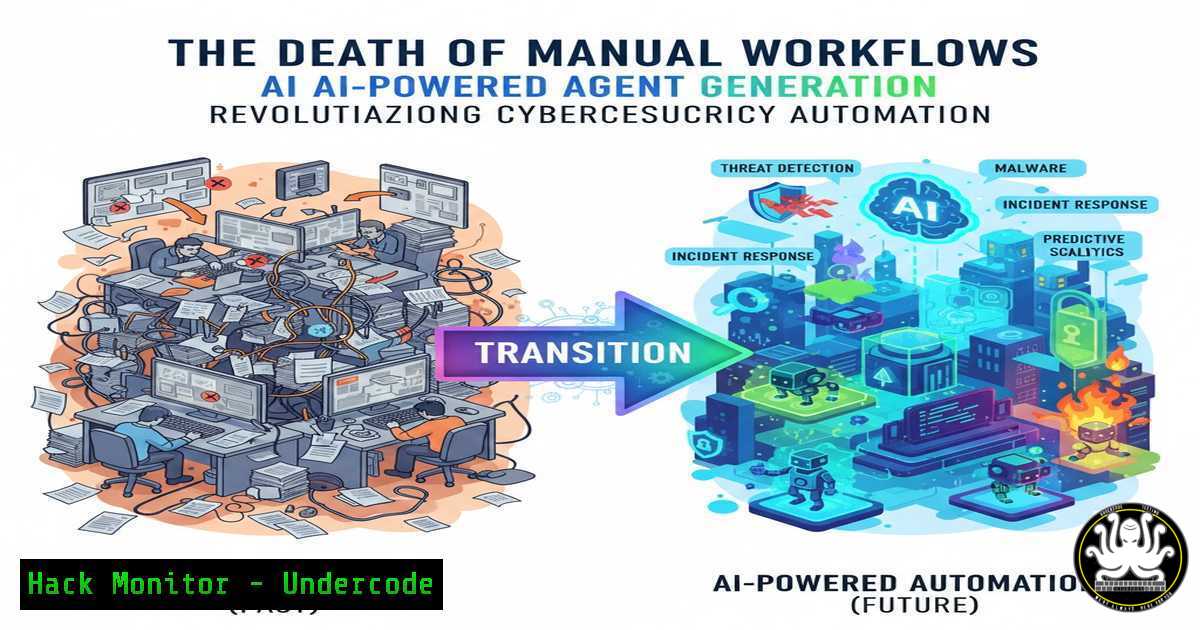
The traditional paradigm of manually constructing automation workflows—node by painful node—is collapsing. In cybersecurity and IT operations, where speed and precision are non-negotiable, the emergence of AI agents that can generate complex n8n workflows from plain English descriptions represents a seismic shift. This evolution from manual scripting to agent-first automation is not just about convenience; it’s a critical upgrade in how organizations deploy defensive measures, manage vulnerabilities, and orchestrate responses at machine speed.
Learning Objectives:
- Understand the architecture and security implications of using AI (like Claude Code) to generate n8n workflows for IT and SecOps.
- Learn to implement and validate AI-generated automation workflows in a secure, controlled manner.
- Master the integration of these auto-generated agents with critical security tools (SIEM, EDR, ticketing) and cloud APIs.
- Identify and mitigate the novel risks and attack surfaces introduced by AI-generated automation.
You Should Know:
- The Prompt is the New Perimeter: Securing Your AI Workflow Generator
The core of this new method is a simple prompt. However, from a security perspective, the prompt becomes a high-value target and a potential injection vector.
Step‑by‑step guide:
Step 1: Environment Hardening. Isolate your AI code-generation tool (e.g., Claude Code environment). Run it in a dedicated container or VM.
 Linux example: Deploy Claude Code API in a Docker container with limited privileges
docker run -d --name claude-code-generator \
--cpu-quota 50000 --memory 512m \
--read-only --cap-drop=ALL \
-v /secure/prompt/templates:/app/templates:ro \
-p 127.0.0.1:8080:8080 \
your-claude-code-image
Step 2: Implement Prompt Validation & Sanitization. Before sending a user’s natural language request to the AI, sanitize the input to prevent prompt injection attacks that could steer the AI to generate malicious workflows.
 Python pseudo-code for basic prompt sanitization
import re

def sanitize_prompt(user_prompt):
 Block attempts to inject instructions for external HTTP calls or file access
blacklist_patterns = [
r"http[bash]?://(?!internal-approved-domain.com)",
r".(exe|sh|bat|ps1)\b",
r"system(|exec(|subprocess.call",
r"apiKey|password|secret.="
]
for pattern in blacklist_patterns:
if re.search(pattern, user_prompt, re.IGNORECASE):
raise ValueError("Potentially malicious prompt injection detected.")
return user_prompt.strip()
Step 3: Generate in a Sandbox. Configure your system so the AI’s output (the n8n workflow JSON) is first written to a sandboxed n8n instance for validation, not directly to production.
- From English to Execution: Anatomy of an AI-Generated Security Agent
Let’s deconstruct how a prompt becomes a functional security alert triage agent.
Step‑by‑step guide:
Step 1: Craft the Security-Focused Prompt. Be specific about tools, data sensitivity, and actions.
Prompt Example: “Create an n8n workflow that acts as a Security Alert Triage Agent. It should: 1. Poll the SIEM API (/alerts/critical) every 5 minutes. 2. For each new alert, query the EDR API (/endpoint/{hostname}) for process and connection history. 3. Enrich data with threat intel from AbuseIPDB. 4. If the threat score > 75, create a high-priority ticket in Jira Service Desk and post a formatted summary to the security-incidents Slack channel. 5. Log all actions to a secure audit S3 bucket.”
Step 2: AI Generates the Structured Workflow. Claude Code interprets this and outputs a n8n workflow JSON file with nodes for HTTP Requests, Code (for data transformation), and various app integrations.
Step 3: Critical Security Review of Generated Code. Never deploy blindly. Inspect the generated “Code” nodes and HTTP request nodes.
Check for Hardcoded Secrets: Ensure no placeholder `{{$secret}}` is left undefined.
Verify API Endpoints: Confirm URLs point to correct, internal sources.
Audit Data Flow: Ensure PII or sensitive alert data is not inadvertently logged to insecure locations.
- Validation & Testing: The Security Gate for AI-Generated Workflows
Automation accelerates, but human oversight must govern.
Step‑by‑step guide:
Step 1: Deploy to a Staging n8n Instance. Use a mirrored, non-production environment.
 Use n8n's CLI or API to import the workflow JSON into a test instance
curl -X POST 'http://staging-n8n.internal/api/v1/workflows' \
-H 'Content-Type: application/json' \
-H 'X-N8N-API-KEY: $STAGING_API_KEY' \
--data-binary @generated-security-triage-agent.json
Step 2: Execute with Dummy Data. Use tools like `mockoon` to simulate your SIEM and EDR APIs, feeding safe, fabricated alert data.
 Example using curl to mock an API alert (run in your mock server environment)
echo '{"alerts":[{"id":"test_alert_1", "host":"test-pc01", "severity":"critical"}]}' > mock_response.json
Step 3: Conduct a “Break” Test. Feed malformed data or simulate API failures to see if the workflow fails gracefully without leaking errors publicly or retrying infinitely.
- Hardening the Deployment: Securing the n8n Execution Environment
The most brilliant workflow is a liability if n8n itself is vulnerable.
Step‑by‑step guide:
Step 1: Apply the Principle of Least Privilege. Run the n8n process/service under a dedicated, low-privilege user account.
 Linux systemd service snippet
[bash]
User=n8n-runner
Group=n8n-runner
CapabilityBoundingSet=CAP_NET_BIND_SERVICE
NoNewPrivileges=true
PrivateTmp=true
Step 2: Encrypt Credentials. Ensure n8n uses a secure external secrets store (like HashiCorp Vault, AWS Secrets Manager) or its built-in encryption, not environment variables in plain text for production secrets.
Step 3: Network Segmentation. Place your production n8n instance in a dedicated network segment, only allowing outbound connections to specific, necessary APIs (SIEM, EDR, Slack) and blocking all inbound traffic except from your internal admin VPN.
- The New Risk Landscape: Adversarial AI and Supply Chain Poisoning
Embracing this technology introduces novel threats that must be anticipated.
Step‑by‑step guide for Mitigation:
Step 1: Protect the Training Data/Model. If you fine-tune the underlying AI model, your training data (example workflows) becomes a target. Ensure its integrity.
 Use checksums to validate your training dataset hasn't been tampered with
sha256sum workflow_training_dataset.json > dataset.sha256
 Regularly verify
sha256sum -c dataset.sha256
Step 2: Monitor for Anomalous Workflow Generation. Implement logging to detect if the AI suddenly starts generating workflows with unusual nodes (e.g., `Execute Command` nodes, calls to unknown external IPs).
Step 3: Maintain a Human-in-the-Loop (HITL) for Critical Actions. For workflows that perform destructive actions (isolating endpoints, blocking IPs at the firewall), design the generated workflow to require a human approval step before execution. The AI can draft the action, but a person must approve it.
What Undercode Say:
- Automation Democratization = Attack Surface Expansion. While AI-driven workflow generation empowers faster defense, it also allows junior staff or rushed teams to inadvertently deploy insecure automations at scale. The barrier to creation drops, but the security responsibility does not.
- The Integrity of the Generator is Paramount. If an attacker compromises the AI workflow generator (Claude Code, etc.), they could implant backdoors, data exfiltrators, or logic bombs into every subsequently generated “security” automation, creating a perfect supply chain attack.
Analysis: This shift is fundamentally about moving the complexity from the builder’s interface to the system’s architecture. The cognitive load of wiring nodes is replaced by the critical load of designing secure prompts, validating sophisticated outputs, and hardening the orchestration fabric. Cybersecurity teams must now develop skills in “AI Whispering”—crafting precise, secure prompts—and robust validation protocols. The era of trusting black-box AI generation is over before it began; the new era is about verified, auditable, and resilient AI-assisted automation. The organizations that will lead are those that integrate this speed with military-grade oversight.
Prediction:
Within 18-24 months, AI-generated automation will become the standard for initial workflow deployment in SecOps and IT, similar to how Infrastructure as Code (IaC) transformed provisioning. This will lead to the rise of “Automation Security Posture Management” (ASPM) tools that continuously scan and audit generated workflows for security misconfigurations, credential leakage, and compliance violations. Simultaneously, we will see the first major breaches attributed to “Adversarial Prompt Injection” attacks, where threat actors manipulate AI generators to create workflows that covertly exfiltrate data or create persistent access. The arms race will evolve from exploiting code vulnerabilities to exploiting the trust and output of generative AI within the automation pipeline.
▶️ Related Video (82% Match):
🎯Let’s Practice For Free:
IT/Security Reporter URL:
Reported By: Iqschool Stop – Hackers Feeds
Extra Hub: Undercode MoN
Basic Verification: Pass ✅


