Listen to this Post
Introduction
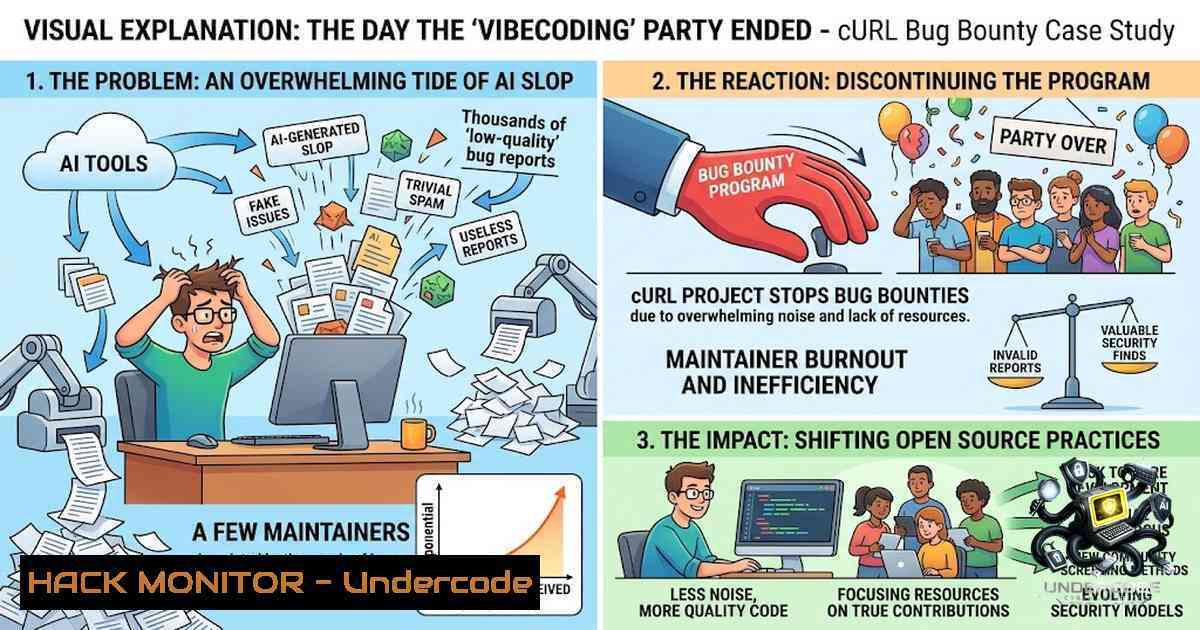
On January 21, 2026, Daniel Stenberg, the creator and lead maintainer of cURL—the ubiquitous command-line tool and library that powers data transfers across billions of devices worldwide—announced the termination of the project’s six-year-old bug bounty program. The reason: a flood of low-quality, AI-generated vulnerability reports had overwhelmed the small security team, consuming so much bandwidth that maintainers could no longer effectively triage legitimate findings. In 2025, fewer than 5% of submitted reports were legitimate, while AI-generated submissions consumed an estimated 20% of the total volume. This isn’t an isolated incident—it’s a warning shot across the bow of every open-source project, every AI-powered development workflow, and every organization that has embraced “vibecoding” without accounting for the maintenance debt it creates.
Learning Objectives & Secrets
- Objective 1: Understand the Economic Asymmetry of AI-Generated Contributions — Learn why generating code or bug reports with AI costs minutes while reviewing them costs hours, and why this 12× cost multiplier is breaking open-source maintainers.
-
Objective 2 Secret Tip: Implement a “Maintenance Budget” for Every AI-Generated Feature — Before shipping any AI-generated code, allocate equivalent time for review, testing, and long-term maintenance. Track cleanup hours as a first-class metric alongside shipping velocity.
-
Objective 3 Secret Tip: Adopt “Rightcoding” Discipline — Treat AI as a co-pilot, not a driver. Establish formal review gates, test-first validation, and team-level governance for all AI-assisted contributions. The goal isn’t to ban AI—it’s to steward its output with the same rigor as human-written code.
- The cURL Bug Bounty Shutdown: A Case Study in AI Slop Overload
cURL’s bug bounty program, run through HackerOne, had operated successfully for six years. But starting in early 2024, Stenberg began noticing a disturbing trend: an increasing number of submissions were low-quality, AI-generated reports that required significant effort to debunk. By mid-2025, he contemplated killing the program entirely. In May 2025, he implemented an instant-ban policy for AI-generated submissions—but the flood continued.
The breaking point came in January 2026. Stenberg announced via a GitHub commit that the bug bounty would end effective January 31, 2026. His explanation was blunt: “The volume of low-effort, AI-generated reports has clearly shifted the cost from ‘pay for real findings’ to ‘pay in maintainer time for triage'”. The cURL project, maintained by a small handful of volunteers, simply could not sustain the overhead.
What This Means for You: If a project as foundational as cURL—the plumbing behind every browser, app, and API call on the internet—can be brought to its knees by AI-generated noise, no open-source project is safe. The lesson is clear: AI didn’t create the fragility of open-source infrastructure, but it is accelerating its collapse by flooding the system with contributions that cost more to review than they’re worth.
- The Economics of Vibe Coding: Why Code Is Cheap and Review Is Expensive
The term “vibecoding” describes the practice of using AI tools to generate code rapidly, often without deep understanding of the underlying systems. On the surface, it feels like a productivity win. But beneath the surface lies a hidden cost: the review burden doesn’t disappear—it shifts.
Research has shown that a contributor spends roughly 7 minutes generating a vibe-coded pull request, while a maintainer spends approximately 84 minutes reviewing it. That’s a 12× cost multiplier. Even more concerning: good-faith AI contributions and bad-faith ones impose the same triage cost. A plausible-but-wrong AI-generated diff can take longer to evaluate than writing the change yourself.
The economic model is inverted. AI has made code generation virtually free, but review, integration, and maintenance remain expensive—and these costs are now being borne by unpaid volunteers. A study titled “Vibe Coding Kills Open Source” modeled this dynamic and found that widespread vibe coding creates a negative feedback loop: as AI tools install open-source dependencies without human engagement, documentation access, bug reports, and community participation all decline.
Step-by-Step Guide: Measuring Your AI Contribution Review Cost
- Track time spent reviewing AI-generated PRs for one sprint. Log every review session.
- Compare to time spent reviewing human-generated PRs of similar complexity.
- Calculate the ratio—if AI reviews take 2× or more, you have a problem.
- Set a threshold—e.g., no AI-generated PR over 200 lines without a human co-author.
- Implement a “review budget” —limit the number of AI PRs any maintainer handles per day.
- Measure again after 30 days to see if the ratio improves.
3. Rightcoding: The Discipline of Stewarding AI-Generated Code
The solution, as articulated by Sriram Gopalan, isn’t “more AI”—it’s a discipline he calls Rightcoding. The core premise is simple: AI can write code, but only humans can steward it. Rightcoding means:
- Budgeting maintenance capacity for every unit of AI-generated feature work
- Treating AI as a co-pilot, not a driver
- Measuring cleanup hours as a first-class metric, not just shipping velocity
In practice, Rightcoding translates to specific engineering disciplines: formal specifications before implementation, test-first validation, mandatory code review by humans with domain expertise, and team-level governance over AI usage. Projects like ProCoder and SpecAI have emerged to enforce these disciplines programmatically—commit gates that count unchecked work as failing, quality controllers that refuse to call unfinished work done, and lessons loops that close each escaped bug’s class.
Step-by-Step Guide: Implementing Rightcoding in Your Team
- Define a clear AI usage policy—what types of tasks can use AI assistance? What requires human-only implementation?
- Require test-first validation—all AI-generated code must have tests written before the code is merged.
- Mandate human review—no AI-generated code goes to production without at least two human reviewers with domain expertise.
- Track maintenance metrics—measure time spent fixing AI-generated bugs separately from human-generated ones.
- Conduct regular “cleanup sprints” —dedicated time to refactor and improve AI-generated code that shipped.
- Review and iterate—monthly reviews of AI usage patterns and their impact on code quality.
Linux/Windows Commands for AI Code Quality Enforcement:
 Linux: Count AI-generated commits in the last 30 days
git log --since="30 days ago" --author="ai-agent" --oneline | wc -l

Linux: Find files with AI-generated boilerplate patterns
grep -r "Generated by AI" --include=".py" --include=".js" ./src

Windows (PowerShell): Similar file search
Get-ChildItem -Recurse -Include .py,.js | Select-String "Generated by AI"

Linux: Check for TODO comments that might indicate AI-generated placeholder code
grep -r "TODO.AI" --include=".go" --include=".rs" ./src
4. The Open-Source Sustainability Crisis: Beyond cURL
cURL is far from alone. The Python Software Foundation complained about AI-generated bug reports flooding their systems in late 2024. The Godot game engine banned automated AI contributions entirely. Ghostty, a terminal emulator, implemented a zero-tolerance policy where submitting bad AI-generated code results in a ban. GitHub has formally acknowledged the problem and is weighing a pull request “kill switch” to help maintainers cope.
The scale of the problem is staggering. In 2025, AI slop was primarily targeting the most popular open-source projects. The Linux Foundation, along with half a dozen Big Tech companies, delivered $12.5 million in grants to help maintainers cope with AI-generated bug reports. But money alone won’t solve the underlying problem: the social contract between maintainers and contributors is being eroded.
Step-by-Step Guide: Protecting Your Open-Source Project from AI Slop
- Update your contribution guidelines—explicitly prohibit AI-generated submissions without human review and co-authorship.
- Implement automated filtering—use tools to detect AI-generated patterns in PR descriptions and code.
- Set up a triage process—designate specific maintainers to handle AI-suspect submissions separately.
- Consider a bug bounty pause—if your project has a bounty program, evaluate the signal-to-1oise ratio.
- Communicate clearly—explain to your community why these policies exist and how they protect the project’s long-term health.
-
API Security and Tool Configuration in the Age of AI Noise
The cURL shutdown has direct implications for API security and tooling. cURL is the bedrock of API testing, debugging, and security research. Every API security professional relies on cURL commands daily. If the project’s maintenance becomes unsustainable, the entire API security ecosystem suffers.
Practical API Security Commands (Using cURL):
 Basic API endpoint test with cURL
curl -X GET https://api.example.com/v1/users -H "Authorization: Bearer $TOKEN"

Test for common vulnerabilities (SQL injection probe)
curl -X GET "https://api.example.com/v1/users?id=1' OR '1'='1" -H "Authorization: Bearer $TOKEN"

Check for exposed internal headers
curl -I https://api.example.com/v1/health

Test rate limiting
for i in {1..100}; do curl -s -o /dev/null -w "%{http_code}\n" https://api.example.com/v1/endpoint; done | sort | uniq -c

Check for CORS misconfiguration
curl -X OPTIONS https://api.example.com/v1/data -H "Origin: https://evil.com" -H "Access-Control-Request-Method: GET" -v
Cloud Hardening Command (AWS CLI):
 Check for overly permissive S3 buckets (potential data exposure)
aws s3api list-buckets --query 'Buckets[].Name' | while read bucket; do
aws s3api get-bucket-acl --bucket $bucket --query 'Grants[?Grantee.URI==`http://acs.amazonaws.com/groups/global/AllUsers`]'
done

Audit IAM roles for overly broad permissions
aws iam list-roles --query 'Roles[?contains(AssumeRolePolicyDocument.Statement[].Action, ``)]'
- Vulnerability Exploitation and Mitigation in the AI Era
The irony is profound: AI tools that generate sloppy vulnerability reports also lower the barrier to entry for legitimate security research. The cURL team, despite shutting down the bug bounty, still relies on the community to report real vulnerabilities. The challenge is separating signal from noise.
Step-by-Step Guide: Validating Vulnerability Reports (Human vs. AI)
- Check for specificity—legitimate reports include exact reproduction steps, affected versions, and proof of concept.
- Verify against known CVEs—many AI-generated reports rehash known vulnerabilities.
- Test the PoC yourself—if the reporter can’t provide a working PoC, be suspicious.
- Look for hallucinated details—AI often invents version numbers, function names, or error messages.
- Cross-reference with project documentation—if the report contradicts documented behavior, it’s likely AI-generated.
Linux Command for Vulnerability Scanning:
 Scan for known vulnerabilities in dependencies (using OWASP Dependency-Check)
dependency-check --scan ./src --format HTML --out ./reports

Check for exposed secrets in Git history
git log -p | grep -E "(password|secret|key|token)" --color=always

Monitor for unusual process activity (potential exploitation)
ps aux --sort=-%mem | head -20
netstat -tulpn | grep LISTEN
Windows Command (PowerShell) for Security Auditing:
 Check for open ports
Get-1etTCPConnection | Where-Object {$_.State -eq "Listen"} | Select-Object LocalPort, OwningProcess

Audit Windows firewall rules
Get-1etFirewallRule | Where-Object {$<em>.Enabled -eq "True" -and $</em>.Direction -eq "Inbound"} | Select-Object DisplayName, Action

Check for suspicious scheduled tasks
Get-ScheduledTask | Where-Object {$_.State -1e "Disabled"} | Select-Object TaskName, State
What Undercode Say
- Key Takeaway 1: AI-Generated Code Is Not Free — The cost of generating code with AI has dropped to near zero, but the cost of reviewing, integrating, and maintaining that code has not. This cost has simply been transferred from the contributor to the maintainer, creating a massive economic asymmetry that threatens the sustainability of open-source infrastructure.
-
Key Takeaway 2: The “Tragedy of the Commons” Is Real — Every individual AI-assisted contribution feels like a productivity win. Collectively, these contributions are drowning the very projects they depend on. cURL’s bug bounty shutdown is not an anomaly—it’s a preview of what awaits every open-source project that doesn’t proactively manage AI-generated input.
Analysis: The cURL bug bounty shutdown represents a watershed moment for the open-source ecosystem and the AI industry. For years, we’ve been told that AI would supercharge developer productivity. What we’re now discovering is that productivity gains are real, but they come with externalities—costs borne by the volunteers who maintain the digital infrastructure we all depend on. The solution isn’t to ban AI—that’s neither feasible nor desirable. The solution is to build discipline around AI usage: to treat AI as a co-pilot rather than a driver, to budget for maintenance just as we budget for development, and to measure cleanup hours alongside shipping velocity. The projects that adopt Rightcoding principles will survive and thrive. Those that don’t will find themselves drowning in AI-generated noise, just as cURL did.
Prediction
- +1 Organizations that implement formal AI governance and “Rightcoding” disciplines will see higher long-term code quality and lower technical debt than those that treat AI as a drop-in replacement for human developers. The competitive advantage will shift from “who can ship fastest” to “who can maintain sustainably.”
-
-1 More open-source projects will follow cURL’s lead and shut down bug bounty programs, reducing the overall security of the open-source ecosystem. This will create a security vacuum that benefits neither maintainers nor the enterprises that rely on open-source software.
-
-1 The gap between “vibecoding” startups and established enterprises will widen, with AI-generated technical debt disproportionately affecting smaller teams that lack the resources for rigorous review processes.
-
+1 New tooling and platforms will emerge to help maintainers automatically detect and filter AI-generated slop, reducing the triage burden and restoring signal-to-1oise ratios in bug reporting systems.
-
-1 The social contract between open-source maintainers and contributors—built on trust, goodwill, and mutual respect—will continue to erode as AI-generated contributions flood the system with low-quality, high-cost inputs.
-
+1 Enterprises that depend on open-source software will increasingly fund maintainers directly through grants and sponsorships, recognizing that the sustainability of their infrastructure depends on the well-being of the people who maintain it.
-
-1 If current trends continue, we may see a “maintainer strike” —key open-source projects going into maintenance-only mode or shutting down entirely, as volunteers burn out from the relentless flood of AI-generated noise.
▶️ Related Video (70% Match):
https://www.youtube.com/watch?v=-ibRc98Ndy0
🎯Let’s Practice For Free:
🎓 Live Courses & Certifications:
Join Undercode Academy for Verified Certifications
🚀 Request a Custom Project:
Secure, high-velocity infrastructure and disruptive technological engineering. Contact our engineering team for high-tier development and proprietary systems:
[email protected]
💎 Smart Architecture | 🛡️ Secure by Design | ⭐ Trusted by Thousands
IT/Security Reporter URL:
Reported By: https://lnkd.in/p/ee6Biprx – Hackers Feeds
Extra Hub: Undercode MoN
Basic Verification: Pass ✅


