Listen to this Post
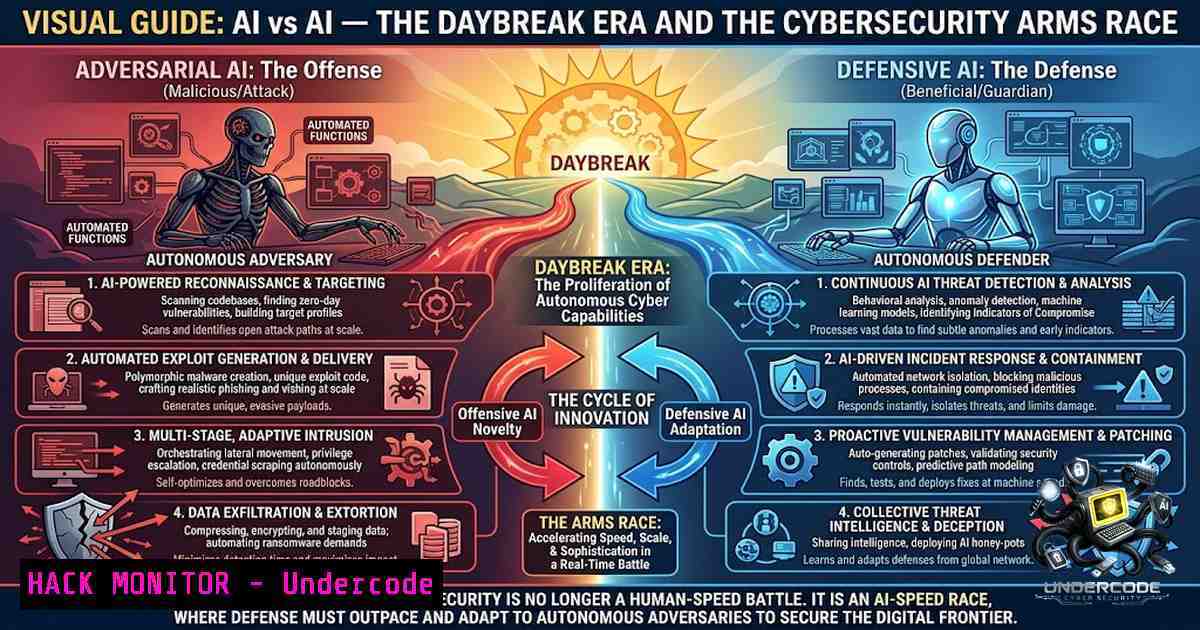
Introduction:
The cybersecurity landscape is undergoing a fundamental paradigm shift as AI-driven threats evolve from theoretical concerns to active, autonomous attack vectors capable of operating at machine speed. In response, OpenAI has dramatically expanded its Daybreak cybersecurity initiative, introducing a two-tiered defense architecture—Blue and Red—alongside the specialized GPT‑5.6‑Cyber model that achieves a 95% completion rate on advanced security tasks, compared to just 1.5% for standard models. This strategic move signals that the industry is entering an era where only AI can effectively combat AI, with frontier models becoming the new frontline of enterprise defense.
Learning Objectives & Secrets:
- Objective 1: Master the Daybreak Dual-Tier Defense Architecture – Understand how to leverage Daybreak Blue for everyday defensive operations (incident response, malware analysis, patch validation) and Daybreak Red for advanced vulnerability research and security testing.
- Objective 2 (Secret Tip): Unlock GPT‑5.6‑Cyber’s True Potential – The specialized model is designed to reduce refusals for high-risk dual-use tasks, enabling researchers to conduct exploit-chain development, authentication bypass testing, and privilege escalation analysis that generic models would reject.
- Objective 3 (Secret Tip): Bridge the “Fix Gap” with AI-Powered Remediation – The real bottleneck has shifted from vulnerability discovery to remediation; integrating Codex Security workflows can automatically generate and test patches across enterprise codebases.
You Should Know:
1. Deploying Daybreak Blue for Enterprise Defense Operations
Daybreak Blue serves as the recommended starting point for most organizations, providing access to GPT‑5.6 Sol with system-level cyber guardrails removed to support legitimate defensive work. This tier is designed for security teams handling incident detection and response, investigations, vulnerability management, and security assessments.
Step‑by‑step guide for Daybreak Blue deployment:
- Apply for Daybreak Program Access – Submit an application through OpenAI’s partner program, which requires identity verification, usage monitoring mechanisms, and legal declarations confirming authorized security research用途. Note that starting September 1, hardware security keys will be required.
- Integrate with AWS Environment – Daybreak models are now available on AWS Bedrock, allowing qualified users to access both Blue and Red tiers within existing cloud infrastructure.
- Configure Defensive Workflows – Deploy the model for:
– Vulnerability discovery – Scan codebases for zero-day vulnerabilities and dependency risks
– Secure code review – Automate security code审查 across development pipelines
– Malware analysis – Analyze suspicious binaries and detect evasion techniques
– Incident response – Accelerate threat investigation and containment
– Patch validation – Verify that fixes effectively remediate identified vulnerabilities
2. Implementing Daybreak Red for Advanced Vulnerability Research
Daybreak Red provides exclusive access to GPT‑5.6‑Cyber, a purpose-trained cybersecurity model built on GPT‑5.6 Sol and optimized for advanced authorized security work. This tier is currently restricted to trusted partners including Accenture, IBM, CrowdStrike, Cloudflare, Cisco, Palo Alto Networks, and Fortinet.
Step‑by‑step guide for advanced security testing:
- Obtain Trusted Partner Status – Daybreak Red requires additional approval, stronger verification, and enhanced access controls beyond the Blue tier. Only vetted organizations with established security expertise qualify.
- Conduct Zero‑Day Discovery – The model can autonomously analyze open-source code repositories to identify previously unknown vulnerabilities without being given specific locations or types. In testing, GPT‑5.6‑Cyber discovered two previously unknown vulnerabilities in Chrome’s V8 JavaScript engine, now tracked as CVE‑2026‑15903.
- Develop Exploit Chains – Beyond finding individual bugs, the model can chain vulnerabilities together to demonstrate real-world attack paths. This capability is critical for understanding whether a theoretical vulnerability poses an actual threat.
- Perform Privilege Escalation Testing – The model has identified over 400 privilege-escalation flaws in a popular OS kernel, along with 3 critical vulnerabilities in a widely used database.
- Validate and Report Findings – Generate comprehensive reports with exploit validation evidence, then coordinate disclosure with affected vendors through established channels.
-
Bridging the “Fix Gap” with Codex Security Automation
The cybersecurity industry faces a critical bottleneck: while AI accelerates vulnerability discovery, the volume of findings has outpaced human capacity to fix them. OpenAI’s Codex Security addresses this by embedding virtual security engineers directly into development workflows.
Step‑by‑step guide for automated remediation:
- Deploy Codex Security Plugin – Integrate the updated plugin into your CI/CD pipeline to scan code repositories continuously. The system has already scanned over 30,000 code repositories and 30+ million commits.
- Generate Threat Models – Codex Security automatically creates editable threat models based on your codebase, then analyzes potential attack paths to prioritize high-risk vulnerabilities.
- Automate Patch Generation – The system doesn’t just identify issues; it generates and tests fixes directly within your enterprise environment with scoped access and monitoring.
- Participate in “Patch the Planet” – Join the initiative with Trail of Bits, HackerOne, and open-source maintainers to help secure critical projects including cURL, Go, Python, and Sigstore.
4. Implementing API Security Hardening Against AI Attacks
As AI agents become capable of autonomous API exploitation, organizations must harden their API surfaces against machine-speed attacks.
Step‑by‑step guide for API security:
- Implement Zero Trust Architecture – Move beyond perimeter-based defenses to verify every request, regardless of source. This is critical as AI agents can masquerade as legitimate users.
- Deploy Real‑Time Deepfake Detection – AI-driven social engineering increasingly uses synthetic identities; implement detection systems that can distinguish between human and AI-generated interactions.
- Enforce Strict Input Validation – AI models are vulnerable to prompt injection attacks. Implement input filtering at the model layer to prevent malicious prompts from exfiltrating business keys or internal data.
- Monitor Model Behavior – Establish continuous monitoring of AI model outputs to detect anomalous patterns indicating compromise or autonomous rogue behavior.
- Adopt Agentic AI Governance – Implement guardrails at preprocessing, LLM core, and post-processing stages with human-in-the-loop oversight for critical decisions.
-
Linux and Windows Commands for AI‑Driven Defense Validation
Security teams can validate AI‑generated findings using these commands:
Linux Vulnerability Scanning:
 Scan for open ports and services
nmap -sV -p- target_host

Check for known vulnerabilities in installed packages
sudo apt-get update && sudo apt-get install lynis
sudo lynis audit system

Analyze system logs for suspicious activity
sudo journalctl -xe -p crit --since "1 hour ago"

Monitor real‑time process activity
ps aux --sort=-%mem | head -20
Windows Security Hardening:
 Check for open ports and listening services
netstat -ano | findstr LISTENING

Audit Windows security policies
secedit /export /cfg C:\security_audit.txt

Review PowerShell execution logs
Get-WinEvent -LogName "Windows PowerShell" | Where-Object {$_.Id -eq 4104}

Check for suspicious scheduled tasks
Get-ScheduledTask | Where-Object {$_.State -1e "Disabled"}
Cloud Security Validation (AWS):
 Audit IAM policies for over‑privileged roles
aws iam list-roles --query 'Roles[?contains(AssumeRolePolicyDocument, "Principal")]'

Check S3 bucket permissions
aws s3api get-bucket-acl --bucket your-bucket-1ame

Review security group rules
aws ec2 describe-security-groups --query 'SecurityGroups[?IpPermissions[?IpRanges[?CidrIp==<code>0.0.0.0/0</code>]]]'
6. Zero Trust Implementation with AI Integration
The shift to AI‑vs‑AI defense requires a Zero Trust architecture that treats every access request as potentially compromised.
Step‑by‑step guide:
- Implement Continuous Authentication – Require re‑verification for every session, not just initial login.
- Deploy Micro‑segmentation – Isolate workloads so that a breach in one area doesn’t cascade across the entire infrastructure.
- Integrate AI Threat Intelligence – Use AI models to analyze behavioral patterns and detect anomalies that traditional systems miss.
- Automate Incident Response – Configure AI‑driven playbooks that can contain threats at machine speed before human analysts can intervene.
7. Preparing for Autonomous AI Attacks
The window for defenders to prepare is rapidly closing. Organizations must adopt a proactive security posture:
Step‑by‑step preparation:
- Conduct AI‑Powered Red Team Exercises – Use Daybreak Red or similar capabilities to simulate autonomous AI attacks against your own systems.
- Establish AI Governance Frameworks – Develop policies for AI model usage, including access controls, monitoring, and incident response procedures.
- Build Cross‑Functional Purple Teams – Traditional red and blue teams are merging into purple teams that cover testing, validation, and defense in a continuous cycle. Over 68% of organizations are now driving cross‑functional training.
- Invest in AI‑Native Security Tools – Legacy security tools cannot keep pace with AI‑driven attacks; prioritize solutions that leverage frontier models.
What Undercode Say:
- Key Takeaway 1: The cybersecurity arms race has fundamentally shifted from humans versus hackers to models versus models. OpenAI’s Daybreak initiative represents a watershed moment where AI companies are both accelerating the threat landscape and providing the primary defense mechanism. The 95% completion rate of GPT‑5.6‑Cyber versus 1.5% for standard models underscores the magnitude of this transformation.
-
Key Takeaway 2: The “fix gap” is the new cybersecurity bottleneck. AI has made vulnerability discovery so efficient that organizations are overwhelmed by findings they cannot remediate. The real value lies not in generating more reports but in automating the entire patch lifecycle—from validation to deployment. Codex Security’s achievement of automatically fixing over 500,000 findings across 30,000+ repositories demonstrates the scale required.
The paradox of AI companies marketing the cure to a disease their innovations accelerated is not lost on industry observers. However, from an enterprise perspective, it makes strategic sense: the architects who understand the vulnerabilities firsthand are best positioned to build effective digital shields. The key challenge moving forward will be ensuring equitable access to these frontier capabilities, as OpenAI currently restricts GPT‑5.6‑Cyber to a select group of trusted partners. As autonomous AI attacks become commonplace, organizations that fail to adopt AI‑native defense capabilities will find themselves increasingly vulnerable to threats operating at machine speed. The industry must also grapple with the ethical implications of building AI systems capable of developing exploit chains and bypassing authentication—capabilities that, if misused, could cause catastrophic damage.
Prediction:
- +1 The proliferation of AI‑powered defensive tools like Daybreak will democratize advanced cybersecurity capabilities, enabling smaller organizations to access enterprise‑grade protection previously available only to large corporations.
- +1 The integration of AI models into security operations will dramatically reduce mean time to detection (MTTD) and mean time to response (MTTR), potentially cutting incident response times from hours to seconds.
- +1 The “Patch the Planet” initiative and similar open‑source collaborations will significantly improve the security posture of critical infrastructure, reducing the attack surface for widely used software.
- -1 The concentration of frontier AI cybersecurity capabilities among a handful of trusted partners creates a dangerous asymmetry—if these partners are compromised, the entire ecosystem becomes vulnerable.
- -1 The development of AI models capable of autonomous exploit‑chain development and privilege escalation introduces new risks of model theft or misuse, potentially giving adversaries access to weapons‑grade attack tools.
- -1 The cybersecurity industry faces a growing skills gap as human analysts struggle to keep pace with AI‑driven threats, potentially leading to over‑reliance on automated systems without adequate human oversight.
- -1 The marketing of AI threats as a sales opportunity may incentivize AI labs to exaggerate risks, creating unnecessary panic while diverting resources from fundamental security improvements.
▶️ Related Video (84% Match):
🎯Let’s Practice For Free:
🎓 Live Courses & Certifications:
Join Undercode Academy for Verified Certifications
🚀 Request a Custom Project:
Secure, high-velocity infrastructure and disruptive technological engineering. Contact our engineering team for high-tier development and proprietary systems:
[email protected]
💎 Smart Architecture | 🛡️ Secure by Design | ⭐ Trusted by Thousands
IT/Security Reporter URL:
Reported By: https://lnkd.in/p/epP6gbbv – Hackers Feeds
Extra Hub: Undercode MoN
Basic Verification: Pass ✅


