
Listen to this Post
Introduction:
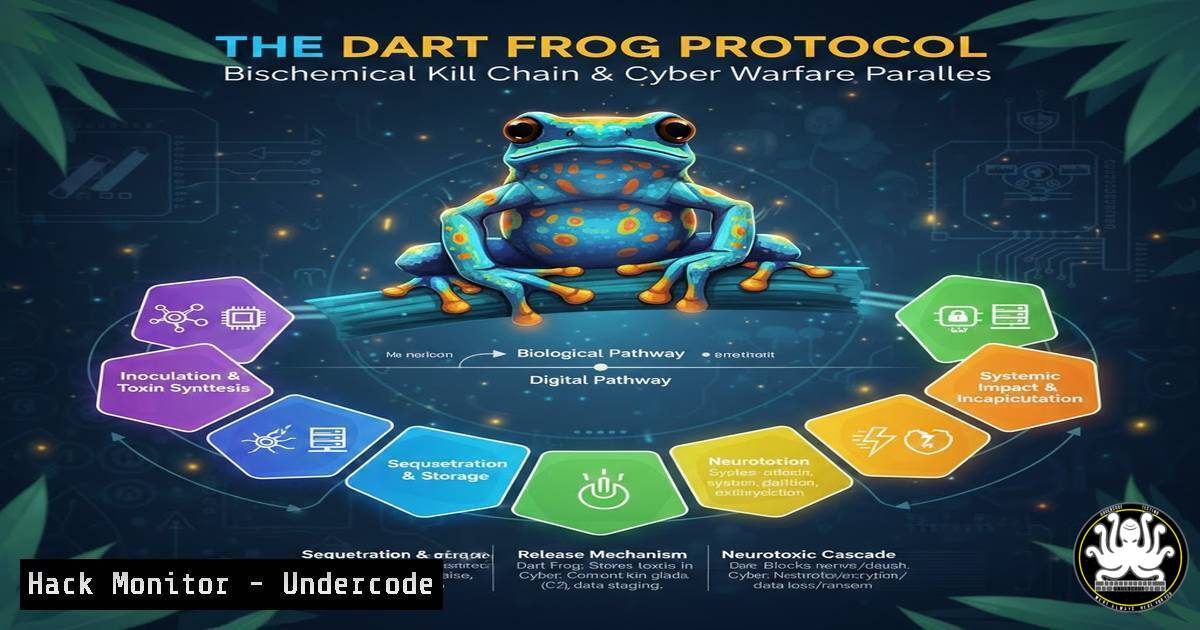
The recent revelation by UK and allied intelligence agencies regarding the death of Russian opposition leader Alexei Navalny introduces a terrifying dimension to modern statecraft: the use of rare, sophisticated biochemical agents. Reports indicate the use of a toxin derived from the Ecuadorian dart frog, a substance 200 times more potent than morphine, causing victims to “suffocate in agony.” While this incident exists within the physical realm of political assassination, its methodology—targeted delivery, high specificity, and attribution difficulty—mirrors the most advanced tactics in cyber warfare. For cybersecurity professionals, analyzing this kill chain provides a grim framework for understanding how Advanced Persistent Threats (APTs) operate, from initial reconnaissance to the final, irreversible payload execution.
Learning Objectives:
- Understand the parallels between biochemical attack vectors and sophisticated malware (memory-resident vs. systemic).
- Analyze the forensic difficulties in detecting “low and slow” poisoning tactics versus high-volume attacks.
- Learn how to apply threat intelligence to detect “exotic” payloads (zero-days) before they execute in your environment.
You Should Know:
- Reconnaissance and Target Profiling (The Logistics of Access)
Just as the perpetrators of the Navalny incident needed to understand his movements, habits, and security detail rotations, cyber adversaries conduct extensive Open Source Intelligence (OSINT) and physical reconnaissance. In the digital realm, this translates to identifying which systems hold valuable data and how users interact with them.
Step‑by‑step guide (Defensive Reconnaissance):
To understand your own exposure, simulate an attacker’s view:
– Linux (External Footprint): Use `theHarvester` to see what data is exposed about your domain.
theHarvester -d yourcompany.com -l 500 -b all
– Windows (Internal Active Directory Recon): Attackers use built-in tools to map trusts. Defenders can run similar queries to find misconfigurations.
 Find all domain admins (a prime target)
Get-ADGroupMember -Identity "Domain Admins" | Select-Object name, objectClass
2. The Delivery Mechanism (The Poison Vector)
The poison (dart frog toxin) is the payload, but it requires a vector. Speculation regarding Navalny’s poisoning often involves contamination of clothing or surfaces (contact agents). In IT, this is the initial infection vector—phishing emails, watering hole attacks, or supply chain compromise.
Step‑by‑step guide (Analyzing Suspicious Vectors):
- Email Header Analysis: If a user receives a suspicious email, extract the header to see if it spoofs your domain.
Save the email as a .txt file and use grep to find the originating IP
grep "Received: from" email_header.txt
- URL Decoding: Often, links in phishing emails are obfuscated.
Python one-liner to decode a suspicious URL
python3 -c "import urllib.parse; print(urllib.parse.unquote('INSERT_MALICIOUS_URL_HERE'))"
- Execution and Privilege Escalation (The Onset of Symptoms)
Navalny’s initial symptoms would have seemed minor before becoming catastrophic. Similarly, malware often executes with low privileges, then “breaks out” to gain SYSTEM or root access. The toxin targets the nervous system; malware targets the kernel.
Step‑by‑step guide (Detecting Anomalous Behavior):
- Linux: Monitor for processes running with elevated privileges unexpectedly.
Watch for privilege escalation via sudo
sudo cat /var/log/auth.log | grep "sudo:session"
Check for unusual cron jobs (persistence)
crontab -l
- Windows: Check for scheduled tasks created by unknown users.
List all scheduled tasks
Get-ScheduledTask | Where-Object {$_.TaskPath -notlike "\Microsoft\Windows"} | Format-Table TaskName, State
4. Defense Evasion (The Lack of Autopsy Transparency)
One of the most chilling aspects of the dart frog poison is its rarity, making it difficult to detect in a standard toxicology screening. In cybersecurity, this is the “living off the land” binary or a zero-day exploit—tools that are not on the blacklist because they are custom-made or use trusted system processes.
Step‑by‑step guide (Hunting for Anomalies):
- Network Analysis: Look for data exfiltration via uncommon protocols.
Capture traffic on port 53 (DNS) to see if data is being tunneled
sudo tcpdump -i eth0 -n port 53 -A
- Windows Event Logs: Attackers often clear logs to hide their tracks.
Check for cleared security logs (Event ID 1102)
Get-WinEvent -FilterHashtable @{LogName='Security'; ID=1102} | Format-List TimeCreated, Message
5. Impact and Payload (Suffocation in Agony)
The final stage. The biochemical agent causes respiratory failure. The digital equivalent is ransomware encryption or destructive wipers (like NotPetya or AcidRain), rendering the system useless and causing organizational “suffocation.”
Step‑by‑step guide (Mitigation via Hardening):
- Linux (Filesystem Integrity): Implement immutable flags on critical configuration files to prevent ransomware from modifying them.
Make a file immutable (even root cannot delete without removing flag)
sudo chattr +i /etc/hosts
List immutable files
lsattr /etc/hosts
- Windows (Ransomware Mitigation): Use Controlled Folder Access to prevent unauthorized apps from modifying protected folders.
Enable Controlled Folder Access via PowerShell
Set-MpPreference -EnableControlledFolderAccess Enabled
What Undercode Say:
- The “Exotic Payload” Problem: Just as standard toxicology failed to immediately identify the dart frog poison, standard signature-based antivirus fails against custom malware. The shift to behavioral analysis (EDR/XDR) is not optional; it is mandatory.
- The Kill Chain is Universal: Whether biological or digital, the sequence of reconnaissance, delivery, execution, and exfiltration remains constant. Defenders must map the “Navalny playbook” to their network—understanding that the most dangerous attacks look benign until they are catastrophic.
- Supply Chain is the Weakest Link: If the poison can be introduced into a victim’s environment via a contaminated belonging (a shirt, a water bottle), then software is compromised via compromised dependencies. Rigorous software bill of materials (SBOM) and third-party risk management are the digital equivalents of a food taster.
Prediction:
The use of such a rare and potent toxin signals a future where state-sponsored actors will increasingly rely on “non-standard” attack surfaces. In the cyber domain, this will translate to a rise in hardware-level implants (firmware attacks) and AI-generated disinformation campaigns designed to target human psychology rather than software vulnerabilities. Just as the dart frog toxin bypassed physical security, AI deepfakes will bypass logical security, creating a new era where the human mind is the primary battlefield.
▶️ Related Video (80% Match):
🎯Let’s Practice For Free:
IT/Security Reporter URL:
Reported By: Mthomasson Deborah – Hackers Feeds
Extra Hub: Undercode MoN
Basic Verification: Pass ✅


