
Listen to this Post
Introduction:
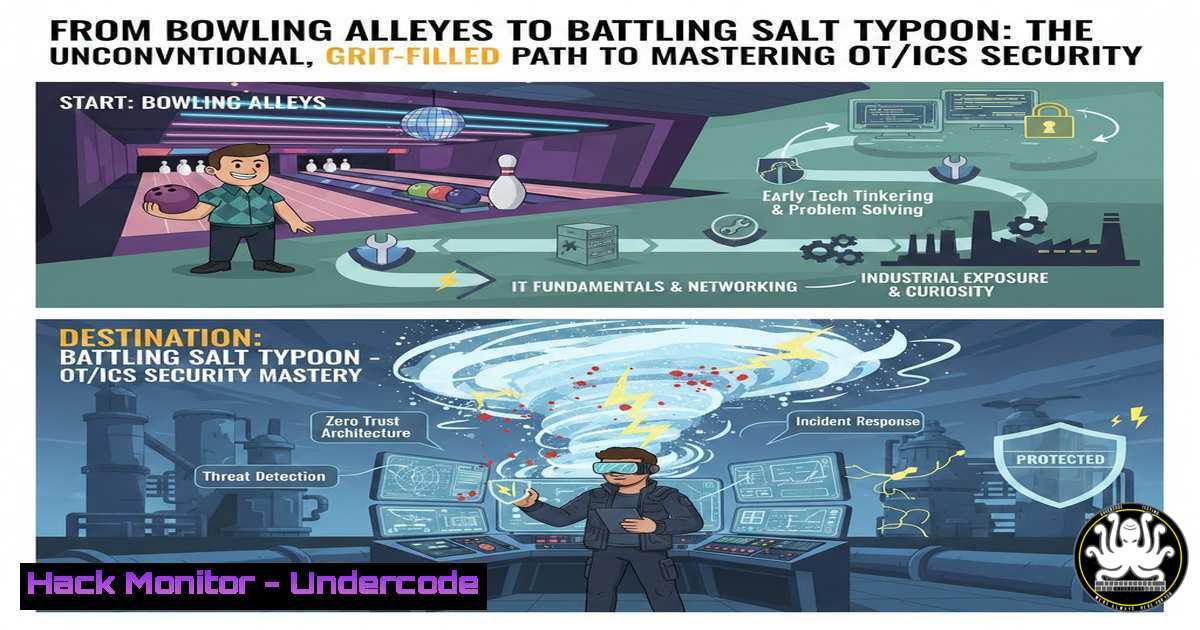
The journey into cybersecurity is rarely a straight line; it is often forged in the grit of hands-on failure and unexpected detours. This article deconstructs one professional’s eclectic career—from movie theater usher to OT/ICS Fellow—to extract the hard technical skills and foundational knowledge required to defend modern networks. By mapping his经历的 roles (QA, Network Admin, Instructor, Pen Tester) to concrete tools and techniques, we provide a roadmap for transitioning from general IT to specializing in the high-stakes world of Operational Technology and Industrial Control Systems security.
Learning Objectives:
- Map unconventional career experience (hardware, theater, mechanics) to specific competencies required for network and OT security.
- Execute fundamental Windows and Linux commands for system administration and security auditing.
- Differentiate between IT and OT/ICS security paradigms and apply basic hardening techniques for industrial environments.
- Understand the attacker’s perspective using penetration testing methodologies and tools.
- Identify critical vulnerabilities in ISP infrastructure and OT systems, referencing real-world threats like Salt Typhoon and Stuxnet.
- From QA Tester to Network Admin: Mastering the Fundamentals
The journey began with software testing and a firing that led to deeper technical immersion. Before securing a network, you must understand how it fails. In the role of a Network Administrator, managing “over a hundred computers” requiring daily re-imaging built a deep familiarity with operating system deployment.
Step‑by‑step guide: Automating System Imaging and Configuration
To replicate this environment, you need to master deployment tools and command-line utilities.
On Windows (using DISM and Sysprep):
- Capture a Reference Image: After configuring a “golden” Windows machine, boot into Windows PE and use:
`dism /Capture-Image /ImageFile:D:\MyImages\Windows10.wim /CaptureDir:C:\ /Name:”Windows10Reference”`
- Generalize the System: Before deployment, run Sysprep to remove system-specific data:
`C:\Windows\System32\Sysprep\sysprep.exe /oobe /generalize /shutdown`
- Automate Configuration with PowerShell: To join a domain and install applications post-imaging, use a script:
Add-Computer -DomainName "undercode.local" -Restart
Install-WindowsFeature -Name RSAT, DNS
On Linux (using Bash and Clonezilla):
- Check Disk Usage: Before imaging, understand what you are copying.
`df -h`
- Create a compressed image (using dd and gzip):
`sudo dd if=/dev/sda of=/dev/stdout bs=4M | gzip > /backup/disk_image.gz`
Note: This is a fundamental command for disaster recovery and duplication. -
The IT Instructor Turned Security Advocate: Teaching the Stack
Transitioning to an IT Instructor required breaking down complex protocols like TCP/IP, Active Directory, and early Windows Server versions. To teach security, you must first explain the architecture.
Step‑by‑step guide: Auditing Active Directory Security
Understanding how to secure Active Directory (evolved from NT 4.0 and Windows 2000) is critical.
1. Enumerate Users and Groups: Using PowerShell to spot anomalies.
`Get-ADUser -Filter -Properties | Select-Object Name, LastLogonDate, PasswordLastSet`
2. Check for Legacy Protocols: Many attacks (like NTLM relay) exploit older protocols. Verify if NTLMv1 is disabled via Group Policy or registry.
`Get-ItemProperty -Path “HKLM:\SYSTEM\CurrentControlSet\Control\Lsa” -Name “LmCompatibilityLevel”`
Value 5 or higher is recommended to send NTLMv2 responses only.
3. SOC Analyst Perspective: Defending the ISP
Moving to a SOC Lead role at a large telecommunications company provided a unique vantage point. The mention of “Salt Typhoon” highlights the vulnerability of ISP backbones. Analysts must understand traffic flow and intrusion detection at scale.
Step‑by‑step guide: Basic Network Traffic Analysis with tcpdump
As an ISP defender, you need to capture and analyze traffic without impacting performance.
1. Capture traffic on a specific interface:
`sudo tcpdump -i eth0 -c 100 -w capture.pcap`
- Filter for specific threats: Look for connections to known malicious IPs or unusual DNS queries.
`sudo tcpdump -nn -r capture.pcap ‘dst port 53’`
- Check for anomalous outbound traffic: Data exfiltration often uses non-standard ports. Look for large volumes of traffic on high-numbered UDP ports.
`sudo tcpdump -nn -r capture.pcap ‘udp and dst port > 1024’`
4. Penetration Tester: Learning to Attack to Defend
The passion for penetration testing involves understanding exploitation to build better defenses. This requires hands-on practice with scanning and vulnerability assessment.
Step‑by‑step guide: External Reconnaissance and Scanning
- Passive Recon: Use tools like `whois` and `dig` to gather information about a target domain.
`whois undercode.local`
`dig ns undercode.local` (Find name servers)
- Active Scanning: Use Nmap to identify live hosts and open ports. Start with a basic ping sweep, then move to service detection.
`sudo nmap -sn 192.168.1.0/24` (Discover live hosts)
`sudo nmap -sV -sC -O -p 1-1000
3. Web Application Testing: If a web server is found, use `curl` to test for insecure headers.
`curl -I https://targetsite.com | grep -i “strict-transport-security”`
Missing HSTS or security headers indicates a misconfiguration.
- The Leap to OT/ICS: Bridging the Air Gap
The move to OT/ICS cybersecurity post-Stuxnet requires a fundamental shift in mindset. In IT, the priority is Confidentiality; in OT, it is Availability and Safety. Engineers were receptive because they understood the physical consequences of a hack.
Step‑by‑step guide: Basic OT Network Segmentation (The Purdue Model)
Implementing the Purdue Model prevents IT attacks from reaching the factory floor.
1. Level 0-2 (Process/Control): These networks (PLCs, RTUs, HMIs) should have no direct routing to the corporate network (Level 4-5).
2. Implement an Industrial Demilitarized Zone (I-DMZ): This buffer zone uses firewalls to broker communication.
3. Command-Line Firewall Rule (Linux iptables): On a gateway between IT and OT, block all but specific protocols like Modbus TCP (port 502) from trusted IPs only.
 Allow Modbus traffic from a specific engineering workstation to the PLC network
sudo iptables -A FORWARD -i eth1 (IT) -o eth2 (OT) -p tcp --dport 502 -s 192.168.10.50 -d 10.0.0.0/24 -j ACCEPT
sudo iptables -A FORWARD -i eth1 -o eth2 -j DROP
6. Hardening Against the “Salt Typhoon” Threat
The reference to Salt Typhoon, a sophisticated threat actor targeting telecoms, underscores the need for supply chain security and network segmentation within the provider’s own infrastructure.
Step‑by‑step guide: Securing Network Infrastructure Devices
- Disable Unused Services: On Cisco or Juniper devices, disable discovery protocols (CDP/LLDP) on edge ports to prevent information leakage.
`(config) no cdp run`
- Implement Strong Logging and NTP: Ensure all logs are sent to a secure, remote syslog server to detect tampering.
`(config) logging host 192.168.99.50`
`(config) ntp server time.undercode.local`
- Use SSHv2 and disable legacy protocols: Replace Telnet and insecure SNMP versions.
`(config) ip ssh version 2`
`(config) snmp-server community MyROstring RO` Avoid using “public” or “private”.
7. Vulnerability Exploitation and Mitigation: The Stuxnet Legacy
Stuxnet exploited Windows vulnerabilities (like the Print Spooler vulnerability) to jump the air gap and then targeted specific Siemens PLCs. Understanding this chain is vital.
Step‑by‑step guide: Checking for Print Spooler Vulnerabilities (CVE-2021-34527)
Even today, print spooler vulnerabilities are rampant.
1. Check if the Spooler service is running:
Windows: `Get-Service -Name Spooler`
Linux (if using CUPS): `systemctl status cups`
- Mitigation: If printing is not required in an OT environment, disable the service entirely.
Windows: `Stop-Service -Name Spooler -Force` followed by `Set-Service -Name Spooler -StartupType Disabled`
What Undercode Say:
- Key Takeaway 1: Unconventional career paths build unique, valuable skill sets. Experience in mechanics or QA provides a tangible understanding of how systems fail physically and logically—a perspective often missing in purely academic cybersecurity graduates.
- Key Takeaway 2: The evolution from IT to OT security is not just a change in tools, but a change in priority. Defending an industrial environment requires deep respect for process, safety, and availability, demanding that security measures integrate seamlessly with legacy, fragile control systems.
The narrative shared proves that cybersecurity is a field built on cumulative knowledge. Every role—from the bowling alley mechanic who understood electricity to the admin who mastered Windows 2000—contributed to a holistic understanding of risk. For professionals today, the path is clear: master the fundamentals of networking and systems, embrace the attacker mindset to truly understand defense, and respect the unique constraints of the environment you are protecting, whether it’s a corporate LAN or a power plant.
Prediction:
As state-sponsored attacks like Salt Typhoon continue to target critical infrastructure (ISPs, power grids), the demand for hybrid professionals who understand both deep technical networking and OT/ICS protocols will outpace supply. We will see a merging of IT and OT security teams, driven by regulation, forcing a cultural shift where “grit” learned from hands-on failure becomes as valuable as formal certification in defending national security assets.
▶️ Related Video (78% Match):
🎯Let’s Practice For Free:
IT/Security Reporter URL:
Reported By: Brito1 We – Hackers Feeds
Extra Hub: Undercode MoN
Basic Verification: Pass ✅


