
Listen to this Post
Introduction:
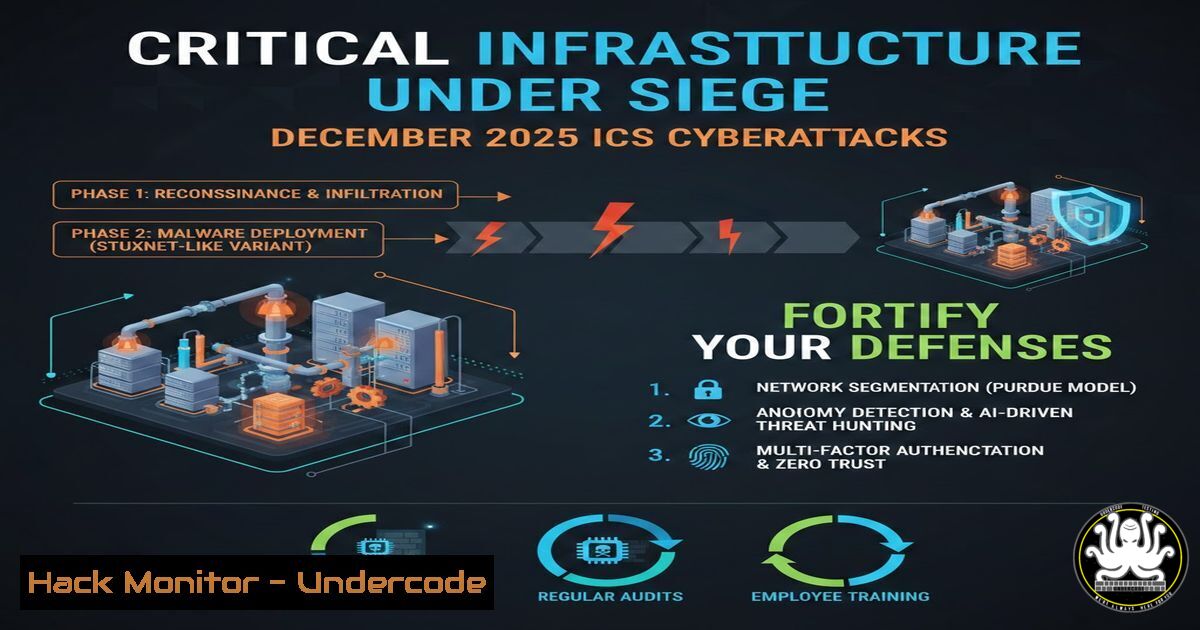
December 2025 marked a significant escalation in cyber warfare targeting Industrial Control Systems (ICS) and Operational Technology (OT). A coordinated wave of attacks, attributed to Russian-sponsored groups like Sandworm, struck critical infrastructure in Romania and Poland, targeting water management systems, power grids, and energy producers. While some attacks were contained to IT networks, the intrusion into Romania’s water authority control systems highlights the increasing capability and intent of adversaries to move beyond data theft toward potentially catastrophic physical disruption. This article dissects these incidents and provides a technical roadmap for security professionals to assess, harden, and monitor their ICS/OT environments against such advanced persistent threats.
Learning Objectives:
- Analyze the Tactics, Techniques, and Procedures (TTPs) used in the December 2025 ICS attacks, specifically Sandworm’s wiper malware and ransomware deployment in hybrid IT/OT environments.
- Conduct asset discovery and vulnerability assessments on ICS networks using open-source and commercial tools.
- Implement network segmentation and monitoring strategies to detect and contain lateral movement from IT to OT.
- Harden Windows-based Human-Machine Interfaces (HMIs) and engineering workstations against commodity malware and targeted wipers.
- Apply the key findings from the SANS 2025 ICS/OT State of Security report to prioritize defensive controls.
You Should Know:
- Incident Deep Dive: Anatomy of the December 2025 Attacks
The attacks in late 2025 demonstrate a clear evolution in nation-state behavior. The Romanian “National Water Management Authority” breach is the most concerning, as attackers gained access to systems that manage dams and water flow. Though they failed to manipulate physical processes, the access achieved indicates a failure in network segmentation. Simultaneously, the ransomware attack on Romania’s largest coal-based power producer was limited to IT systems, suggesting either a different objective or that OT-specific safeguards prevented the malware from crossing the divide. Most technically sophisticated was Sandworm’s wiper attack on Poland’s Power Grid, designed to destroy data and cripple systems without financial gain, purely for disruption.
Step-by-Step Analysis and Verification:
To understand the kill chain, analysts should look for indicators of compromise (IoCs) and behaviors associated with these groups.
1. YARA Rule for Sandworm Wiper: Create a rule to detect known wiper patterns.
rule APT_Sandworm_Industroyer2_Wiper {
meta:
description = "Detects potential Industroyer2 wiper artifacts"
author = "Analyst"
date = "2026-02-14"
strings:
$s1 = "StopService" fullword ascii
$s2 = "DeleteService" fullword ascii
$s3 = "C:\Windows\System32\cmd.exe /c del /f /q" ascii
$s4 = "Tell_Your_Children_My_Name" wide ascii
condition:
any of them
}
2. Windows Event Log Analysis: On compromised engineering workstations, check for evidence of service manipulation.
 Check for services being stopped or deleted around the incident time (adjust date)
Get-WinEvent -FilterHashtable @{LogName='System'; ID=7036; StartTime='2025-12-01'} | Where-Object {$<em>.Message -match "stopped"}
Get-WinEvent -LogName Security | Where-Object { $</em>.Id -eq 4657 -and $_.Message -match "Object Name:.Service" }
- ICS Asset Discovery: You Can’t Protect What You Can’t See
The SANS 2025 report likely emphasizes the challenge of asset visibility. Many OT networks still rely on manual spreadsheets. The first step to preventing a breach is having a real-time, accurate inventory of all devices, including PLCs, RTUs, intelligent electronic devices (IEDs), and the network switches connecting them.
Step-by-Step Guide to Active and Passive Discovery:
- Passive Discovery (Recommended for Live Environments): Use tools like Wireshark or GRASSMARLIN to listen to network traffic without sending packets, ensuring no disruption to fragile legacy devices.
– Command: `sudo tcpdump -i eth0 -w capture.pcap -c 10000`
– Action: Load the `capture.pcap` into Wireshark and filter for industrial protocols like modbus, s7comm, dnp3, or `iec60870-5-104` to identify PLCs and their communication patterns.
2. Active Discovery (Use with Caution): Nmap can be used during scheduled maintenance windows.
– Command: `sudo nmap -sS -T4 -p 102,502,20000,44818 –open 192.168.100.0/24`
– -sS: SYN stealth scan.
– -p: Scans common ICS ports (Siemens S7, Modbus, DNP3, Ethernet/IP).
– --open: Shows only responsive hosts.
3. Vulnerability Lookup: Once you have a device’s firmware version (often found in its web interface or via a protocol query), check for known vulnerabilities.
– Resource: Search the CISA Known Exploited Vulnerabilities (KEV) catalog or the vendor’s security advisory page.
3. Implementing Zero Trust Segmentation in OT
The Romanian water utility breach succeeded because attackers likely pivoted from the IT network to the OT network. Physical “air gaps” are a myth; modern connectivity demands logical segmentation enforced by technology like industrial firewalls and one-way diodes (data diodes).
Step-by-Step Firewall Hardening (pfSense/OPNsense Example):
- Isolate IT and OT: Create separate VLANs and physical interfaces. Assume the IT network is compromised.
2. Configure Strict Firewall Rules:
- Rule 1: Allow IT to OT only for specific management traffic (e.g., patching WSUS server) sourced from a single, jump-box IP, and only to specific OT assets.
- Rule 2: Block all IT to OT traffic by default.
- Rule 3 (Crucial): On the OT to IT direction, allow only specific outbound traffic (e.g., syslogs to a SIEM, NTP to a time server). Do not allow OT devices to initiate general web browsing or RDP out.
3. Linux-based iptables Implementation:
 Flush existing rules
sudo iptables -F

Default policies: DROP all traffic
sudo iptables -P INPUT DROP
sudo iptables -P FORWARD DROP
sudo iptables -P OUTPUT DROP

Allow OT device (192.168.1.10) to send logs to SIEM (10.0.0.50) on IT network
sudo iptables -A FORWARD -s 192.168.1.10 -d 10.0.0.50 -p tcp --dport 514 -j ACCEPT
sudo iptables -A FORWARD -s 10.0.0.50 -d 192.168.1.10 -p tcp --sport 514 -m state --state ESTABLISHED -j ACCEPT
4. Hardening Windows-Based HMIs and Engineering Stations
Many ICS attacks leverage Windows as the initial foothold. The ransomware on the Romanian power producer’s IT systems highlights the need to harden these often-overlooked Windows endpoints. The Sandworm wiper specifically targets Windows systems.
Step-by-Step HMI Hardening Checklist:
- Application Whitelisting: Use AppLocker or a third-party tool to prevent any unauthorized executables from running, including ransomware and wipers.
– PowerShell (Local Policy): Configure rules to only allow executables from `Program Files` and `Windows` to run.
 Create a default deny rule for all users (run as admin)
Set-AppLockerPolicy -XmlPolicy .\AppLockerPolicy.xml
2. Disable Unnecessary Services: Wipers often abuse service control. Disable services like Print Spooler if not needed.
Set-Service -Name Spooler -StartupType Disabled
Stop-Service -Name Spooler -Force
3. Local Admin Account Management: Remove local admin rights from users. Use Local Administrator Password Solution (LAPS) to manage local admin passwords uniquely per machine, preventing pass-the-hash attacks from spreading.
5. Monitoring for Anomalies with Zeek (formerly Bro)
Proactive monitoring is essential. The Canadian CCCS alert emphasizes the need to detect ICS-specific attacks. Zeek, with its ICS protocol analyzers, can log events that indicate malicious activity, such as a write command to a PLC from an unauthorized source.
Step-by-Step Zeek Setup for ICS Monitoring:
1. Installation (Ubuntu/Debian):
sudo apt-get update
sudo apt-get install zeek
2. Configure Zeek to load ICS scripts. Edit `/opt/zeek/share/zeek/site/local.zeek` and add:
@load protocols/modbus
@load protocols/dnp3
@load policy/protocols/modbus/track-memmap
3. Run Zeek on the OT network SPAN port:
sudo zeek -i eth0 local
4. Analyze Logs: After an incident, check `modbus.log` for function codes. Function code 16 (Write Multiple Registers) from an IP in the IT range would be a major red flag.
cat modbus.log | zeek-cut ts uid id.orig_h id.resp_h function_code | grep 16
6. API Security in Modern ICS Environments
As highlighted by blackcell.io and other security feeds, modern ICS integrates with cloud and IoT, increasing the attack surface via APIs. An insecure API could allow an attacker to query or even command industrial equipment remotely.
Step-by-Step API Security Test (using OWASP Top 10):
- Discover API Endpoints: Use tools like `ffuf` or `gobuster` to find hidden API documentation or endpoints.
ffuf -u https://[target-ics-domain]/FUZZ -w /usr/share/wordlists/api_discovery.txt
- Check for Broken Object Level Authorization (BOLA): Intercept a legitimate request using Burp Suite. Change a numeric ID in the request (e.g., `/api/device/123/status` to
/api/device/456/status). If you get data for device 456 without proper authorization, it’s vulnerable. - Check for Excessive Data Exposure: Review API responses. If a request for `device/status` returns fields like `admin_password_hash` or
internal_network_config, the API is exposing too much data.
What Undercode Say:
- The Attack Surface Has Shifted: The December attacks prove that adversaries are no longer just targeting IT data; they are actively seeking to disrupt physical processes. Defenders must prioritize the “C” (Control) in the CIA triad for OT, sometimes above Confidentiality.
- Unified Visibility is Non-Negotiable: The line between IT and OT security is artificial to an attacker. You must have a unified view of your environment. The Romanian water authority incident is a textbook case of what happens when you protect the IT network but leave the OT network vulnerable to lateral movement.
Analysis: The convergence of IT and OT, driven by Industry 4.0 initiatives, has created a perfect storm. While we harden firewalls and patch Windows servers, we often neglect the specialized protocols and legacy devices on the OT floor. The Sandworm wiper attack on Poland’s grid is a chilling reminder that destructive malware is now a primary weapon. Defenders must move beyond compliance checklists and adopt a threat-informed defense strategy, emulating the adversary’s playbook to identify blind spots before they are exploited. The fact that the Romanian water authority attack was contained to control system access, not physical manipulation, is less a testament to their defense and more a stroke of luck. Next time, it may be a different story.
Prediction:
The next 12 to 24 months will see a surge in “hybrid” attacks targeting the IT/OT boundary. We predict adversaries will increasingly use ransomware not for profit, but as a smokescreen to cover more destructive wiper attacks or attempts to manipulate safety instrumented systems (SIS). This will force regulatory bodies globally to mandate stricter cyber-physical system controls, including mandatory incident reporting for attempted manipulations, not just successful breaches. The concept of “safe mode” for critical infrastructure, allowing for manual, disconnected operation, will be revisited and drilled extensively.
▶️ Related Video (70% Match):
🎯Let’s Practice For Free:
IT/Security Reporter URL:
Reported By: Marianromascanu Some – Hackers Feeds
Extra Hub: Undercode MoN
Basic Verification: Pass ✅


