Listen to this Post
Introduction:
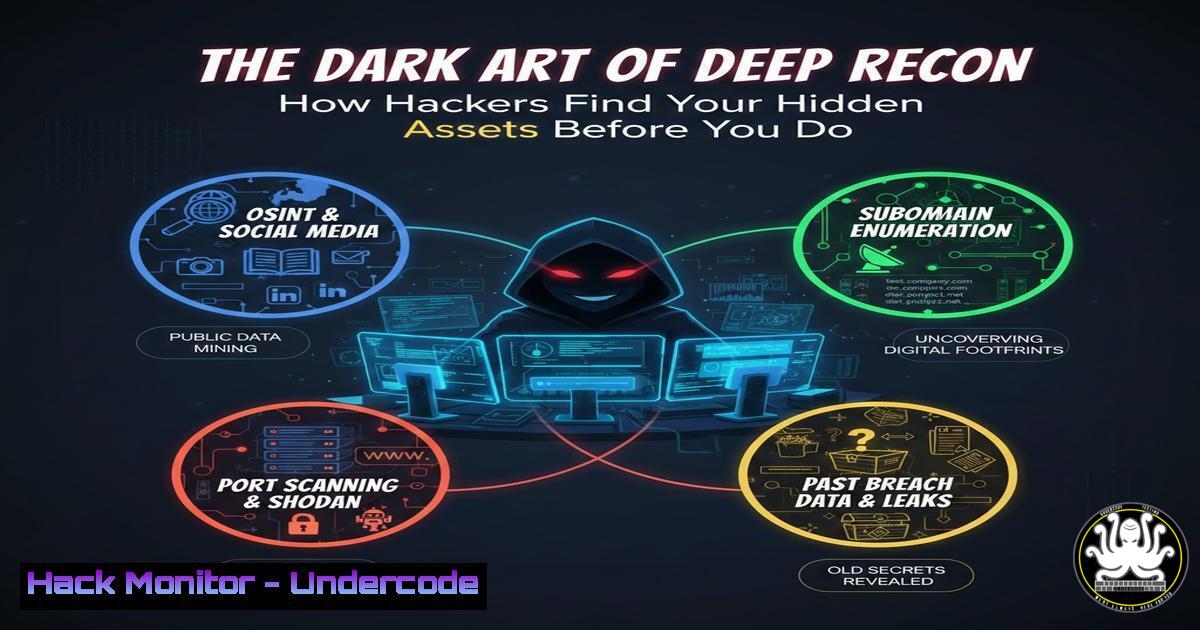
In the shadows of the digital landscape, threat actors operate with a patient, methodological mindset, systematically uncovering the assets organizations forget or never knew they had. This process, known as deep reconnaissance or “deep recon,” forms the critical first phase of a sophisticated cyber attack, focusing on discovering subdomains, forgotten cloud buckets, exposed APIs, and deprecated services. Understanding these techniques is not just for offensive security professionals; it is essential for defenders to illuminate their own attack surface and shatter the illusion of obscurity.
Learning Objectives:
- Understand the core methodologies and tools used for subdomain enumeration and asset discovery.
- Learn practical commands and scripts to perform defensive deep recon on your own infrastructure.
- Identify and secure common hidden assets like cloud storage, forgotten subdomains, and exposed source code repositories.
You Should Know:
1. Subdomain Enumeration: The First Layer of Expansion
Subdomain enumeration is the cornerstone of asset discovery. Attackers use it to expand the target well beyond the main website, finding development, staging, testing, and legacy environments that often have weaker security postures.
Step‑by‑step guide explaining what this does and how to use it.
The goal is to discover all subdomains associated with a root domain (e.g., example.com). Use a combination of tools for best results.
– Using `subfinder` (Passive Enumeration): This tool queries numerous public sources without directly touching the target.
 Install subfinder
go install -v github.com/projectdiscovery/subfinder/v2/cmd/subfinder@latest
 Run against a target domain
subfinder -d example.com -o subdomains.txt
– Using `amass` (Active & Passive): Amass is more comprehensive, capable of passive enumeration and active DNS brute-forcing.
 Install amass
sudo snap install amass
 Passive mode
amass enum -passive -d example.com -o passive_subs.txt
 Active DNS brute-forcing (requires careful use)
amass enum -active -brute -d example.com -src -o active_subs.txt
– Verification with httpx: Filter discovered subdomains to find live web servers.
 Install httpx
go install -v github.com/projectdiscovery/httpx/cmd/httpx@latest
 Check which subdomains are alive
cat subdomains.txt | httpx -silent -o live_subs.txt
2. Mining Certificate Transparency Logs
Certificate Transparency (CT) logs are public ledgers of every SSL/TLS certificate issued. They are a goldmine for finding subdomains, including internal ones mistakenly issued public certificates.
Step‑by‑step guide explaining what this does and how to use it.
CT logs can reveal domains and subdomains at the moment they are registered for HTTPS.
– Using `curl` with `crt.sh` Database: Query the popular crt.sh website.
 Query crt.sh for a domain
curl -s "https://crt.sh/?q=%25.example.com&output=json" | jq -r '.[].name_value' | sed 's/\.//g' | sort -u > ct_subs.txt
– Using a Dedicated Tool like certspotter:
 Install certspotter
 Clone and install from GitHub (check official repo for latest instructions)
 Monitor for new certificates
certspotter -watch example.com
3. DNS Reconnaissance and Zone Walking
Beyond subdomains, DNS records themselves leak information. MX records (email), TXT records (SPF, DKIM, API keys), and even attempts at zone transfers can reveal infrastructure details.
Step‑by‑step guide explaining what this does and how to use it.
– Querying Specific DNS Record Types: Use `dig` to gather intelligence.
 Find mail servers
dig mx example.com +short
 Find SPF/DKIM records (often in TXT)
dig txt example.com +short
 Find name servers
dig ns example.com +short
– Attempting a Zone Transfer (AXFR): A misconfigured DNS server may allow this, dumping all its records.
 Identify nameservers first, then attempt AXFR
nameserver=$(dig ns example.com +short | head -1)
dig axfr example.com @$nameserver
Note: This is a defensive check. If it works, it’s a critical misconfiguration.
4. Discovering Cloud and S3 Buckets
Misconfigured public cloud storage (AWS S3, Google Cloud Storage, Azure Blobs) is a leading cause of data breaches. Attackers use permutation-based wordlists to find buckets named after the target.
Step‑by‑step guide explaining what this does and how to use it.
– Manual Checking for AWS S3: Buckets are accessible via HTTP.
 Try to access a potential bucket
curl -I http://s3.amazonaws.com/[bucket-name]/
curl -I http://[bucket-name].s3.amazonaws.com/
– Using Automated Tools like s3scanner:
 Install s3scanner
pip install s3scanner
 Use a wordlist of common bucket names related to your target
s3scanner --bucket-wordlist my_wordlist.txt --domain example.com
– Key Command for Defenders: Use the AWS CLI to audit your own buckets.
 List all buckets and their public access block configuration
aws s3api list-buckets
aws s3api get-public-access-block --bucket-name [my-bucket]
5. Finding Exposed Source Code and APIs
Developers sometimes leave source code in public repositories (GitHub, GitLab) containing secrets, or expose internal API endpoints.
Step‑by‑step guide explaining what this does and how to use it.
– GitHub Dorking: Use advanced search operators on GitHub.
Search: "example.com" password filename:.env
Search: "api_key" AND "example.com"
Search: org:ExampleCompany filename:config.json
– Identifying API Endpoints: From your live subdomains (live_subs.txt), probe for common API paths.
 Use httpx or ffuf to fuzz for endpoints
cat live_subs.txt | httpx -path "/api/v1/users" -status-code -mc 200
 More advanced fuzzing with ffuf
ffuf -u https://FUZZ.example.com/api/FUZZZ -w subdomain_wordlist.txt:FUZZ -w api_endpoints.txt:FUZZZ -fs 42
6. Automating the Recon Workflow
Threat actors automate everything. Building a reconnaissance pipeline is essential for both red and blue teams.
Step‑by‑step guide explaining what this does and how to use it.
A simple bash script can chain tools together.
!/bin/bash
DOMAIN=$1
echo "[] Starting deep recon for: $DOMAIN"

<ol>
<li>Subdomain Enumeration
echo "[] Running subfinder..."
subfinder -d $DOMAIN -o subfinder_$DOMAIN.txt
echo "[] Running amass (passive)..."
amass enum -passive -d $DOMAIN -o amass_$DOMAIN.txt</p></li>
<li><p>Combine and sort results
cat subfinder_$DOMAIN.txt amass_$DOMAIN.txt | sort -u > all_subs_$DOMAIN.txt
echo "[+] Found $(wc -l < all_subs_$DOMAIN.txt) unique subdomains."</p></li>
<li><p>Probe for live hosts
echo "[] Probing live hosts with httpx..."
httpx -l all_subs_$DOMAIN.txt -silent -o live_$DOMAIN.txt
echo "[+] Found $(wc -l < live_$DOMAIN.txt) live hosts."</p></li>
<li><p>Screenshot live hosts for quick review (using eyewitness or aquatone)
echo "[] Taking screenshots..."
aquatone -input-file live_$DOMAIN.txt -out screenshot_$DOMAIN</p></li>
</ol>

<p>echo "[!] Reconnaissance pipeline complete. Review live_$DOMAIN.txt."
Save as recon.sh, make executable (chmod +x recon.sh), and run: ./recon.sh example.com.
What Undercode Say:
- Obscurity is Not Security: A hidden asset is not a secure asset. The threat actor’s methodology proves that anything not actively inventoried and monitored will be found, given enough time and motive.
- Defense Through Offensive Insight: The most effective way to shrink your attack surface is to think like an attacker. Regularly running controlled, authorized deep recon against your own organization is no longer optional; it’s a critical component of modern cyber hygiene.
Prediction:
The future of deep reconnaissance lies in the integration of artificial intelligence and continuous data aggregation. AI will not only automate discovery but also intelligently predict an organization’s asset landscape based on patterns, employee data, and technology stacks. Defensively, this will lead to the rise of Attack Surface Management (ASM) platforms as a core security control, operating in real-time to provide a dynamic, attacker-view map of assets. The gap between what an organization thinks it has exposed and what is actually discoverable will narrow, forcing a paradigm shift from perimeter-based security to relentless asset visibility and governance. The organizations that automate their defensive recon will be the ones staying ahead of the silent enumeration already happening against them.
🎯Let’s Practice For Free:
IT/Security Reporter URL:
Reported By: Abhirup Konwar – Hackers Feeds
Extra Hub: Undercode MoN
Basic Verification: Pass ✅


