Listen to this Post
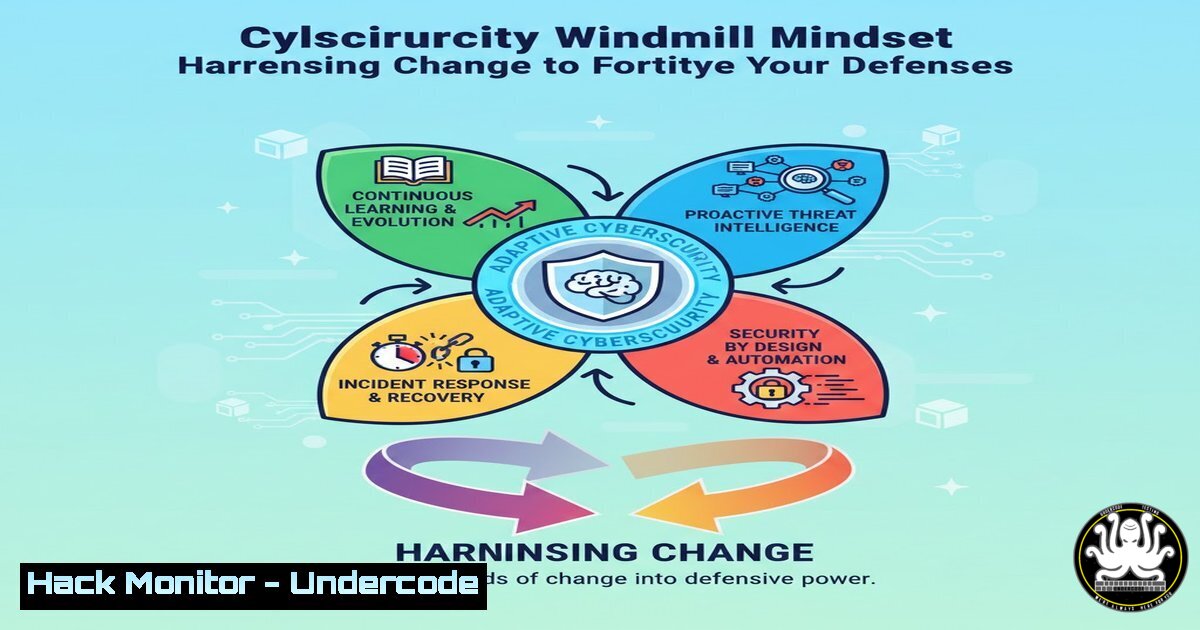
Introduction:
In the relentless landscape of cybersecurity, change is the only constant. New vulnerabilities emerge daily, threat actors evolve their tactics, and technological paradigms shift overnight. The choice presented isn’t whether change will happen, but how organizations respond—by building walls of outdated, static defense or constructing agile “windmills” that transform these challenges into strategic momentum for stronger security.
Learning Objectives:
- Understand the critical shift from reactive, perimeter-based security to proactive, adaptive security postures.
- Learn practical, actionable steps for implementing a “windmill” mindset through continuous learning, automation, and incident response hardening.
- Master key technical commands and configurations for Linux and Windows that enable rapid adaptation and system hardening.
You Should Know:
1. From Static Firewalls to Dynamic Threat Intelligence
The old “wall” mentality relied solely on fortress-like firewalls and signature-based antivirus. The modern “windmill” approach integrates dynamic threat intelligence feeds to anticipate attacks. This means not just blocking known bad IPs, but understanding emerging campaigns and adapting rules in real-time.
Step-by-step guide:
Concept: Integrate a Threat Intelligence Platform (TIP) or open-source feeds with your Security Information and Event Management (SIEM) or firewall.
Action (Linux): Use `curl` to pull a blocklist from a reputable open-source intelligence (OSINT) feed and update your local firewall. For example, to fetch and implement a list of known malicious IPs into iptables:
 Fetch the list
curl -s https://feodotracker.abuse.ch/downloads/ipblocklist_recommended.txt > bad_ips.txt
 Create iptables rules for each IP (run with caution, may create many rules)
for ip in $(grep -o '[0-9]{1,3}.[0-9]{1,3}.[0-9]{1,3}.[0-9]{1,3}' bad_ips.txt); do
sudo iptables -A INPUT -s $ip -j DROP
done
 Save the rules persistently (depends on distribution)
sudo iptables-save > /etc/iptables/rules.v4
Action (Windows): Utilize PowerShell to achieve a similar outcome with the Windows Defender Firewall:
 Fetch a list of malicious IPs
$badIPs = Invoke-RestMethod -Uri "https://feodotracker.abuse.ch/downloads/ipblocklist_recommended.txt"
 Add a firewall rule blocking each IP (Admin PowerShell required)
$badIPs | Select-String -Pattern '\d+.\d+.\d+.\d+' -AllMatches | ForEach-Object { $<em>.Matches } | ForEach-Object {
New-NetFirewallRule -DisplayName "Block Threat Intel IP: $($</em>.Value)" -Direction Inbound -RemoteAddress $_.Value -Action Block
}
2. Embracing Automation for Continuous Compliance & Hardening
Manual security checks are a “wall.” Automated, continuous configuration enforcement is a “windmill.” Use infrastructure as code (IaC) and configuration management tools to ensure systems are always in a hardened, known-good state.
Step-by-step guide:
Concept: Use Ansible (agentless) to enforce baseline security configurations across Linux and Windows servers.
Action (Ansible Playbook – Linux Hardening Snippet): Create a playbook security_harden.yml.
<ul>
<li>hosts: all_linux_servers
become: yes
tasks:</li>
<li>name: Ensure SSH Protocol is set to 2
lineinfile:
path: /etc/ssh/sshd_config
regexp: '^Protocol'
line: 'Protocol 2'
notify: restart sshd</p></li>
<li><p>name: Disable root login via SSH
lineinfile:
path: /etc/ssh/sshd_config
regexp: '^PermitRootLogin'
line: 'PermitRootLogin no'
notify: restart sshd</p></li>
<li><p>name: Install and enable fail2ban
apt:
name: fail2ban
state: present
when: ansible_os_family == 'Debian'
Run with: `ansible-playbook -i inventory.ini security_harden.yml`
3. Adaptive Incident Response with Immutable Logging
When breached, reacting in panic builds walls. Having a pre-engineered, immutable logging system turns incident data into momentum for rapid containment and forensic analysis.
Step-by-step guide:
Concept: Configure remote syslog logging to a secured, central server where logs cannot be altered by an attacker on the compromised host.
Action (Linux – Rsyslog): On the client server, configure forwarding to a central log server (e.g., logserver.corp.local).
 Edit /etc/rsyslog.conf
sudo nano /etc/rsyslog.conf
 Add the line (using TCP for reliability):
. @@logserver.corp.local:514
 Restart the service
sudo systemctl restart rsyslog
Action (Windows – WinRM for Central Collection): Use PowerShell to configure Windows Event Forwarding.
 On the source Windows machine, configure the WinRM listener
winrm quickconfig -quiet
 Create a subscription on the central collector (Group Policy is preferred for scale)
Ensure collector logs are stored with append-only permissions to prevent tampering.
4. Shifting from Password Walls to Identity Windmills
Static passwords are brittle walls. Adaptive, context-aware identity and access management (IAM) acts as a windmill, using multi-factor authentication (MFA) and conditional access to secure access.
Step-by-step guide:
Concept: Implement SSH key-based authentication with forced commands for jump hosts instead of passwords.
Action (Linux SSH Key Restriction): In the `~/.ssh/authorized_keys` file on the target server, prepend a public key entry with a command restriction to limit access.
command="/usr/bin/sftp-server",no-agent-forwarding,no-port-forwarding,no-pty,no-user-rc,no-X11-forwarding ssh-rsa AAAAB3NzaC1yc2E... user@jumpbox
This key can now only be used for SFTP, not for a full shell session.
5. Transforming Cloud Configuration Drift into Security Policy
Letting cloud environments (AWS, Azure, GCP) drift from a secure baseline is building a wall of ignorance. Continuously scanning Infrastructure as Code (IaC) templates and runtime configurations generates the momentum of assured compliance.
Step-by-step guide:
Concept: Use Open Policy Agent (OPA) with its cloud-native rego language to define and enforce security policies.
Action (OPA Rego Policy for AWS S3): Create a policy `s3_encryption.rego` to deny creation of unencrypted S3 buckets.
package s3.encryption

default allow = false

deny[bash] {
input.resource_type == "aws_s3_bucket"
not input.document.server_side_encryption_configuration
msg := "S3 buckets must have server-side encryption enabled."
}
Integrate this policy into your CI/CD pipeline using `conftest` or directly with Terraform to evaluate plans before deployment.
What Undercode Say:
- Mindset is the Ultimate Security Control: The most sophisticated tools fail if the operational culture is rigid and resistant to adaptation. Proactive learning and experimentation must be baked into the security team’s DNA.
- Automation is the Engine of the Windmill: Manual processes cannot scale or keep pace with threats. Security windmills are built on code—automated playbooks, immutable infrastructure, and policy-as-code—that turns the constant wind of change into consistent, reliable action.
Analysis: The philosophical post highlights a non-technical truth that is technically critical. In cybersecurity, comfort is vulnerability. The “wall” mindset leads to checklist security, where compliance is mistaken for safety, creating a brittle environment prone to catastrophic failure. The “windmill” mindset aligns with frameworks like Zero Trust—never assuming safety, always verifying, and using context to adapt. It turns incidents into lessons via blameless post-mortems, and threats into intelligence via shared indicators. The future belongs to organizations whose security teams are funded and empowered not just to defend, but to continuously evolve, build, and harness the very forces arrayed against them.
Prediction:
The organizations that succeed in the next five years will be those that institutionalize the windmill mindset. This will manifest as the death of the “set-and-forget” security policy and the rise of AI-driven, autonomous security operations centers (SOCs) that dynamically adapt attack surfaces, isolate compromised segments in milliseconds, and generate predictive patches. The hackers’ advantage of agility will be systematically eroded by defensive systems that learn and evolve faster than human-led teams ever could, fundamentally changing the cyber conflict from a game of stealth to a battle of adaptive algorithms.
▶️ Related Video (88% Match):
🎯Let’s Practice For Free:
IT/Security Reporter URL:
Reported By: Sarfarajalamofficial Change – Hackers Feeds
Extra Hub: Undercode MoN
Basic Verification: Pass ✅


