Listen to this Post
Introduction:
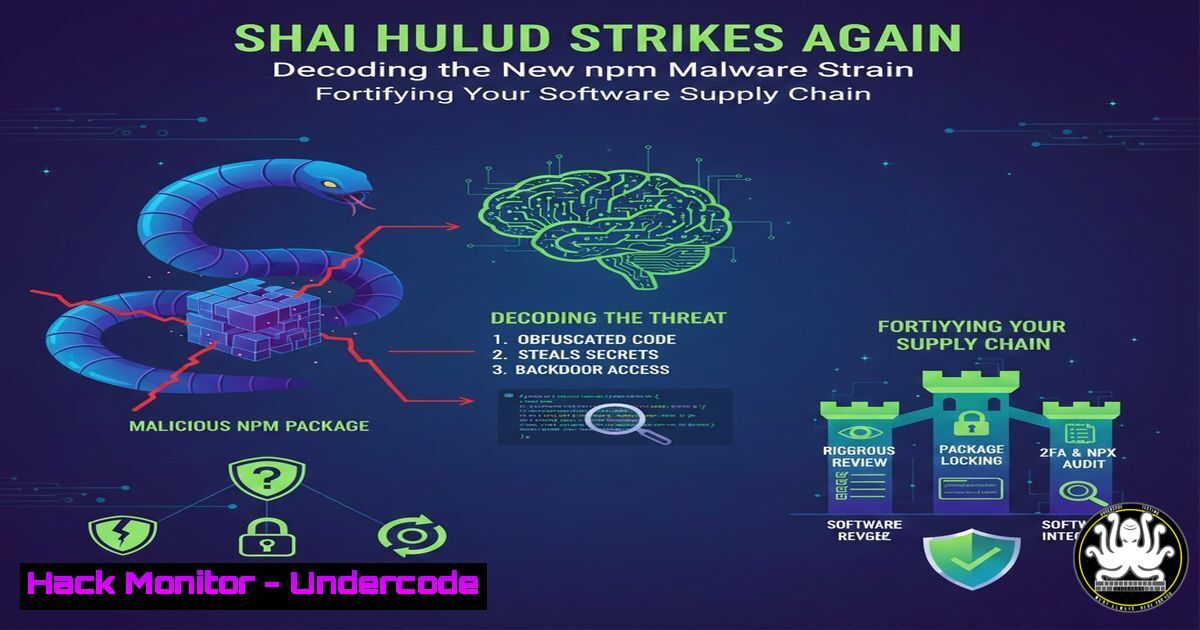
A new, stealthier variant of the infamous “Shai Hulud” malware has been discovered lurking in the npm registry, signaling an evolution in software supply chain attacks. This sophisticated threat, linked to the same actors behind previous campaigns, demonstrates a dangerous shift towards more covert, persistent, and damaging infiltration methods. This article dissects the technical nuances of this new strain and provides a comprehensive defensive playbook for security teams.
Learning Objectives:
- Understand the technical evolution and key characteristics of the new Shai Hulud malware strain.
- Learn actionable steps to detect, analyze, and mitigate supply chain threats in npm and other ecosystems.
- Implement proactive security controls and hardening measures for development environments and CI/CD pipelines.
You Should Know:
- The Anatomy of a Stealthier Predator: Inside Shai Hulud’s New Code
The latest Shai Hulud iteration represents a significant tactical shift. Unlike its predecessors, which often contained obvious “deadman switches” or noisy obfuscation, this variant is engineered for quiet persistence. Early analysis by Aikido Security researchers indicates modifications focused on avoiding heuristic detection, establishing long-term footholds, and executing more targeted payloads. The malware’s codebase shows signs of professional development, suggesting a threat actor investing in the long-term viability of their attack infrastructure.
Step‑by‑step guide explaining what this does and how to use it.
To analyze a suspicious npm package for similar traits, you can perform a preliminary manual inspection.
Step 1: Fetch the Package. Use npm’s pack command to download the tarball for local inspection.
npm pack <suspicious-package-name>
tar -xzf <package-name-.tgz>
Step 2: Examine Key Files. Look for obfuscated code, unusual scripts, or dependencies in package.json.
cat package/package.json | jq '.scripts, .dependencies, .devDependencies'
Step 3: Search for Obfuscation & Strings. Use `grep` to find encoded strings, large minified files, or calls to suspicious domains.
grep -r "base64|eval|atob|http[bash]://" package/ --include=".js"
This initial triage helps identify packages that warrant deeper, sandboxed analysis.
2. Immediate Response: Detecting and Containing Compromise
Speed is critical upon discovery of a malicious package. The goal is to determine exposure and prevent further execution in your environment.
Step‑by‑step guide explaining what this does and how to use it.
Step 1: Inventory and Lockdown. Immediately list all projects and environments where the compromised package version is installed. Use your dependency management tools to enforce a lock.
 Find installations across systems (example for Linux)
find /path/to/projects -name "package-lock.json" -o -name "yarn.lock" | xargs grep -l "malicious-package:1.2.3"

Use npm to force-clean the specific package from cache globally
npm cache clean --force
npm uninstall -g malicious-package
Step 2: Analyze Node Modules. Examine the installed `node_modules` directory for the package. Malware often downloads secondary payloads post-install.
 Inspect the installed module's actual files
ls -la node_modules/malicious-package/
 Check for recently created or modified files that shouldn't be there
find node_modules/malicious-package/ -type f -mtime -1
Step 3: Review CI/CD Logs. Scans your build and deployment logs (e.g., GitHub Actions, Jenkins) for any successful execution of scripts from the malicious package. Look for network calls to unknown domains or unexpected file system writes.
3. Hardening the npm Ecosystem: Proactive Configuration
Prevention is more effective than response. Harden your npm and Node.js environment to reduce the attack surface.
Step‑by‑step guide explaining what this does and how to use it.
Step 1: Enforce Integrity with package-lock.json. Never run `npm install` without a lockfile. Configure npm to fail on lockfile mismatches.
 Ensure you are using a lockfile
npm config set package-lock true
 Use `npm ci` for clean installs in CI, which is stricter than `npm install`
npm ci
Step 2: Implement `.npmrc` Security Policies. Use a project or global `.npmrc` file to enforce security settings.
 Example .npmrc security settings
audit=true
fund=false
package-lock=true
engine-strict=true
 Registry scoping - consider using a private, vetted registry for critical dependencies
registry=https://registry.npmjs.org/
Step 3: Utilize npm Audit and Automation. Integrate `npm audit` and its `–audit-level` flag into your CI pipeline to block builds with critical vulnerabilities.
 Scan and fail the build if critical vulnerabilities are found
npm audit --audit-level=critical
- Beyond Basic Scanning: Implementing Advanced Supply Chain Security
Traditional vulnerability scanners are necessary but insufficient against sophisticated typosquatting, dependency confusion, and live malware. You need contextual, behavior-based analysis.
Step‑by‑step guide explaining what this does and how to use it.
Step 1: Integrate Specialized SCA Tools. Platforms like Aikido (mentioned in the source) or Vulnetix provide deduplication, autotriage, and context-aware filtering that drastically reduce alert fatigue. They can scan for dependency risks, malicious package behavior, and infrastructure-as-code misconfigurations in one place.
Step 2: Enforce Package Allow Lists (Curated Registries). For production environments, move from block lists to allow lists. Use tools like Artifactory or Azure Artifacts to create private, curated registries. Publish vetted packages internally.
 Configure npm to use your private registry
npm config set registry https://your-company.jfrog.io/artifactory/api/npm/npm-virtual/
Step 3: Adopt Behavioral Analysis in CI. Integrate tools that perform dynamic analysis, such as sandboxed execution of installation scripts in an isolated environment to monitor for suspicious network or file system activity before allowing the package into your main codebase.
5. Organizational Defense: Building a Resilient DevSecOps Culture
Technology alone cannot secure the supply chain. Processes and people are your final layer of defense.
Step‑by‑step guide explaining what this does and how to use it.
Step 1: Establish Clear Ownership and Policies. Define who is responsible for open-source software (OSS) governance. Create policies for package approval, update frequency, and mandatory security controls. Use a platform like Vulnetix to apply business-context prioritization across all your security tools.
Step 2: Mandate Security Training for Developers. Conduct regular training on OSS risks, secure coding, and how to identify social engineering in repositories (e.g., fake packages, malicious pull requests). The post by Aikido Security is an example of a timely threat intelligence briefing that should be shared with development teams.
Step 3: Simulate Supply Chain Attacks. Regularly run red team exercises that simulate attacks like dependency confusion or typosquatting against your own development pipelines to test detection and response capabilities.
What Undercode Say:
- The Threat Actor is Evolving, Not Leaving. The discovery of this modified strain confirms the attacker is actively refining their tools and techniques, making them more dangerous and harder to detect. This is a persistent campaign, not a one-off event.
- The Line Between Noise and Signal is the Battlefield. The security community’s debate on the post about the malware’s characteristics highlights a critical challenge: filtering true threats from false positives. This is exactly the problem platforms like Aikido and Vulnetix aim to solve with autotriage and contextual analysis, moving security from overwhelming noise to actionable intelligence.
Prediction:
The Shai Hulud campaign foreshadows a future where software supply chain attacks become more normalized, persistent, and economically motivated. We will likely see a rise in “sleeper” packages—malware designed to lie dormant until triggered by a specific event or date, or until it reaches a specific install base. Defensively, this will accelerate the adoption of AI-powered security platforms that unify SAST, SCA, and CSPM with behavioral analysis, as well as a major shift towards developer-first security tools integrated directly into IDEs and CI/CD pipelines. The industry will move towards zero-trust principles for dependencies, mandating digital signatures, reproducible builds, and curated internal registries as standard practice.
▶️ Related Video (76% Match):
🎯Let’s Practice For Free:
IT/Security Reporter URL:
Reported By: Charlie Eriksen – Hackers Feeds
Extra Hub: Undercode MoN
Basic Verification: Pass ✅


