Listen to this Post
Introduction:
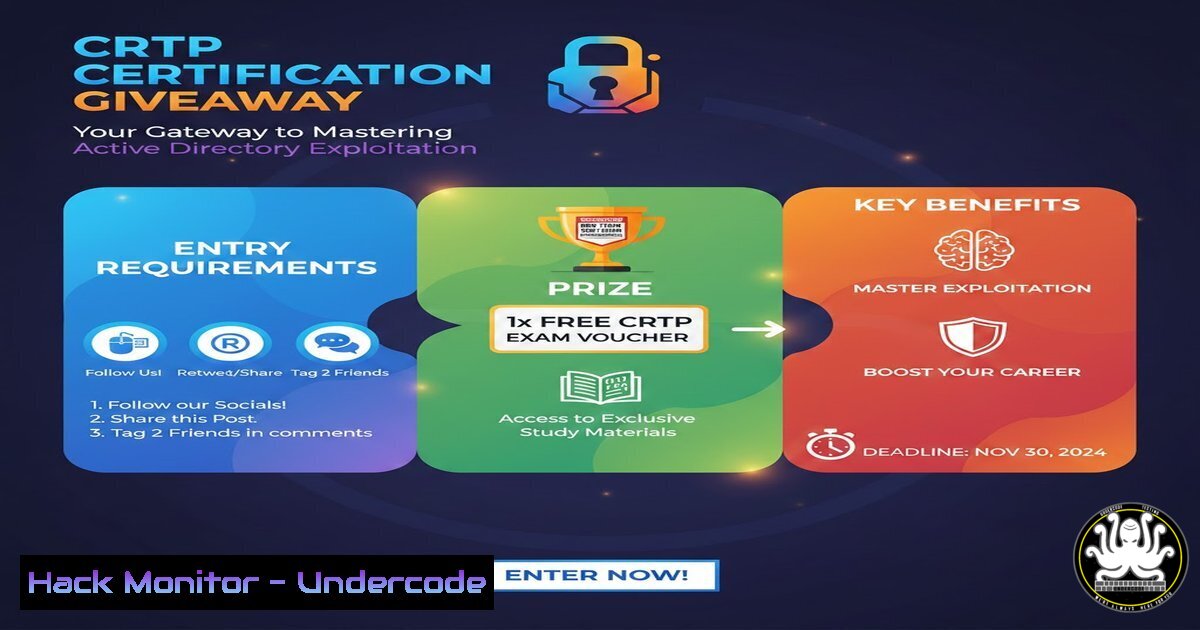
The Certified Red Team Professional (CRTP) certification, offered by Altered Security, represents a critical milestone for offensive security practitioners focusing on Windows enterprise environments. This hands-on credential delves deep into real-world Active Directory (AD) exploitation techniques, moving beyond theoretical concepts to provide practical, lab-based experience. The recent giveaway initiative by a seasoned professional highlights the high value placed on these skills within the cybersecurity community.
Learning Objectives:
- Understand and perform common Active Directory enumeration and privilege escalation attacks.
- Execute credential harvesting techniques, including Kerberoasting and Silver Ticket attacks.
- Develop methodologies for lateral movement and cross-trust attacks within a complex AD forest.
You Should Know:
- Active Directory Enumeration: The First Step to Dominion
Active Directory enumeration is the foundational phase of any red team engagement, involving the systematic gathering of information about the domain structure, users, groups, and computers. This reconnaissance is crucial for identifying potential attack paths. Using built-in Windows tools and PowerShell, an attacker can map the entire attack surface.
Step-by-step guide explaining what this does and how to use it.
Step 1: Initial Footing. Gain an initial foothold on a domain-joined Windows machine, even with low-privilege user credentials.
Step 2: Basic Domain Information. Use the `net` command to get basic domain information.
`C:\> net group “Domain Computers” /domain`
Step 3: PowerView for Advanced Enumeration. Utilize PowerView, a PowerShell script part of the PowerSploit framework, for in-depth enumeration. First, import the module.
`PS C:\> Import-Module .\PowerView.ps1`
Step 4: Enumerate Domain Users and Groups.
`PS C:\> Get-NetUser | select samaccountname, description, memberof`
`PS C:\> Get-NetGroup -GroupName “Domain Admins”`
Step 5: Find Shares and SPNs. Hunt for network shares and Service Principal Names (SPNs) which can be leveraged for later attacks.
`PS C:\> Find-DomainShare -CheckShareAccess`
`PS C:\> Get-NetUser -SPN`
2. Kerberoasting: Cracking Service Account Passwords
Kerberoasting is a popular technique for attacking service accounts in Active Directory. It involves requesting Kerberos service tickets (TGS) for accounts with registered SPNs and then attempting to crack the encrypted portion of the ticket offline to reveal the account’s password. This is effective because service account passwords are often not changed frequently and may be weak.
Step-by-step guide explaining what this does and how to use it.
Step 1: Request Service Tickets. Use a tool like `Rubeus` on Windows or `Impacket’s GetUserSPNs.py` on Linux to request TGS tickets for all accounts with SPNs.
On Windows:
`C:\> Rubeus.exe kerberoast /stats`
On Linux:
` python3 GetUserSPNs.py -dc-ip domain.local/user -request`
Step 2: Extract the Hash. The tool will output the ticket in a format like $krb5tgs$23$..., which is a crackable hash.
Step 3: Crack the Hash Offline. Use a password cracking tool like `hashcat` to crack the hash.
` hashcat -m 13100 -a 0 kerberoast_hashes.txt /usr/share/wordlists/rockyou.txt`
3. Abusing Kerberos Delegation for Privilege Escalation
Kerberos delegation allows a service to impersonate a user to other services. Unconstrained delegation is a significant security risk, as it permits a service to forward a user’s Ticket-Granting Ticket (TGT) to itself, which can then be reused by an attacker to impersonate that user anywhere on the network.
Step-by-step guide explaining what this does and how to use it.
Step 1: Find Computers with Unconstrained Delegation. Using PowerView, identify systems where this dangerous setting is enabled.
`PS C:\> Get-NetComputer -Unconstrained`
Step 2: Monitor for Authentication. If you have compromised such a computer, you can use a tool like `Rubeus` to monitor for and extract TGTs of users authenticating to it.
`C:\> Rubeus.exe monitor /interval:5 /filteruser:DOMAIN_ADMIN_USER`
Step 3: Reuse the TGT. Once a TGT is captured, it can be imported into your current session using Rubeus‘s `ptt` (Pass-The-Ticket) function, granting you the privileges of the captured user.
`C:\> Rubeus.exe ptt /ticket:`
4. Lateral Movement via Pass-The-Hash and Session Hijacking
Lateral movement is the process of pivoting from one compromised system to another within the network. Pass-The-Hash (PtH) is a classic technique that allows an attacker to authenticate to a remote system using a user’s NTLM hash instead of the plaintext password.
Step-by-step guide explaining what this does and how to use it.
Step 1: Dump Hashes. First, obtain the NTLM password hashes from the compromised machine. This can be done with tools like `Mimikatz` or SecretsDump.py.
`C:\> mimikatz sekurlsa::logonpasswords`
Step 2: Pass The Hash. Use the captured hash to authenticate to another machine. With `Impacket` on Linux, you can get a shell.
` python3 psexec.py -hashes domain/user@TARGET_IP`
Step 3: Windows Native Command. On Windows, you can use the built-in `runas` command with the `/netonly` flag in combination with PtH tools.
5. Cross-Trust Attacks: Pivoting Between Domains
In multi-domain AD forests, trust relationships exist between domains. An attacker in a less-secure child domain or trust relationship can often pivot into a more secure parent or sibling domain by exploiting these trusts, a key topic in the CRTP curriculum.
Step-by-step guide explaining what this does and how to use it.
Step 1: Enumerate Trusts. Discover the trust relationships from your current domain context.
`PS C:\> Get-NetDomainTrust`
Step 2: Hunt for Users in the Parent Domain. Look for users in the trusted domain who are members of high-privilege groups in your current domain (e.g., “Enterprise Admins” in the root domain).
`PS C:\> Get-NetGroupMember -Domain “parent.domain.local” -GroupName “Enterprise Admins”`
Step 3: Perform a Trust Attack. Techniques like “SID History” exploitation or “Golden Ticket” attacks that include the SID of the trusted domain’s enterprise admin group can be used to gain access across the trust boundary. A Golden Ticket attack requires the KRBTGT account’s hash from the domain.
`C:\> mimikatz kerberos::golden /user:fakeuser /domain:child.domain.local /sid:
6. API Security and Cloud Hardening in a Hybrid AD Environment
Modern enterprises often integrate on-premise Active Directory with cloud services like Azure AD. Misconfigurations in this hybrid setup, especially related to application APIs and security tokens, can create new attack vectors for red teams.
Step-by-step guide explaining what this does and how to use it.
Step 1: Enumerate Azure AD Connect. The Azure AD Connect server synchronizes on-prem AD with the cloud. Compromising this server can lead to cloud tenant takeover. Check for the ADSync configuration database.
Step 2: Exploit Weak Service Principal Configurations. In Azure AD, Service Principals (enterprise applications) can have credentials like passwords or certificates. Use Azure PowerShell modules to enumerate these and check for weak credentials.
`PS C:\> Get-AzureADServicePrincipal -All $true | Where-Object { $_.KeyCredentials -ne $null }`
Step 3: Mitigation via Hardening. Defenders should enforce Conditional Access Policies, require Multi-Factor Authentication (MFA) for all administrative accounts, regularly audit and remove unnecessary application permissions, and protect the Azure AD Connect server as a Tier-0 asset.
What Undercode Say:
- The CRTP certification’s practical, lab-driven approach is invaluable, transforming theoretical knowledge of AD vulnerabilities into actionable offensive skills.
- Giveaways and community challenges, like the one described, lower the barrier to entry for high-quality security training, fostering a more skilled defensive and offensive community.
The initiative to create a dedicated challenge platform for the giveaway is a masterstroke in community engagement. It not only promotes the certification but also acts as a filtering mechanism, ensuring that participants are genuinely interested and possess basic problem-solving skills relevant to security. This model of “learn by doing, win by proving” is far more effective than simple raffles. The focus on core AD attack vectors in the challenges directly mirrors the CRTP syllabus, providing a perfect primer for the intensive lab work ahead. For organizations, the proliferation of such skills in the workforce is a double-edged sword; it empowers red teams but also means that attackers have access to a larger pool of formally trained individuals. The emphasis on cross-trust attacks and hybrid environment exploitation in the CRTP is particularly prescient, as these are the complex, real-world scenarios that modern defenders must be prepared to face.
Prediction:
The normalization of hands-on, AD-focused offensive training, as exemplified by the CRTP and its promotion through community giveaways, will lead to a significant rise in the sophistication of internal network attacks. In the next 3-5 years, we predict that attack methodologies once considered “advanced” will become commonplace in penetration testing reports and criminal breaches. This will force a paradigm shift in defensive strategies, moving away from perimeter-based security and towards a Zero-Trust model, where granular access control, robust credential hygiene (e.g., LAPS), and pervasive monitoring of authentication events become non-negotiable standards for any enterprise relying on Active Directory.
🎯Let’s Practice For Free:
IT/Security Reporter URL:
Reported By: Florian Sch%C3%BCssler – Hackers Feeds
Extra Hub: Undercode MoN
Basic Verification: Pass ✅


