Listen to this Post
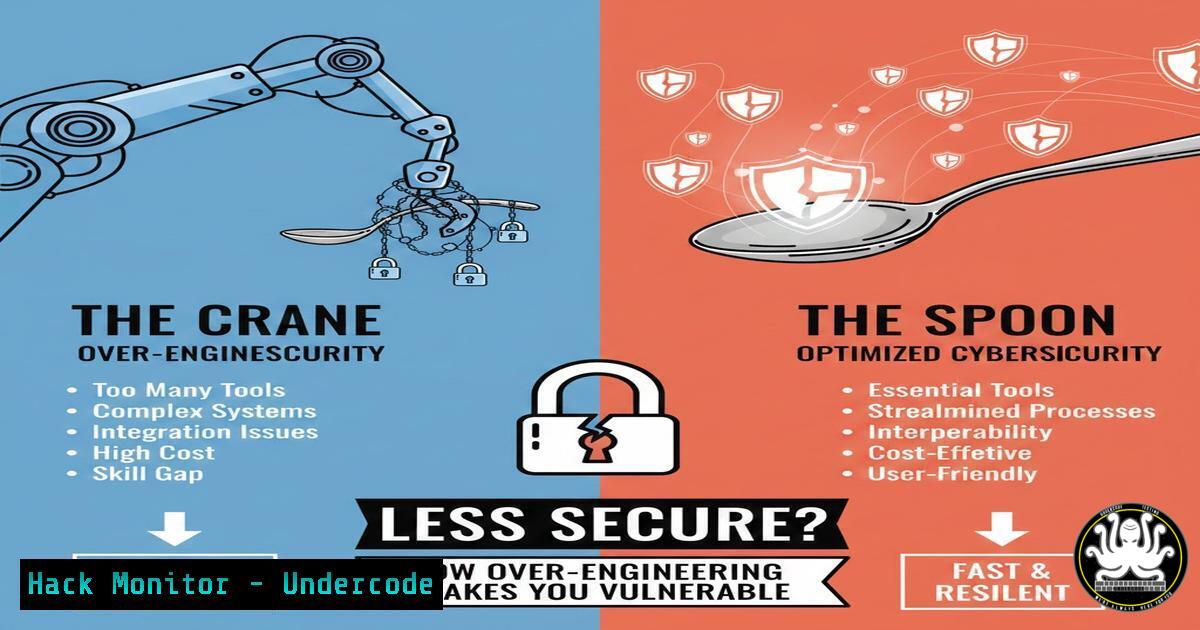
Introduction:
In cybersecurity, the allure of complex, “state-of-the-art” solutions often overshadows the elegant simplicity of robust, foundational controls. This tendency to build metaphorical “cranes” for “spoon-sized” problems introduces unnecessary attack surfaces, configuration errors, and operational fragility, ultimately weakening an organization’s security posture. This article deconstructs this critical engineering failure mode and provides actionable guidance for implementing effective, proportional security.
Learning Objectives:
- Identify common patterns of security over-engineering in access management, monitoring, and tooling.
- Apply the principle of proportional complexity to assess and justify security controls.
- Implement simple, auditable, and effective security commands and configurations as robust alternatives to over-engineered systems.
You Should Know:
- The Zero-Trust Crane for a Simple Password Reset
The post critiques architecting a zero-trust system for a basic password reset. Over-engineering here means integrating biometrics, continuous authentication, and complex policy engines where a secure, time-tested method suffices.
Step‑by‑step guide:
The “spoon” is a secure, auditable password reset flow. Avoid building a custom pipeline; use your existing Identity Provider (IdP). For internal tools, a simple script with logging can be sufficient.
Linux Command to Generate a Secure, One-Time Reset Token (Example):
 Generate a secure, URL-safe token and log the event
TOKEN=$(openssl rand -base64 32 | tr '+/' '-_')
echo "$(date -u) - Reset token generated for user: $USER_EMAIL - Token Hash: $(echo -n $TOKEN | sha256sum)" >> /var/log/secure_reset.log
 Send token via secure channel (e.g., integrated with AWS SES/SNS)
Windows PowerShell Equivalent:
 Generate a secure token
$Token = -join ((33..126) | Get-Random -Count 32 | % {[bash]$_})
$LogEntry = "$(Get-Date -Format o) - Reset token for: $UserEmail - Token Hash: $((Get-FileHash -InputStream ([IO.MemoryStream]::new([Text.Encoding]::ASCII.GetBytes($Token)))).Hash)"
Add-Content -Path "C:\Logs\secure_reset.log" -Value $LogEntry
This provides a verifiable, simple solution without the overhead of a custom biometric verification microservice.
- The ML-Powered Semantic Search Crane for Log Analysis
Deploying machine learning for log search when simple pattern matching (keyword/grep) solves 95% of analyst queries is a classic crane. It adds model training, data pipelines, and false positives.
Step‑by‑step guide:
Master structured logging and efficient querying first. Use tools like grep, jq, and `awk` for rapid, predictable analysis.
Linux Commands for Effective Log Triage:
 1. Find failed SSH attempts from a specific IP in auth.log
grep "Failed password" /var/log/auth.log | grep "from 192.168.1.100"

<ol>
<li>Parse JSON-formatted application logs for 'ERROR' and extract specific fields
tail -f /var/log/app.log | grep "ERROR" | jq '{time: .timestamp, message: .event, user: .user_id}'</p></li>
<li><p>Real-time monitoring for a specific critical event
tail -f /var/log/nginx/access.log | grep -E "(POST|PUT) /admin"
Building competency with these simple tools ensures analysts can work quickly and reliably before considering more complex ML-based solutions.
- The Orchestrated Data Pipeline Crane for a Simple Data Export
Building a full transformation/validation/notification pipeline for a user export feature is overkill. It increases the codebase, potential for data leakage bugs, and maintenance burden.
Step‑by‑step guide:
Implement a secure, direct database query or use existing reporting tools with role-based access control (RBAC).
Example Secure Export via Pre-defined SQL View & RBAC:
-- 1. Create a database view with built-in data filtering (e.g., for user 'analyst1')
CREATE VIEW vw_export_data AS
SELECT order_id, amount, date FROM transactions WHERE department = CURRENT_USER_DEPARTMENT;

-- 2. Grant execute permission on a stored procedure to generate the export
GRANT EXECUTE ON PROCEDURE sp_generate_export TO 'analyst_role';
Linux Command to Securely Export Results to CSV:
 Connect to DB and run the pre-authorized view, outputting to a timestamped file
mysql -u $READ_ONLY_USER -p$SECURE_PASSWORD -D mydb -e "SELECT  FROM vw_export_data;" | sed 's/\t/,/g' > /secure_share/export_$(date +%Y%m%d_%H%M%S).csv
 Set restrictive permissions
chmod 600 /secure_share/export_.csv
This approach is auditable, secure, and leverages existing database security controls.
- The “Conference-Worthy” Architecture Crane for Basic Access Control
Implementing a labyrinthine microservice architecture for API access control when a well-configured API Gateway and a verified OpenID Connect (OIDC) integration would suffice.
Step‑by‑step guide:
Harden your API Gateway (e.g., AWS API Gateway, NGINX) with simple, strong policies.
NGINX Configuration Snippet for JWT Validation (The Spoon):
location /api/secure/ {
 Validate JWT from your existing IdP (e.g., Auth0, Keycloak)
auth_jwt "Restricted API";
auth_jwt_key_request /_jwks_uri;

proxy_pass http://backend_service;
 Rate limiting
limit_req zone=api_limit burst=10 nodelay;
}
AWS API Gateway Policy Snippet (CloudFormation YAML):
ApiGatewayMethod:
Type: AWS::ApiGateway::Method
Properties:
AuthorizationType: JWT
AuthorizerId: !Ref MyCognitoAuthorizer
ApiKeyRequired: true  Simple, effective additional control
This provides enterprise-grade security without building and maintaining a custom zero-trust proxy network.
- The Automated Incident Response Crane That Misses the Basics
Developing complex SOAR playbooks that automate niche response actions while failing to implement comprehensive, centralized logging and basic endpoint detection and response (EDR).
Step‑by‑step guide:
First, ensure universal logging and basic host hardening. These foundational steps stop most attacks.
Linux Commands for Foundational Security Checks:
 1. Ensure auditd is running and capturing critical events (The Real Spoon)
sudo systemctl status auditd
sudo auditctl -l | grep -E "(sudo|sshd|user-modify)"

<ol>
<li>Check for unnecessary open ports (simpler than full network modeling)
sudo ss -tulpn | grep LISTEN</p></li>
<li><p>Verify file integrity of critical binaries (foundational)
sudo rpm -Va --noconfig bin/ 2>/dev/null | head -20  For RHEL/CentOS
Windows PowerShell for Basic Hardening:
 Ensure Windows Defender is enabled and updated
Get-MpComputerStatus | Select AntivirusEnabled, AntivirusSignatureLastUpdated
 Audit user accounts for weak configurations
Get-LocalUser | Where-Object { $_.PasswordRequired -eq $false } | Format-List Name
Building your “crane” (SOAR) on this solid ground is logical. Building it without this foundation is security theater.
What Undercode Say:
- Key Takeaway 1: Security efficacy is inversely proportional to unnecessary complexity. Every additional moving part is a potential vulnerability and a definite maintenance cost. The simplest solution that fully meets the security requirement is almost always the most secure.
- Key Takeaway 2: Engineer satisfaction must be derived from user success and risk reduction, not from technological novelty. Celebrating the elegant, simple fix that mitigates a real threat is a critical cultural shift for security teams.
The primary analysis is that over-engineering in cybersecurity is not a victimless crime. It directly creates blind spots, wastes resources that could be spent on patching critical vulnerabilities, and leads to alert fatigue. A team spending six months building a “smart” threat-hunting platform while their servers are unpatched for critical CVEs has chosen the crane. The adversary thrives in the complexity shadow it casts. Security leaders must champion the “spoon”: boring, robust, auditable controls that solve the actual problem in front of them.
Prediction:
The future of effective cybersecurity will be defined by organizations that master proportional response and architectural simplicity. As attack surfaces explode with IoT and cloud adoption, the inability to distinguish between a “crane” and a “spoon” problem will become a primary cause of breaches. We will see a rise in “simplicity auditing” and a valuation premium for security tools and platforms that prioritize transparency, interoperability, and minimal operational overhead over marketing buzzwords. The teams that ship the “spoon” quickly will maintain velocity and adaptability, leaving the over-engineered competitors vulnerable and slow to respond to evolving threats.
▶️ Related Video (78% Match):
🎯Let’s Practice For Free:
IT/Security Reporter URL:
Reported By: Jasuja When – Hackers Feeds
Extra Hub: Undercode MoN
Basic Verification: Pass ✅


