Listen to this Post
Introduction:
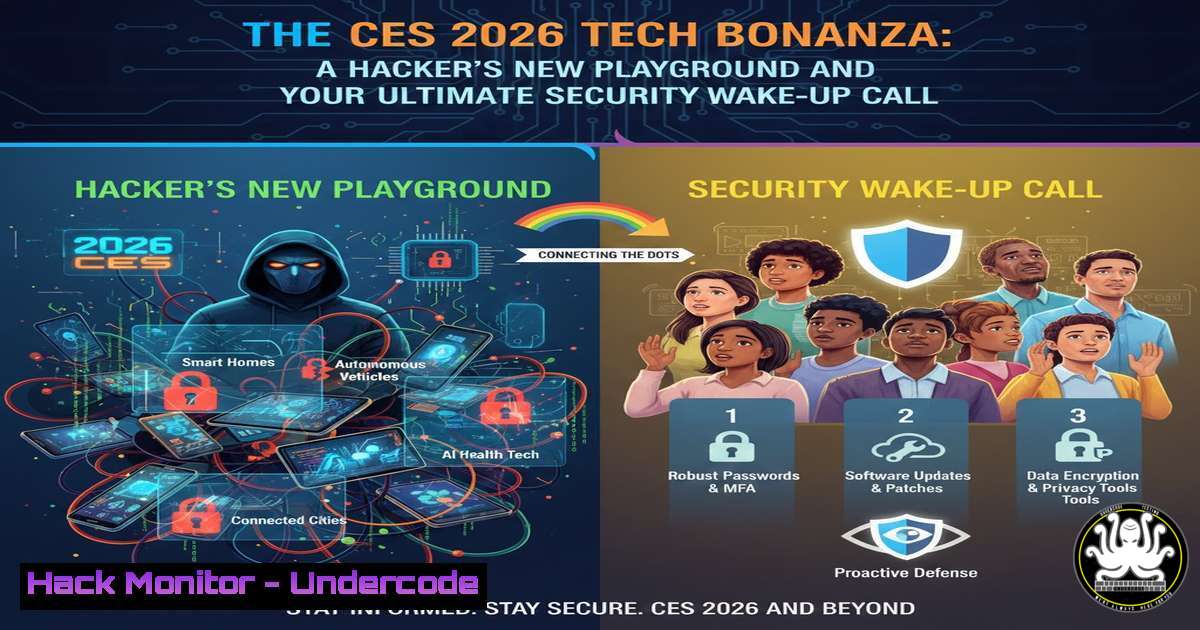
The glittering innovations showcased at CES 2026 by giants like Intel, Samsung, and NXP Semiconductors aren’t just consumer marvels; they represent an exponentially expanding attack surface for cybercriminals. This convergence of AI, IoT, smart home, and advanced connectivity spells a future where every device is a potential entry point, making robust cybersecurity knowledge not just an IT concern but a fundamental life skill. This article deconstructs the hidden risks behind the CES hype and provides actionable, technical steps to fortify your defenses.
Learning Objectives:
- Understand the specific security vulnerabilities introduced by next-gen IoT, AI-integrated devices, and smart home ecosystems.
- Learn practical, command-level hardening for consumer and professional devices connecting to these new technologies.
- Develop a proactive security mindset to evaluate and mitigate risks in rapidly adopted tech from major vendors.
You Should Know:
- The IoT Onslaught: Securing Your Network’s New Frontiers
The billions of new IoT devices from CES, from smart sensors to connected appliances, are often built with minimal security. Their primary function is connectivity, not protection.
Step‑by‑step guide:
Step 1: Network Segmentation. Isolate IoT devices on a separate network VLAN to prevent a compromised smart gadget from becoming a launchpad for attacking your primary computers.
Linux (using `iptables`):
 Create a new chain for IoT devices
sudo iptables -N IOT-ISOLATE
 Drop forward traffic from IoT network (e.g., 192.168.2.0/24) to main LAN (192.168.1.0/24)
sudo iptables -A FORWARD -s 192.168.2.0/24 -d 192.168.1.0/24 -j IOT-ISOLATE
sudo iptables -A IOT-ISOLATE -j DROP
Windows (Using PowerShell – requires internal firewall or router config): Conceptually, use Group Policy or your router’s GUI to create rules blocking inter-subnet traffic.
Step 2: Change Default Credentials & Disable UPnP. Use `nmap` to discover devices and their open ports: nmap -sV 192.168.2.1-254. Log into each device’s admin interface (found via nmap) and change default passwords. Disable Universal Plug and Play (UPnP) on routers and devices to prevent automatic, insecure port forwarding.
- AI at the Edge: When Your Smart Device Turns Against You
AI chips from Intel and NXP enable local data processing, but compromised AI models or firmware can lead to data poisoning, privacy breaches, and malicious autonomous behavior.
Step‑by‑step guide:
Step 1: Firmware Integrity Checks. Regularly verify the checksum of downloaded firmware updates before installation.
 Generate SHA-256 hash of the downloaded file
sha256sum firmware_v2.1.bin
 Compare it meticulously with the hash provided on the vendor's official security portal.
Step 2: Sandbox AI Interactions. For developers, use containerization to limit the system access of AI processes.
 Run an AI inference service in a Docker container with limited capabilities
docker run --rm -it --cap-drop=ALL --network="none" ai-inference-service:latest
- API Insecurity: The Silent Data Leak in Every Connected Ecosystem
Samsung SmartThings, Enphase Energy systems, and every cloud-connected device rely on APIs. Insecure APIs are a top data breach vector.
Step‑by‑step guide:
Step 1: Test for Common API Vulnerabilities. Use tools like `OWASP ZAP` or `Postman` to probe device/cloud APIs.
 Example using curl to test for excessive data exposure (replace with your API endpoint)
curl -H "Authorization: Bearer YOUR_TOKEN" https://api.smartdevice.com/v1/user/data
 Analyze the response. Does it return more data (e.g., other users' info) than it should?
Step 2: Implement Rate Limiting & Input Validation. If you develop APIs, use middleware. Example in Node.js:
const rateLimit = require('express-rate-limit');
const limiter = rateLimit({ windowMs: 15  60  1000, max: 100 });
app.use('/api/', limiter);
- Hardware-Level Threats: From CPU Flaws to Side-Channel Attacks
Discussions with semiconductor leaders underscore performance, but history shows hardware vulnerabilities like Spectre, Meltdown, and Infineon’s TPM flaw have widespread impact.
Step‑by‑step guide:
Step 1: Apply Microcode/BIOS Updates. These mitigate CPU-level flaws. Check on:
Linux: `sudo dmesg | grep microcode` or use your package manager (sudo apt install intel-microcode).
Windows: Use PowerShell `Get-WmiObject Win32_Processor` to identify CPU, then visit manufacturer’s website for firmware updates.
Step 2: Enable Full Disk Encryption. Protect against physical access attacks. Use BitLocker (Windows) or LUKS (Linux).
 Linux LUKS setup on a partition /dev/sda2
sudo cryptsetup luksFormat /dev/sda2
sudo cryptsetup open /dev/sda2 my_encrypted_volume
5. The Human Firewall: Beyond Technical Controls
The promotional interview with execs highlights innovation, but the sponsored DBA program comment underscores a need for strategic, knowledgeable leadership in security.
Step‑by‑step guide:
Step 1: Continuous Security Training. Enroll in verified courses from platforms like Coursera (“IoT Security”) or SANS Institute. Simulate phishing attacks internally.
Step 2: Implement a Security Policy for New Tech. Create a checklist for adopting any CES-style gadget: Does it receive automatic updates? Can its data collection be disabled? Is the vendor reputable for patching?
What Undercode Say:
- Key Takeaway 1: The integration hype at CES 2026 directly translates to attack chain integration for threat actors. A vulnerable smart light bulb can be the first domino leading to a corporate network breach.
- Key Takeaway 2: Security is now a hardware, software, and human continuum. Patching a server is futile if the AI chip in the office smart camera has a backdoor or if an executive is social-engineered.
Analysis: The post, while a promotional recap, inadvertently maps the modern threat landscape. The mentioned companies are building the foundational layers—chips, connectivity, AI—upon which all applications run. A vulnerability at this layer is catastrophic. The future of cyber defense lies in visibility (knowing every device), segmentation (containing breaches), and secure development lifecycle (SDLC) pressure on these very vendors. The DBA promo, though off-topic, hints at the necessary evolution: decision-makers must be technically and strategically literate in cybersecurity to govern this complex risk environment effectively.
Prediction:
The next two years will see the first major, multi-vector “CES-born” cyber-physical attack. This will not be a simple data breach but a cascading failure leveraging a chain of vulnerabilities: an exploited API in a smart home hub (from Company A), pivoting through a compromised IoT device (using Company B’s chip), to launch a ransomware attack on a critical home or small business system, potentially exacerbated by poisoned local AI models. This event will force regulatory intervention, demanding mandatory security baselines for connected consumer hardware and shifting liability squarely onto manufacturers.
▶️ Related Video (78% Match):
🎯Let’s Practice For Free:
IT/Security Reporter URL:
Reported By: Marknvena Smarttechcheck – Hackers Feeds
Extra Hub: Undercode MoN
Basic Verification: Pass ✅


