Listen to this Post
Introduction:
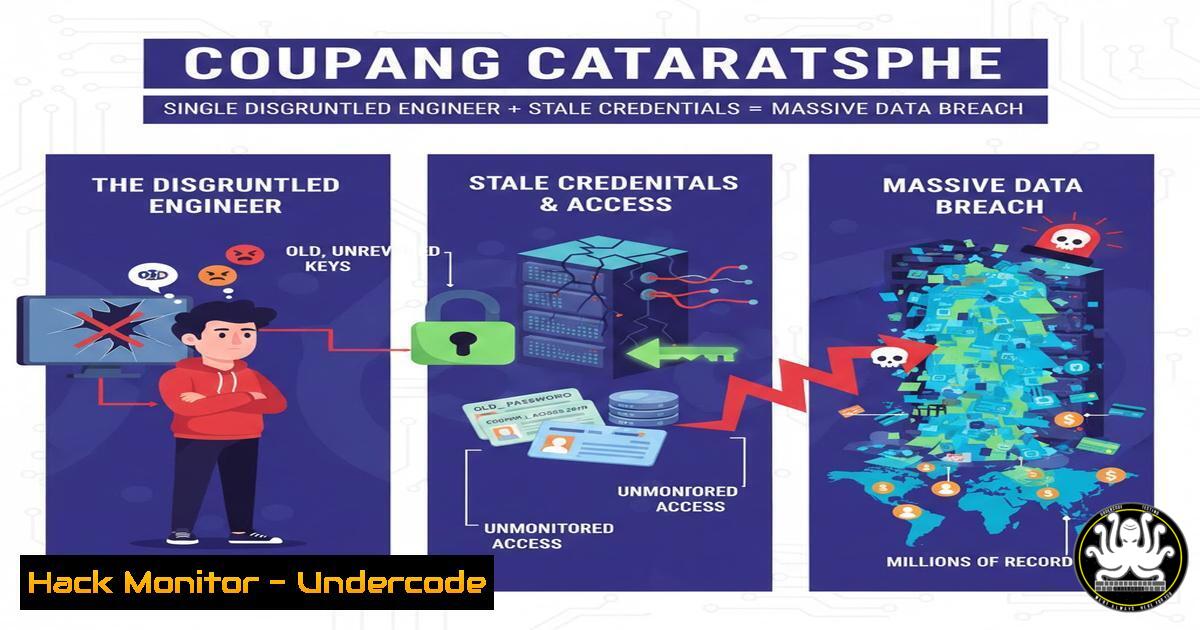
The recent data breach at a major e-commerce firm, reportedly Coupang, underscores a critical and often overlooked vulnerability in cybersecurity: the insider threat enabled by poor credential lifecycle management. A terminated engineer, allegedly retaining access to pivotal authentication keys for months, systematically exfiltrated customer data by generating and exploiting valid authentication tokens. This incident highlights a catastrophic failure in fundamental security protocols, where the absence of automated credential revocation and insufficient anomaly detection allowed a significant breach to proceed undetected.
Learning Objectives:
- Understand the critical importance of Immediate Access Revocation and Privileged Access Management (PAM) upon employee termination.
- Learn how to implement and monitor for anomalous token generation and API crawling activities.
- Master the configuration of Key Rotation policies and Security Information and Event Management (SIEM) alerting for cloud environments.
You Should Know:
- The Peril of Privileged Access and Automated Deprovisioning
The core of this breach lies in the failure to revoke access rights upon an employee’s departure. Privileged accounts, especially those with access to master keys or APIs that can generate user tokens, are the crown jewels of an organization’s identity infrastructure.
Step-by-Step Guide: Implementing Immediate Access Revocation
What it does: This process ensures that all access rights for a user are automatically and instantly revoked upon a change in their employment status, as defined in the Human Resources information system (HRIS).
How to use it:
- Integrate HRIS with IAM: Connect your HR system (e.g., Workday, SAP SuccessFactors) directly to your Identity and Access Management (IAM) system or Active Directory (AD). A termination event in HRIS should trigger a disable command in the IAM.
2. Automate with Scripts (Example for Linux/Active Directory):
On a Linux system integrated with AD, a script can listen for the HRIS webhook and execute:
 Example script to disable a user account in AD via LDAP
USERNAME="$1"
ldapmodify -H ldap://your-domain-controller -D "cn=admin,dc=yourdomain,dc=com" -W <<EOF
dn: cn=$USERNAME,ou=users,dc=yourdomain,dc=com
changetype: modify
replace: userAccountControl
userAccountControl: 514  Disables the account (NORMAL_ACCOUNT + ACCOUNTDISABLE)
EOF
In a pure Windows Active Directory environment, this is typically managed via Group Policy and integrated HR-driven workflows, but a PowerShell script can be used for automation:
 PowerShell script to disable an AD user account
Disable-ADAccount -Identity "username"
3. Utilize Cloud Identity Providers: For cloud environments (AWS IAM, Azure AD, GCP IAM), leverage native capabilities. In Azure AD, you can configure automatic license removal and account disablement through dynamic groups or Microsoft Graph API triggers.
- The Threat of Token Manipulation and Anomalous Crawling
The attacker didn’t just have access; they used it to create tokens and perform data crawling over an extended period. This indicates a failure in behavioral analytics and log monitoring designed to detect such patterns.
Step-by-Step Guide: Detecting Anomalous Token Generation and API Abuse
What it does: By analyzing logs from your identity provider (e.g., OAuth server, Auth0) and application firewalls, you can establish baselines for normal token generation rates and API call volumes and alert on significant deviations.
How to use it:
1. Centralize Logs: Aggregate logs from all critical systems (Identity Provider, Web Application Firewall, API Gateways, CloudTrail/Azure Activity Log) into a SIEM like Splunk, Elasticsearch, or Azure Sentinel.
2. Create Detection Rules: Build correlation rules within your SIEM. Examples include:
High Volume of Token Generation from a Single Principal: A single service account or user account generating an order of magnitude more tokens than its 30-day average.
-- Example SPL query for Splunk
index=auth source="/var/log/oauth/server.log" "action=token_generate"
| stats count by user
| where count > 1000  Threshold to be tuned
Sustained High-Volume API Requests: A single source IP or user token making millions of GET/POST requests to data-rich API endpoints over 24 hours.
-- Example KQL query for Azure Sentinel
WAFLogs
| where TimeGenerated >= ago(1h)
| where HttpStatus == 200
| summarize RequestCount = count() by ClientIp, UserAgent
| sort by RequestCount desc
| where RequestCount > 100000
3. Configure Alerts: Set these queries to run on a scheduled basis (e.g., every 10 minutes) and trigger a high-severity alert to the security operations center (SOC) when conditions are met.
- The Criticality of Mandatory Key and Secret Rotation
The fact that the “major keys” were not reset after the engineer’s departure is a fundamental failure. Static, long-lived credentials are a severe security risk.
Step-by-Step Guide: Enforcing a Key Rotation Policy
What it does: A mandatory key rotation policy ensures that even if a credential is compromised, its window of usefulness is limited.
How to use it:
- Inventory All Secrets: Use tools like AWS Secrets Manager, HashiCorp Vault, or Azure Key Vault to manage all API keys, database passwords, and service account tokens. Avoid hard-coded credentials.
- Define a Rotation Schedule: Enforce a policy that requires all non-human service account keys to be rotated at least every 90 days, and immediately upon any personnel change with access to them.
- Automate Rotation: Leverage cloud-native automation. For example, in AWS, you can configure Secrets Manager to automatically rotate a secret for an RDS database.
CLI command to set rotation for an AWS Secrets Manager secret
aws secretsmanager rotate-secret --secret-id production/MyAppDatabaseCreds
- Enforce with Policy-as-Code: Use tools like Terraform or Open Policy Agent (OPA) to define and enforce that no secret in your cloud environment is older than its maximum allowed age.
4. Implementing Robust Privileged Access Management (PAM)
Beyond simple user accounts, access to the most critical systems (“major keys”) should be governed by a PAM solution that provides just-in-time access and full session monitoring.
Step-by-Step Guide: Deploying PAM Principles
What it does: A PAM solution vaults privileged credentials, requiring users to check them out for temporary use. All sessions are recorded, providing an immutable audit trail.
How to use it:
- Onboard Privileged Accounts: Identify all root accounts, administrative service accounts, and API keys with broad permissions and import them into the PAM vault (e.g., CyberArk, BeyondTrust, Thycotic).
- Enforce Least Privilege: Users are not given direct access. Instead, they request elevation, which is logged. Access is granted for a short, specific timeframe (e.g., 60 minutes).
- Monitor and Record Sessions: For SSH, RDP, or web-based administrative sessions, the PAM solution should record all activity, including keystrokes and video, for later audit and forensic analysis if needed.
5. Cloud Hardening and API Security Configuration
The breach involved accessing customer data via APIs. Hardening these endpoints is non-negotiable.
Step-by-Step Guide: Basic Cloud and API Hardening
What it does: This involves configuring your cloud environment and API gateways to minimize the attack surface and detect misuse.
How to use it:
- Enable Comprehensive Logging: Ensure AWS CloudTrail, Azure Activity Log, or GCP Audit Logs are enabled across all regions and subscriptions, logging both read and write events.
- Implement API Rate Limiting and Throttling: At your API Gateway (AWS API Gateway, Azure API Management), set strict rate limits per API key/IP address to hinder mass data exfiltration.
Example AWS API Gateway usage plan snippet for rate limiting
aws_api_gateway_usage_plan:
name: "StandardPlan"
api_stages:</li>
</ol>

- api_id: "myapi"
stage: "prod"
throttle_settings:
burst_limit: 1000
rate_limit: 500
3. Network Segmentation: Use VPCs (Virtual Private Clouds) and Network Security Groups (NSGs) to ensure that backend databases and services containing sensitive customer data are not directly accessible from the internet and are only reachable by specific, authorized application tiers.
What Undercode Say:
- The human element remains the most potent vulnerability, but it is the lack of automated, system-enforced technical controls that transforms a personnel issue into a catastrophic data breach.
- Continuous monitoring for behavioral anomalies is no longer a “nice-to-have” but a foundational requirement for any organization handling sensitive data. Logs are useless without the analytics to understand them.
This incident is a stark reminder that security is a process, not a state. It demonstrates a failure across multiple layers: process (no offboarding checklist), technical (no key rotation, weak monitoring), and cultural (possibly a lack of security ownership). The prolonged, undetected nature of the exfiltration suggests that while the company may have had logging in place, it lacked the sophisticated correlation and alerting needed to detect a low-and-slow attack masquerading as normal activity. The blame lies not with the individual actor, but with the system that empowered them long after their legitimate need for access had ended.
Prediction:
This breach will serve as a global case study, accelerating regulatory scrutiny and legal precedents around data custodianship and negligence. We predict a surge in the adoption of Zero-Trust principles, specifically Just-In-Time (JIT) privileged access, and mandatory, automated secret rotation enforced by compliance frameworks. Companies will be forced to move beyond simple log collection to implementing advanced AI-driven User and Entity Behavior Analytics (UEBA) to identify such insider threats proactively. Failure to do so will result in not just reputational damage but also severe financial penalties and loss of customer trust from which recovery may be impossible.
🎯Let’s Practice For Free:
IT/Security Reporter URL:
Reported By: Skim71 %EC%9D%B4%EB%9F%B4%EC%88%98%EB%8F%84 – Hackers Feeds
Extra Hub: Undercode MoN
Basic Verification: Pass ✅🔐JOIN OUR CYBER WORLD [ CVE News • HackMonitor • UndercodeNews ]
📢 Follow UndercodeTesting & Stay Tuned:


