Listen to this Post
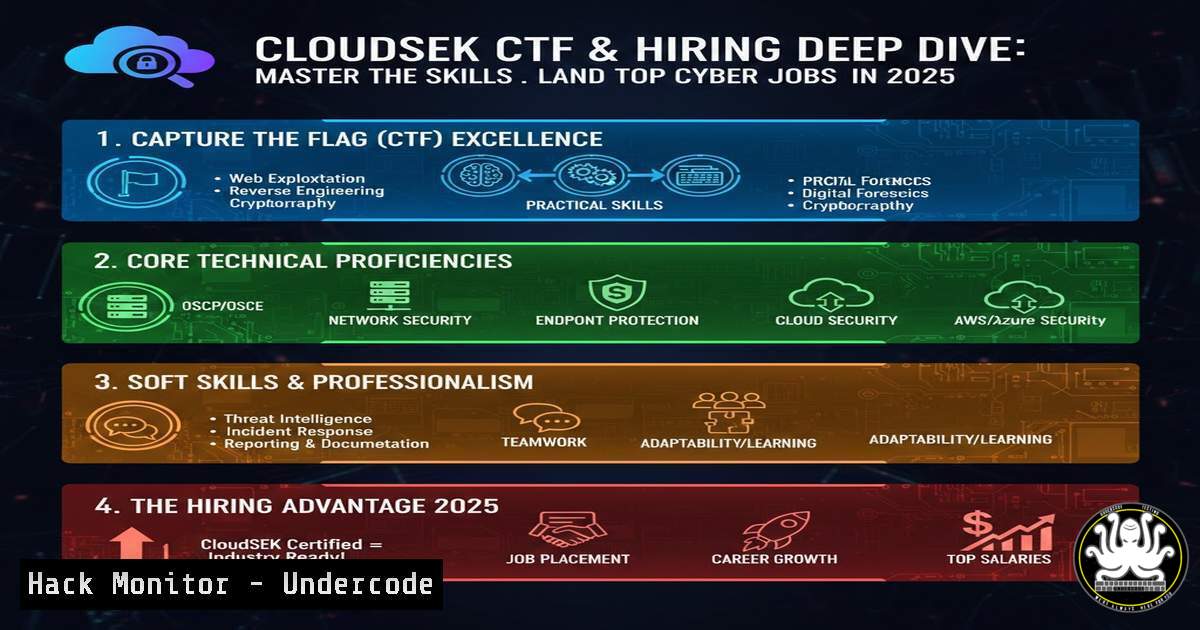
Introduction:
Capture The Flag (CTF) competitions have evolved from niche hobbyist games into critical proving grounds for cybersecurity talent and recruitment pipelines for leading firms. CloudSEK’s upcoming event, coupled with its direct hiring call for Cyber Security Analysts, highlights a strategic shift where practical, hands-on skills trump theoretical knowledge alone. This article deconstructs the mandatory skills listed in the announcement, providing a technical blueprint for aspiring analysts to not only compete but to excel and secure a role in the AI-driven security landscape.
Learning Objectives:
- Deconstruct the core technical competencies required for modern cyber analyst roles, including web app penetration testing, OSINT, and scripting.
- Implement practical, command-level tutorials for vulnerability assessment, network reconnaissance, and automation.
- Develop a strategic understanding of how CTF performance directly correlates with real-world threat hunting and mitigation capabilities.
You Should Know:
1. Web Application Penetration Testing Fundamentals
The announcement prioritizes hands-on Web Application Penetration Testing. This is the art of ethically hacking web apps to discover vulnerabilities before malicious actors do. A fundamental approach involves reconnaissance, mapping the attack surface, identifying vulnerabilities, and attempting exploitation.
Step‑by‑step guide explaining what this does and how to use it.
1. Reconnaissance & Enumeration: Use tools like `curl` and `nmap` to gather initial data.
`curl -I https://target.com` – Retrieves HTTP headers to identify the web server and technologies.
`nmap -sV –script http-enum target.com- Discovers open ports and enumerates common web directories.nikto -h https://target.com` – A simple CGI scanner to identify misconfigurations and known vulnerabilities.
2. Vulnerability Discovery: Automate initial scanning with `nikto` and perform manual testing with a browser proxy.
3. Manual Testing with OWASP ZAP: Intercept and manipulate traffic.
Start OWASP ZAP as a proxy (default: localhost:8080).
Configure your browser to use the ZAP proxy.
Browse the application; ZAP will spider the site and allow you to perform active and passive scans. Manually test forms for SQL Injection (' OR '1'='1) and Cross-Site Scripting (XSS) (<script>alert('XSS')</script>).
2. Mastering OSINT and SOCMINT for Threat Intelligence
Open-Source Intelligence (OSINT) and Social Media Intelligence (SOCMINT) are mandatory for understanding the digital footprint of a target, which could be an organization, an application, or a threat actor. This skill is crucial for proactive defense.
Step‑by‑step guide explaining what this does and how to use it.
1. Domain and IP Intelligence: Use `whois` and `theHarvester` to gather public data.
`whois target.com` – Reveals domain registration details.
`theHarvester -d target.com -b google,linkedin` – Harvests emails, subdomains, and hostnames from public sources.
2. Social Media Profiling (SOCMINT): Manually investigate platforms like LinkedIn (as mentioned in the post) for technical disclosures. Use tools like `sherlock` to find username associations.
`python3 sherlock.py username` – Checks for the presence of a username across hundreds of social media sites.
3. Image Metadata Analysis: Extract hidden data from images posted online using exiftool.
`exiftool image.jpg` – Displays metadata (EXIF) which can contain GPS coordinates, camera model, and software used.
3. Automating Reconnaissance with Bash Scripting
Basic Bash scripting is essential for chaining tools together, automating repetitive tasks, and processing large datasets—a key skill for any analyst.
Step‑by‑step guide explaining what this does and how to use it.
1. Create a Simple Subdomain Enumeration Script: This script uses a wordlist to find potential subdomains.
2. Script Code:
!/bin/bash
 Simple Subdomain Scanner
echo "Enter the domain:"
read domain
echo "Enter the path to wordlist:"
read wordlist

echo "Scanning for subdomains..."
for sub in $(cat $wordlist); do
if host "$sub.$domain" &> /dev/null; then
echo "$sub.$domain"
fi
done
3. How to Use:
Save the code as `subscan.sh`.
Make it executable: `chmod +x subscan.sh`.
Run it: ./subscan.sh. You will be prompted for the target domain (e.g., example.com) and the path to a wordlist (e.g., /usr/share/wordlists/seclists/Discovery/DNS/subdomains-top1million-5000.txt).
- Programming for Security: Python for Exploit and Tool Development
Proficiency in Python, Golang, or Rust is required for understanding exploit code, automating complex tasks, and developing custom security tools.
Step‑by‑step guide explaining what this does and how to use it.
1. Build a Basic HTTP Header Scanner in Python: This script identifies security-related headers.
2. Python Code:
!/usr/bin/env python3
import requests

def check_headers(url):
try:
response = requests.get(url)
headers = response.headers

security_headers = {
'Content-Security-Policy': 'Missing',
'Strict-Transport-Security': 'Missing',
'X-Content-Type-Options': 'Missing',
'X-Frame-Options': 'Missing'
}

for header in security_headers:
if header in headers:
security_headers[bash] = headers[bash]

for header, value in security_headers.items():
print(f"{header}: {value}")

except requests.exceptions.RequestException as e:
print(f"Error: {e}")

if <strong>name</strong> == "<strong>main</strong>":
target = input("Enter the target URL (e.g., https://example.com): ")
check_headers(target)
3. How to Use:
Save the code as `header_checker.py`.
Install the required library: `pip3 install requests`.
Run the script: `python3 header_checker.py`.
5. Network Protocols and Architecture Analysis
A strong understanding of network protocols is non-negotiable. This involves analyzing traffic to identify anomalies, misconfigurations, and malicious activity.
Step‑by‑step guide explaining what this does and how to use it.
1. Passive Traffic Analysis with Wireshark: Use Wireshark to inspect live or captured traffic.
Open Wireshark and select an interface, or open a saved `.pcap` file.
Use the display filter `http.request.method == “POST”` to find all POST requests, which often contain sensitive data like credentials.
Follow a TCP stream (Right-click packet > Follow > TCP Stream) to reconstruct a session between a client and server.
2. Active Network Mapping with Nmap: Go beyond simple port scans.
`nmap -A -O target_ip/24`:
-A: Enables OS detection, version detection, script scanning, and traceroute.
`-O`: Enables OS detection.
`target_ip/24`: Scans the entire subnet.
6. Leveraging AI in Cybersecurity Operations
CloudSEK’s mention of “AI-driven cybersecurity products” signifies a industry-wide trend. Analysts must understand how AI augments threat detection and response, particularly in analyzing vast datasets for patterns indicative of cyber attacks.
Step‑by‑step guide explaining what this does and how to use it.
1. Conceptual Understanding: AI models can be trained on network traffic logs, malware signatures, and user behavior to identify deviations from the norm.
2. Practical Integration: While building a full AI model is complex, analysts can use Python’s `scikit-learn` library to analyze log data.
A simple script could parse web server logs and use a clustering algorithm to flag rare, potentially malicious IP addresses based on request frequency and type.
3. Focus: The key for an analyst is not necessarily to build these models, but to understand their output, validate their findings, and fine-tune their parameters to reduce false positives.
What Undercode Say:
- CTFs are the new technical interview. A strong performance is a direct demonstration of the practical, problem-solving skills companies like CloudSEK desperately need.
- The skills matrix is a direct map to the modern threat landscape. Mastery of OSINT, scripting, and web app testing is no longer optional for a career on the front lines of cybersecurity.
The CloudSEK announcement is a clear market signal. It moves beyond checkbox qualifications and explicitly demands demonstrable, hands-on capabilities. The convergence of their CTF event and hiring drive creates a powerful filter that selects for individuals who can immediately contribute to a Security Operations Center (SOC) or threat intelligence team. This approach effectively bypasses traditional resume screening, valuing proven skill over pedigree. For the aspiring analyst, this is both a challenge and an opportunity; the path to employment is clearly marked by technical proficiency, not just certifications.
Prediction:
The integration of CTFs and gamified assessments into the hiring processes of major cybersecurity firms will become standard within two years. This will force a rapid evolution in cybersecurity education and training, with a heavier emphasis on practical, scenario-based learning over theoretical coursework. Furthermore, the explicit requirement for programming and AI literacy will create a new tier of “hybrid analysts” who can not only respond to alerts but also develop custom tools and work synergistically with AI systems to hunt for advanced persistent threats (APTs), fundamentally reshaping the defensive capabilities of organizations.
🎯Let’s Practice For Free:
IT/Security Reporter URL:
Reported By: Falakimran Cyber – Hackers Feeds
Extra Hub: Undercode MoN
Basic Verification: Pass ✅


