Listen to this Post
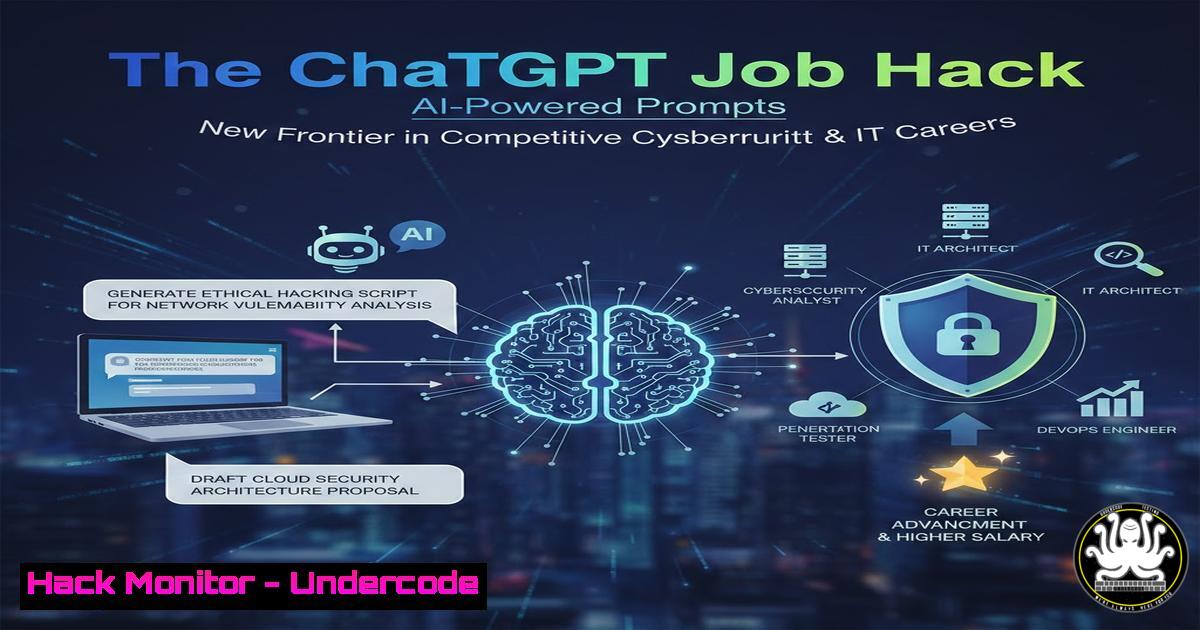
Introduction:
In today’s hyper-competitive tech landscape, landing a role in cybersecurity, IT, or AI demands more than technical prowess; it requires strategic career engineering. Leveraging Large Language Models (LLMs) like ChatGPT for job searches represents a paradigm shift, transforming passive application into a targeted, data-driven campaign. This guide explores how to weaponize AI not just for resume tailoring, but for deep reconnaissance on target companies, simulating technical interviews, and automating the grunt work of the hunt—all while maintaining operational security and ethical boundaries.
Learning Objectives:
- Master advanced ChatGPT prompting for technical role research and vulnerability assessment of potential employers.
- Automate the creation of targeted application artifacts (resumes, cover letters) while avoiding detection by AI-screening tools.
- Implement secure, local automation scripts to manage job search data and interactions with AI APIs.
You Should Know:
1. Advanced Company & Security Posture Research
The generic company research prompt is a starting point. For a cybersecurity professional, you must dig deeper into the company’s public security posture, recent incidents, and technology stack to inform both your application and interview talking points.
Step‑by‑step guide:
Step 1: Reconnaissance Prompting. Go beyond the mission statement. Use prompts like: `”Act as a cybersecurity analyst. Analyze the company website
 and recent news for mentions of technology stack (e.g., AWS/Azure, specific CSPM/Vendors), any publicly disclosed data breaches or security incidents in the last 3 years, and open positions related to security engineering or SOC."`
 Step 2: Technical Stack Analysis. Identify tools to brush up on. Use: `"Extract all mentioned cybersecurity tools, platforms (like Splunk, CrowdStrike, Palo Alto), and standards (ISO 27001, SOC2) from the following job description [Paste JD]. Provide a list of the top 5 most frequently cited."`
 Step 3: Local Data Handling. Never paste sensitive data directly. For local analysis, use command-line tools to pre-process text. For example, to sanitize a resume file before feeding it to ChatGPT, you can use `sed` to remove personal details:
[bash]
sed 's/John Doe/[Your Name]/g; s/555-1234/[bash]/g; s/[email protected]/[bash]/g' resume.txt > sanitized_resume.txt
In Windows PowerShell, use:
(Get-Content resume.txt) -replace 'John Doe', '[Your Name]' -replace '555-1234', '[bash]' | Set-Content sanitized_resume.txt
2. Crafting the Unbeatable, ATS-Optimized Technical Resume
Applicant Tracking Systems (ATS) are the first line of defense. Your resume must pass this automated gatekeeper while appealing to the human hiring manager.
Step‑by‑step guide:
Step 1: Keyword Extraction & Mapping. Use ChatGPT to analyze the job description and your sanitized resume: `”Compare the following job description [Paste JD] with my resume [Paste Sanitized Resume]. List all missing technical keywords (programming languages, tools, frameworks, certifications like CISSP, CEH) from the JD that are not in my resume. Prioritize hard skills.”`
Step 2: Experience Reframing. Quantify and harden your bullet points. `”Rewrite this bullet point from an IT admin resume to focus on cybersecurity impact: ‘Managed company servers and network.’ Use the STAR method and include metrics, e.g., ‘Secured and monitored 50+ Windows/Linux servers, reducing unpatched vulnerabilities by 70% through automated deployment of WSUS and Ansible playbooks.'”`
Step 3: ATS Formatting Verification. Ensure your file is parsable. After drafting, convert to a simple format. Use a Linux command like `pdftotext` (from poppler-utils) to check if your PDF is text-readable:
pdftotext your_resume.pdf - | head -20
If output is garbaged, the ATS might struggle.
3. Generating Dynamic Cover Letters and Portfolio Narratives
A cover letter should connect your technical narrative to the company’s specific pain points, which you identified in your recon phase.
Step‑by‑step guide:
Step 1: Pain-Point Alignment Prompt. `”Using the company’s recent focus on [cloud migration/API security/etc.] from their blog, draft a cover letter opening for a Cloud Security Engineer role. Link my experience in automating AWS GuardDuty findings to their stated need for scalable cloud security.”`
Step 2: Portfolio Project Highlight. Use AI to make side projects relevant: `”I have a GitHub project that uses Python to scan for misconfigured S3 buckets. How can I describe this in one line for a cover letter applying to a company that recently suffered a cloud data leak, emphasizing proactive risk mitigation?”`
4. Simulating Technical Interviews and Challenge Preparation
Go beyond common questions. Train for scenario-based and technical deep dives.
Step‑by‑step guide:
Step 1: Scenario Generation. `”Act as a senior penetration tester interviewing a candidate. Provide a step-by-step scenario question: ‘A client reports suspicious outbound traffic from their web server. Walk me through your investigative process, from initial log analysis to potential containment.'”`
Step 2: Command-Line Drill. Practice explaining commands. Prepare to discuss: `”Explain what this chain of Linux commands does and how an attacker might use it: `find / -type f -perm -4000 2>/dev/null." (It finds SUID binaries, a common privilege escalation vector).
Step 3: Code Explanation. "Explain the security vulnerability in this Python Flask snippet and how to fix it:@app.route(‘/login’, methods=[‘POST’]) def login(): username = request.form[‘username’]; password = request.form[‘password’]; query = f”SELECT FROM users WHERE username='{username}’ AND password='{password}'”;" (It’s susceptible to SQL Injection).
5. Automating the Search with Secure API Integrations
Manually pasting prompts is inefficient. Use the OpenAI API to build a local, secure job search assistant.
Step‑by‑step guide:
Step 1: Secure API Key Storage. Never hardcode keys. Use environment variables.
 Linux/macOS
export OPENAI_API_KEY='your-key-here'
 In your Python script
import os
api_key = os.getenv('OPENAI_API_KEY')
 Windows PowerShell
$env:OPENAI_API_KEY='your-key-here'
Step 2: Build a Basic Python CLI Tool. Create a script job_helper.py:
import openai
import sys
openai.api_key = os.getenv('OPENAI_API_KEY')
def generate_cover(job_desc, resume_snippet):
response = openai.ChatCompletion.create(
model="gpt-4",
messages=[{"role": "user", "content": f"Write a cover letter snippet for this JD: {job_desc} using this experience: {resume_snippet}"}]
)
return response.choices[bash].message.content
if <strong>name</strong> == "<strong>main</strong>":
 Basic argument handling
print(generate_cover(sys.argv[bash], sys.argv[bash]))
Run it: `python job_helper.py “[JD text]” “[Resume text]”`.
Step 3: Data Privacy. Always sanitize inputs. Consider running local models (via Ollama, LM Studio) for highly sensitive data processing to keep all information on-premise.
What Undercode Say:
- Key Takeaway 1: The modern job search is an intelligence operation. The professional who uses AI to conduct deep technical and organizational reconnaissance on a target company gains a significant asymmetric advantage, transforming the interview from an examination into a strategic dialogue.
- Key Takeaway 2: Automation and customization are no longer mutually exclusive. By leveraging the ChatGPT API with secure, local scripts, you can generate hyper-personalized application materials at scale, ensuring both quality and volume—a critical factor in a tough market.
The core analysis reveals a shift from effort-based to tool-augmented job seeking. The winners in the 2025 tech job market will be those who treat their career as a product and themselves as a growth hacker, utilizing every available technological lever. However, this raises ethical considerations regarding authenticity and the potential for an AI “arms race” between candidates and AI-driven screening systems. The true differentiator will remain the human ability to synthesize AI-generated insights with genuine experience and critical thinking during live, technical evaluations.
Prediction:
Within two years, we will see the emergence of specialized “Career AI” agents that fully automate the job search loop—from scanning job boards and company news, to dynamically generating and submitting tailored applications, to scheduling interviews and providing real-time conversational coaching via AR devices. This will force a counter-evolution in hiring technology, leading to advanced “AI-detection” modes in ATS and a greater emphasis on in-person, practical lab-based assessments to verify a candidate’s un-augmented skills. The divide will grow between candidates who use AI as a basic prompt crutch and those who deeply integrate it into a secure, automated, and strategic career management system.
▶️ Related Video (72% Match):
🎯Let’s Practice For Free:
IT/Security Reporter URL:
Reported By: Rishabh Jaitwar – Hackers Feeds
Extra Hub: Undercode MoN
Basic Verification: Pass ✅


