Listen to this Post
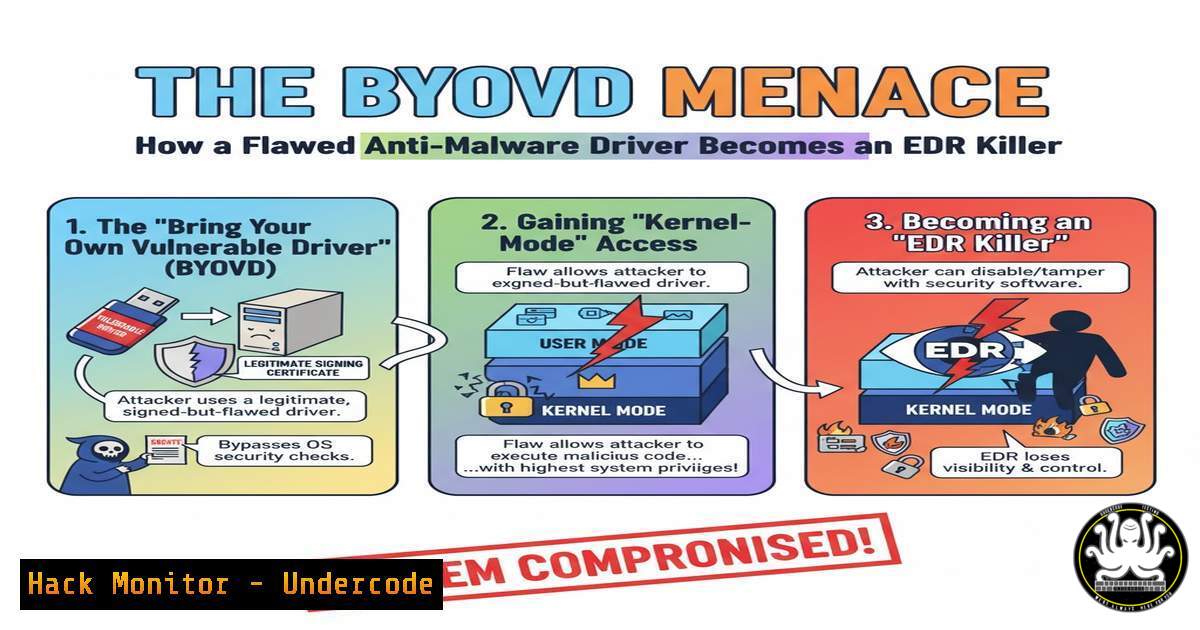
Introduction:
Bring Your Own Vulnerable Driver (BYOVD) attacks represent a critical escalation in the cyber threat landscape, where adversaries exploit legitimate but poorly secured kernel-mode drivers to disable security software. The recent public release of WatchDogKiller, a Proof-of-Concept (PoC) exploit targeting the WatchDog Anti-Malware driver (amsdk.sys), demonstrates how a single vulnerability can be weaponized to dismantle endpoint detection and response (EDR) and antivirus (AV) protections, granting attackers unfettered access to a system.
Learning Objectives:
- Understand the mechanics of a BYOVD attack and its implications for endpoint security.
- Learn key commands for investigating loaded drivers and process integrity on Windows and Linux systems.
- Develop mitigation strategies to defend against driver-based exploitation and privilege escalation.
You Should Know:
1. Investigating Loaded Drivers with PowerShell
Before an attacker can exploit a driver, they must identify a vulnerable one present on the system. Security teams can use PowerShell to audit loaded drivers.
Get-WmiObject Win32_PnPSignedDriver | Select-Object DeviceName, DriverVersion, Manufacturer | Where-Object {$_.DeviceName -like "WatchDog"}
Step-by-step guide:
This PowerShell command queries the Windows Management Instrumentation (WMI) class for all signed drivers. It filters the results to show only drivers with “WatchDog” in the device name, displaying the driver’s name, version, and manufacturer. Regularly running such audits helps identify known vulnerable drivers that should be removed or updated. A more general command to list all drivers is driverquery /v, which can be exported to a file for baseline comparison.
2. Checking Process and Service Integrity with SC
The `sc` command is a powerful built-in Windows tool for querying and managing services, including drivers.
sc query amsdk
sc query type= driver
Step-by-step guide:
The first command (sc query amsdk) checks the specific state of the “amsdk” driver service, showing whether it is running, stopped, or in a pending state. The second command (sc query type= driver) lists all installed kernel driver services. In a BYOVD attack, an attacker would use `sc` to start the vulnerable driver if it is not already running, enabling them to subsequently issue malicious IOCTLs.
3. Leveraging Sysinternals DriverView for Real-Time Analysis
Microsoft’s Sysinternals suite provides essential tools for deep system analysis. DriverView offers a GUI-based overview of all loaded drivers.
DriverView.exe /stext C:\baseline\drivers.txt
Step-by-step guide:
Running DriverView from the command line with the `/stext` parameter exports a complete list of all loaded drivers, their memory addresses, and their file paths to a text file. By creating a known-good baseline and then periodically comparing the current driver list against it, blue teams can quickly identify unauthorized or suspicious drivers that have been loaded, a common precursor to a BYOVD attack.
4. Windows Security Feature: Vulnerable Driver Blocklist
Microsoft maintains a blocklist of known vulnerable drivers. This feature can be configured via Group Policy or the registry.
reg add "HKEY_LOCAL_MACHINE\SYSTEM\CurrentControlSet\Control\CI\Config" /v "VulnerableDriverBlocklistEnable" /t REG_DWORD /d 1
Step-by-step guide:
This registry command enables the vulnerable driver blocklist feature on a Windows system. The value `1` activates the blocklist. The list of blocked drivers is updated through the Windows Security intelligence update (KB4052623). For enterprise management, this setting should be deployed via Group Policy under “Computer Configuration > Administrative Templates > System > Kernel DMA Protection” to ensure all endpoints are protected from known bad drivers.
- Linux lsmod and dmesg for Kernel Module Vigilance
While the WatchDog exploit targets Windows, the BYOVD concept is a universal threat. Linux administrators must also monitor their kernel modules.lsmod | grep -i "watchdog" dmesg | grep -i "module" sudo rmmod module_name
Step-by-step guide:
The `lsmod` command lists all currently loaded kernel modules. Piping it to `grep` allows you to search for specific modules. The `dmesg` command displays the kernel ring buffer, which often contains messages related to module loading and unloading. If a malicious or vulnerable module is identified, the `rmmod` command (with sudo privileges) can be used to remove it from the running kernel.
6. Implementing Code Integrity Guard (Windows)
Windows Code Integrity policies can restrict which drivers are allowed to load, effectively neutralizing many BYOVD attacks.
Get-SystemDriver -ScanPath C:\drivers\ | New-CIPolicy -FilePath C:\Policy.xml -UserPEs
ConvertFrom-CIPolicy -XmlFilePath C:\Policy.xml -BinaryFilePath C:\Policy.bin
Step-by-step guide:
This PowerShell sequence (requiring the ConfigCI module) creates a code integrity policy. The first command scans a directory containing known-good drivers and generates a policy file. The second command converts the XML policy into a binary format that can be deployed. This binary file can then be distributed via Group Policy to enforce a whitelist of approved drivers, preventing unknown or vulnerable drivers from loading.
7. Exploitation Mechanics: The IOCTL Attack Vector
The core of the WatchDogKiller exploit lies in sending a malicious Input/Output Control (IOCTL) code to the driver, leveraging a vulnerability that allows arbitrary kernel memory writes.
include <windows.h>
include <winioctl.h>

HANDLE hDevice = CreateFile(TEXT("\\.\amsdk"), GENERIC_READ | GENERIC_WRITE, 0, NULL, OPEN_EXISTING, FILE_ATTRIBUTE_NORMAL, NULL);
DeviceIoControl(hDevice, VULNERABLE_IOCTL_CODE, maliciousBuffer, maliciousSize, NULL, 0, &bytesReturned, NULL);
CloseHandle(hDevice);
Step-by-step guide:
This simplified C code snippet demonstrates the exploitation logic. `CreateFile` obtains a handle to the driver device (in this case, \\\\.\\amsdk). The `DeviceIoControl` function is then used to send a specific, vulnerable IOCTL code along with a maliciously crafted buffer. This buffer exploits the driver’s lack of proper validation to overwrite critical kernel structures, ultimately terminating protected EDR/AV processes. Mitigation involves drivers rigorously validating all IOCTL requests and their associated buffers.
What Undercode Say:
- The Perimeter is Inside. The most dangerous threats are no longer just external; they are the legitimate, signed components already residing on or brought into your system. Trusting a driver solely based on its digital signature is a broken model.
- Offense Informs Defense. The public release of PoC exploits like WatchDogKiller is a double-edged sword. While it provides a tool for attackers, it is an indispensable resource for defenders, offering an unambiguous signal to patch, block, and build detections.
The emergence of WatchDogKiller is not an anomaly but a sign of a maturing offensive tradecraft. Attackers are systematically shifting their focus up the stack, from exploiting user applications to exploiting the very security software designed to protect them. This PoC provides a reproducible blueprint for other threat actors, meaning similar exploits will become commodity tools in the near future. The analysis is clear: a reactive security posture is insufficient. Organizations must proactively hunt for and purge known vulnerable drivers, enforce strict code integrity policies, and assume that any driver with a known vulnerability will be used against them. The line between red and blue team is blurring, and the victor will be the one who can best weaponize this information—for attack or for defense.
Prediction:
The weaponization of vulnerable drivers will rapidly evolve from a targeted technique to a mainstream persistence and defense-evasion method. We will see a surge in automated tools that scan for a wide range of vulnerable drivers, not just a single instance like amsdk.sys. This will force a fundamental change in the software supply chain, with increased scrutiny on driver development practices and a likely industry-wide push for a more robust driver code-signing and revocation process, potentially backed by hardware-based root-of-trust like Pluton. EDR vendors will be compelled to move critical detection logic out of user space and into more isolated, hypervisor-protected environments to survive these kernel-level attacks.
🎯Let’s Practice For Free:
IT/Security Reporter URL:
Reported By: Florian Hansemann – Hackers Feeds
Extra Hub: Undercode MoN
Basic Verification: Pass ✅


