Listen to this Post
Introduction:
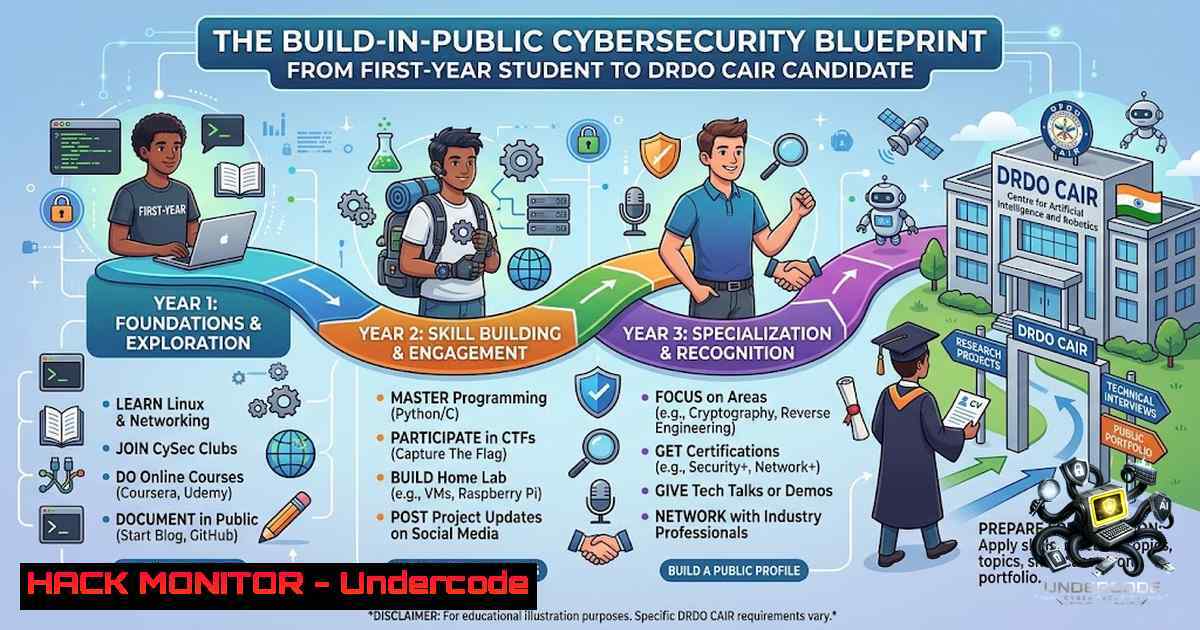
The journey from a first-year undergraduate to a nationally recognized cybersecurity researcher is rarely linear, yet it is precisely this non-linear path that builds the most resilient professionals. Saisiddi Kalmadi’s first-year trajectory—spanning international hackathons, AI-driven medical solutions, EV battery security research, and OSINT red team operations—exemplifies how intentional project-based learning and competitive exposure can accelerate technical mastery. This article deconstructs the technical stack, security methodologies, and career-building strategies embedded in this journey, providing actionable insights for students and professionals aiming to replicate this success while building toward advanced roles in defense research organizations like DRDO CAIR.
Learning Objectives:
- Master the integration of AI/ML frameworks (MediaPipe, FastAPI, LLMs) with cybersecurity principles for real-world applications
- Understand the technical architecture and security considerations of building Chrome Extensions, neuro-rehabilitation tools, and AI calling agents
- Develop a strategic roadmap for transitioning from academic projects to defense-grade research, including GATE CS preparation and DRDO CAIR targeting
You Should Know:
- Building Real-Time Accessibility Solutions: SignSpeak Architecture and Security Implications
SignSpeak, a real-time American Sign Language (ASL) to speech converter built with MediaPipe and FastAPI, represents a critical intersection of computer vision, natural language processing, and edge security. The architecture typically follows this structure:
Step-by-Step Guide:
1. Set up MediaPipe Hands for landmark detection:
pip install mediapipe opencv-python fastapi uvicorn
2. Implement hand tracking with MediaPipe’s holistic solution:
import mediapipe as mp
mp_hands = mp.solutions.hands
hands = mp_hands.Hands(static_image_mode=False, max_num_hands=2, min_detection_confidence=0.5)
3. Create FastAPI endpoints for real-time inference:
from fastapi import FastAPI, WebSocket
app = FastAPI()
@app.websocket("/ws")
async def websocket_endpoint(websocket: WebSocket):
await websocket.accept()
while True:
data = await websocket.receive_bytes()
 Process frame and return prediction
- Deploy with Docker for containerization and security isolation:
FROM python:3.9-slim
WORKDIR /app
COPY requirements.txt .
RUN pip install --1o-cache-dir -r requirements.txt
CMD ["uvicorn", "main:app", "--host", "0.0.0.0", "--port", "8000"]
-
Implement API security with JWT authentication and rate limiting:
from fastapi.security import HTTPBearer
security = HTTPBearer()
@app.middleware("http")
async def rate_limit(request: Request, call_next):
Implement token bucket or sliding window
Windows/Linux Commands for Deployment:
- Windows: `python -m venv signspeak_env && signspeak_env\Scripts\activate`
– Linux: `python3 -m venv signspeak_env && source signspeak_env/bin/activate`
– Test API: `curl -X GET http://localhost:8000/health`
- Chrome Extension Development: Security Hardening and User Data Protection
Building a Chrome Extension used by 100+ peers introduces critical security considerations, including Content Security Policy (CSP), cross-origin requests, and data storage encryption.
Step-by-Step Guide:
1. Manifest V3 compliance for modern extension security:
{
"manifest_version": 3,
"name": "SignSpeak Extension",
"permissions": ["storage", "activeTab", "scripting"],
"host_permissions": ["<all_urls>"],
"content_security_policy": {
"extension_pages": "script-src 'self'; object-src 'self'"
}
}
- Secure storage implementation using Chrome’s storage API with encryption:
async function secureStore(data) {
const encrypted = await encryptData(data);
chrome.storage.local.set({ userData: encrypted });
}
3. Implement content script isolation to prevent XSS:
// content.js with strict CSP
window.addEventListener('message', (event) => {
if (event.origin !== 'chrome-extension://your-extension-id') return;
// Process trusted messages only
});
4. Minimize permissions and request optional permissions dynamically:
chrome.permissions.request({
permissions: ['activeTab'],
origins: ['https://trusted-api.com/']
}, (granted) => { / Handle permission / });
- AI Calling Agent Infrastructure: Xverse Architecture and Security Hardening
Co-founding Xverse, an AI calling agent startup targeting NBFCs and EdTech, requires deep understanding of VoIP security, conversational AI vulnerabilities, and financial data protection.
Step-by-Step Guide:
1. Set up WebRTC infrastructure with secure signaling:
npm install -g twilio-cli
twilio phone-1umbers:list
2. Implement SIP security with TLS encryption:
import pjsua2 as pj
account_config = {
"idUri": "sip:[email protected]",
"regUri": "sip:voip.xverse.ai",
"proxyUri": "sip:proxy.xverse.ai",
"credData": ["username", "password"]
}
- LLM integration for conversational AI with prompt injection defenses:
from transformers import pipeline generator = pipeline('text-generation', model='google/flan-t5-large') def safe_generate(prompt): Sanitize input sanitized = re.sub(r'[;|\'"]', '', prompt) return generator(sanitized, max_length=100) -
Secure deployment on cloud with VPC and security groups:
AWS CLI for VPC setup
aws ec2 create-security-group --group-1ame xverse-sg --description "Xverse security group"
aws ec2 authorize-security-group-ingress --group-id sg-123 --protocol tcp --port 5060 --cidr 10.0.0.0/16
-
EV Battery Security Research: iTelematics Approach and IoT Hardening
Cybersecurity Research Internship at iTelematics focuses on EV battery security, a critical domain combining embedded systems, CAN bus protocols, and cloud telemetry.
Step-by-Step Guide:
1. CAN bus sniffing and analysis:
 Linux: Install can-utils
sudo apt-get install can-utils
 Simulate CAN bus
sudo modprobe vcan
sudo ip link add dev vcan0 type vcan
sudo ip link set up vcan0
candump vcan0
2. Implement message authentication for CAN frames:
import can
bus = can.Bus(interface='socketcan', channel='vcan0', bitrate=500000)
def send_authenticated(id, data, key):
mac = hmac.new(key, data, hashlib.sha256).digest()[:4]
msg = can.Message(arbitration_id=id, data=data+mac, is_extended_id=False)
bus.send(msg)
3. Telemetry encryption with MQTT over TLS:
 Mosquitto MQTT broker with TLS
openssl req -1ew -x509 -days 365 -keyout ca.key -out ca.crt
 Configure mosquitto.conf
listener 8883
cafile /etc/mosquitto/ca_certificates/ca.crt
certfile /etc/mosquitto/certs/server.crt
keyfile /etc/mosquitto/certs/server.key
require_certificate false
4. Cloud security monitoring for battery anomaly detection:
 AWS IoT Core integration
import boto3
client = boto3.client('iot-data', region_name='us-east-1')
response = client.publish(
topic='ev/battery/telemetry',
payload=json.dumps(battery_data),
qos=1
)
- OSINT and Red Team Operations: VaultofCodes Internship Technical Stack
Ethical Hacking Internship at VaultofCodes involves OSINT gathering and red team operations. This requires a mastery of intelligence gathering tools, social engineering countermeasures, and digital footprint analysis.
Step-by-Step Guide:
1. Set up OSINT framework:
 Linux: Install theHarvester, Recon-1g, Shodan CLI
pip install theHarvester
theHarvester -d example.com -b google,linkedin,shodan
2. Automated information gathering with Recon-1g:
recon-1g
marketplace install all
workspace create target_operation
use recon/domains-hosts/brute_hosts
set source example.com
run
3. Social media intelligence (SOCMINT) using Python:
import requests
from twikit import Client
client = Client('en-US')
client.login(username, password)
tweets = client.search_tweet('@target_company', 'latest')
4. Implement defensive countermeasures:
 Windows: Configure firewalls and logging
netsh advfirewall set allprofiles state on
auditpol /set /subcategory:"Logon" /success:enable /failure:enable
- AI for Sustainability: 1M1B × IBM SkillsBuild Internship Technical Track
This internship combines AI with environmental sustainability, requiring knowledge of climate data analysis, carbon footprint modeling, and sustainable tech architectures.
Step-by-Step Guide:
1. Carbon footprint API integration:
 IBM Cloud API for carbon tracking
import ibm_boto3
from ibm_botocore.client import Config
cos_client = ibm_boto3.client('s3', config=Config(signature_version='oauth'))
2. Machine learning for energy optimization:
from sklearn.ensemble import RandomForestRegressor
model = RandomForestRegressor(n_estimators=100)
model.fit(X_train, y_train)
 Predict energy consumption patterns
predictions = model.predict(X_test)
3. Sustainable deployment with green computing practices:
 Use energy-efficient instance types
 AWS EC2 - C7g instances (Graviton3)
aws ec2 run-instances --instance-type c7g.large --image-id ami-12345
7. GATE CS Preparation and DRDO CAIR Roadmap
Targeting GATE CS and DRDO CAIR requires systematic preparation, focusing on algorithms, data structures, computer networks, and discrete mathematics.
Step-by-Step Guide:
1. SQL and database optimization:
-- Indexing strategies for DRDO CAIR datasets
CREATE INDEX idx_sensor_data ON telemetry(timestamp, device_id);
EXPLAIN ANALYZE SELECT  FROM telemetry WHERE timestamp > '2026-01-01';
2. Network security protocols practice:
 Implement Diffie-Hellman for secure key exchange
from cryptography.hazmat.primitives.asymmetric import dh
parameters = dh.generate_parameters(generator=2, key_size=2048)
private_key = parameters.generate_private_key()
public_key = private_key.public_key()
3. Data structures for cybersecurity:
 Suffix arrays for malware pattern matching
def build_suffix_array(s):
return sorted(range(len(s)), key=lambda i: s[i:])
4. Automated vulnerability scanning with custom scripts:
 Linux network scanning
nmap -sV -sC -O -p 22,443,80,8080 target.domain
What Undercode Say:
Key Takeaway 1: Project Diversity Breeds Technical Fluency
The breadth of Saisiddi’s projects—from ASL translation to EV battery security to AI calling agents—demonstrates that cybersecurity expertise is not siloed but emerges from cross-domain exposure. Each project teaches a unique threat model and defense mechanism, building a holistic security mindset.
Key Takeaway 2: Hackathons Are Accelerated Learning Labs
Competing in events like INCYFORA and Vision 2047 compresses months of learning into days, forcing rapid prototyping, teamwork, and presentation skills. These competitions mimic real-world incident response scenarios where time and resource constraints test true capability.
Key Takeaway 3: Strategic Career Targeting Matters
Saisiddi’s clear goal—GATE CS → DRDO CAIR—provides direction without limiting exploration. Every project and internship contributes to a portfolio that demonstrates research potential and technical depth, essential for defense research positions.
Key Takeaway 4: The Power of Building in Public
Sharing the journey publicly attracts mentorship, collaboration, and opportunities. Each LinkedIn post and hackathon participation builds a network that compounds over time.
Key Takeaway 5: Resilience Trumps Perfection
The acknowledgment of rejections and self-doubt humanizes the journey and underscores that success is not about avoiding failure but persisting through it. Every rejection in cybersecurity is a data point for improvement, not a verdict on potential.
Prediction:
+1 The integration of AI agents into NBFCs and EdTech will create new attack surfaces, requiring specialized red teaming practices that combine social engineering with AI model adversarial testing, as demonstrated by Saisiddi’s Xverse experience.
+N The global shortage of EV battery security professionals will intensify as electric vehicle adoption accelerates, making specialized programs like iTelematics’ Cybersecurity Research Internship critical talent pipelines.
+1 DRDO CAIR and similar defense research organizations will increasingly prioritize candidates with documented project portfolios and hackathon experience over traditional academic metrics, validating the build-in-public approach.
+N The proliferation of AI calling agents will necessitate new regulatory frameworks for voice-based AI security, potentially disrupting the EdTech and NBFC sectors before adequate security standards are established.
+1 Students who adopt the “mid-build” mindset described in this journey will adapt more quickly to the evolving threat landscape, as the cybersecurity field rewards practical experience over theoretical knowledge.
+1 The convergence of accessibility tech (SignSpeak) with AI security creates a niche market for vulnerability discovery in assistive technologies, which are often overlooked by penetration testers.
+N Without proper standardization, Chrome Extensions will remain a prime vector for browser-based attacks, making Saisiddi’s experience in building secure extensions particularly valuable.
+1 The 1M1B × IBM SkillsBuild AI for Sustainability Internship signals a growing trend where environmental tech and cybersecurity converge, opening new career paths in green cybersecurity.
+N GATE CS preparation aligned with defense research (DRDO CAIR) remains an underutilized pathway, with few resources dedicated to bridging academic algorithms with military-grade security applications.
+1 The trend of cybersecurity internships evolving into specialized defense roles indicates that the industry is maturing, with clearer career progression from student projects to national security contributions.
▶️ Related Video (86% Match):
🎯Let’s Practice For Free:
🎓 Live Courses & Certifications:
Join Undercode Academy for Verified Certifications
🚀 Request a Custom Project:
Secure, high-velocity infrastructure and disruptive technological engineering. Contact our engineering team for high-tier development and proprietary systems:
[email protected]
💎 Smart Architecture | 🛡️ Secure by Design | ⭐ Trusted by Thousands
IT/Security Reporter URL:
Reported By: https://lnkd.in/p/eGv8Jjsp – Hackers Feeds
Extra Hub: Undercode MoN
Basic Verification: Pass ✅


