
Listen to this Post
Introduction
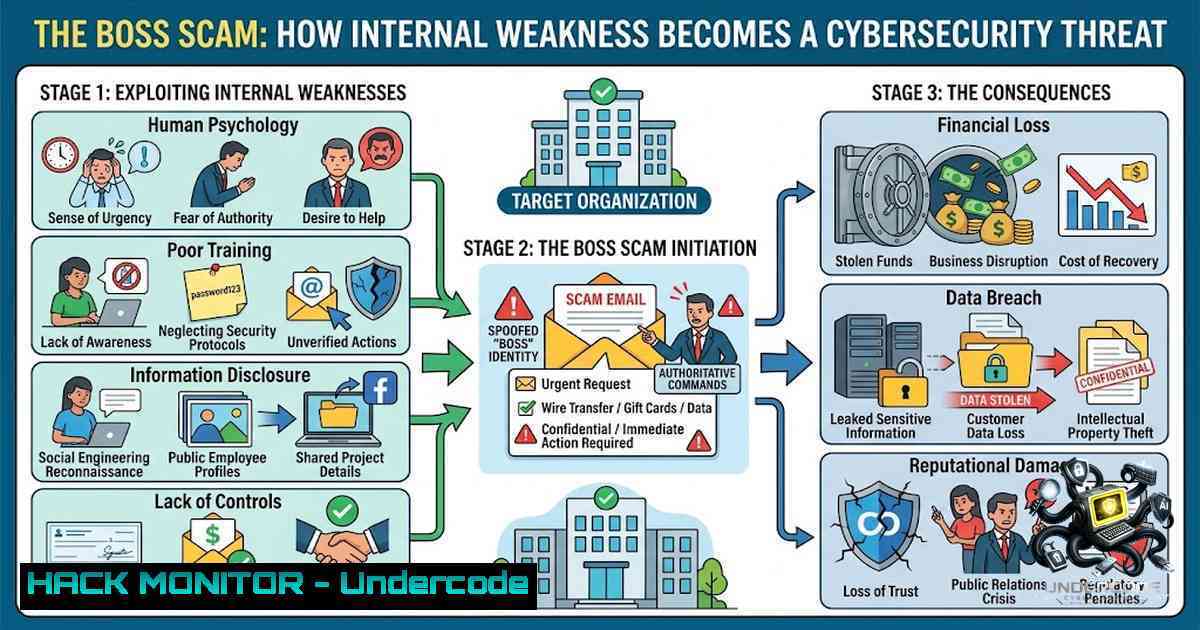
The Boss Scam, also known as CEO impersonation fraud or Business Email Compromise (BEC), represents one of the most financially devastating cybercrime trends of 2025. Unlike traditional hacking that targets technical vulnerabilities, this sophisticated attack weaponizes human psychology, organizational hierarchies, and internal procedural weaknesses. Cybercriminals are no longer just breaching firewalls—they are exploiting the very trust and authority structures that keep businesses running, using AI-generated deepfakes, voice cloning, and malware to impersonate senior executives and trick finance employees into transferring millions. With the FBI’s Internet Crime Complaint Center reporting approximately USD 2.77 billion in BEC losses in 2024 alone, organizations must recognize that cybersecurity is not just about protecting computers—it is about strengthening the people, processes, and systems behind the organization.
Learning Objectives & Secrets
- Objective 1: Understand the Dual Attack Vectors of the Boss Scam – Master the two primary methods criminals use: AI-driven deepfake impersonation (voice cloning, fake video calls, fabricated social media groups) and technical malware delivery via malicious compressed (.zip) files containing executable (.exe) and Dynamic Link Library (.dll) files that hijack WhatsApp Web sessions.
-
Objective 2 Secret Tip: Hijacking Legitimate Accounts Eliminates Traditional Red Flags – Unlike older scams using spoofed emails with suspicious domains or spelling errors, the evolved Boss Scam hijacks the executive’s actual and legitimate WhatsApp account. Attackers compromise the CEO’s device through a Trojan dropper, steal active session tokens, and gain complete control without needing the phone, password, or two-factor authentication code. Employees see messages from a verified, legitimate account—making traditional warning signs virtually invisible.
-
Objective 3 Secret Tip: Weaponizing “Unpublished Price Sensitive Information” (UPSI) – Attackers often instruct employees to keep transactions secret by claiming they involve UPSI or confidential business deals. This psychological manipulation exploits employees’ fear of violating securities regulations or leaking sensitive information, effectively discouraging them from double-checking with anyone else. The secrecy mandate is the attacker’s most powerful tool for bypassing internal verification procedures.
You Should Know
- The Technical Anatomy of the Boss Scam: How Attackers Hijack Executive Accounts
The Boss Scam operates through a meticulously planned, multi-stage attack chain:
Stage 1: Reconnaissance – Attackers study the target organization’s leadership, identify the CEO or Managing Director, and research organizational hierarchies, communication styles, and internal financial workflows.
Stage 2: Targeting the Executive – Cybercriminals approach senior executives through email or WhatsApp while posing as regulatory authorities (e.g., Reserve Bank of India officials). The message claims an urgent compliance violation requiring immediate remedial action and contains a compressed ZIP archive.
Stage 3: Malware Deployment – Inside the archive are malicious .exe and .dll files that, when run on a Windows system, deploy a Trojan dropper capable of establishing persistent access and hijacking active WhatsApp Web session tokens. Once the session token is compromised, the attacker gains complete control over the executive’s WhatsApp account.
Stage 4: Account Takeover and Contact List Manipulation – In more sophisticated attacks, cybercriminals who gain full control of the device secretly save their own phone number under the name of the CEO or Managing Director in the contact list. They then use that number to issue fake payment instructions to finance personnel, making the fraud appear to originate from a trusted senior executive.
Linux/Windows Commands and Detection Techniques:
For Windows (Malware Analysis – Detection & Response):
 Check for suspicious scheduled tasks (common persistence mechanism)
schtasks /query /fo LIST /v | findstr /i "whatsapp"

List recent file downloads in user's download folder
Get-ChildItem -Path "$env:USERPROFILE\Downloads" -Recurse | Where-Object {$_.LastWriteTime -gt (Get-Date).AddDays(-7)}

Check for suspicious .exe and .dll files in temp directories
Get-ChildItem -Path "$env:TEMP" -Recurse -Include .exe, .dll | Where-Object {$_.LastWriteTime -gt (Get-Date).AddDays(-7)}

Monitor active network connections for suspicious outbound traffic
netstat -ano | findstr ESTABLISHED

Check Windows Defender protection history for detected threats
Get-MpThreatDetection | Where-Object {$_.InitialDetectionTime -gt (Get-Date).AddDays(-7)}
For Linux (Email Header Analysis – Detecting Spoofing):
 Analyze email headers for SPF, DKIM, DMARC failures
grep -E "spf=|dkim=|dmarc=" email_header.txt

Extract and analyze sender IP from email headers
grep "Received: from" email_header.txt | tail -1

Check domain reputation using dig
dig +short example.com TXT | grep "v=spf1"

Verify DKIM record
dig +short default._domainkey.example.com TXT
Step‑by‑Step Guide: What This Does and How to Use It
- Monitor for Unusual WhatsApp Web Sessions – Regularly audit active WhatsApp Web sessions by navigating to WhatsApp Settings > Linked Devices. Immediately log out of any sessions you do not recognize.
-
Deploy Endpoint Detection and Response (EDR) – Use EDR solutions to monitor for suspicious file execution patterns, particularly .exe files launched from compressed archives in email or messaging apps.
-
Implement Application Whitelisting – Restrict execution of unsigned or untrusted .exe files, especially those originating from temporary or download folders.
-
Conduct Regular File Integrity Monitoring – Use tools like Sysinternals Autoruns (Windows) or AIDE (Linux) to detect unauthorized changes to system files and registry keys.
-
Log and Analyze Network Traffic – Monitor for unusual outbound connections to unknown IP addresses, which may indicate data exfiltration or command-and-control communication.
-
The Deepfake Dimension: When AI Clones Your CEO’s Voice
The rise of generative AI has transformed CEO impersonation from simple email spoofing into multi-channel, hyper-realistic deception. With a $5 voice-cloning tool and just 30 seconds of audio from a CEO’s recent keynote speech or YouTube video, attackers can generate a hauntingly accurate voice replica. In one real-world penetration test, security expert Rob Shapland cloned a CEO’s voice from a five-minute YouTube video, used ChatGPT to draft dialogue, and telephoned the service desk to request a password reset—the system complied without scrutiny. In another case, Equifax’s cybersecurity team intercepted a deepfake voice memo impersonating CEO Mark Begor, demonstrating that even Fortune 500 companies are targets. Voice deepfake incidents rose 680% year-over-year in 2025, with attackers cloning not just voices but also tone, cadence, and urgency.
Linux/Windows Commands and Detection Techniques:
For Deepfake Audio Detection (Python Script for Spectrogram Analysis):
import librosa
import numpy as np
import matplotlib.pyplot as plt

Load audio file and generate mel-spectrogram
def detect_audio_artifacts(audio_file):
y, sr = librosa.load(audio_file, sr=16000)
mel_spec = librosa.feature.melspectrogram(y=y, sr=sr, n_mels=128)
log_mel = librosa.power_to_db(mel_spec, ref=np.max)

Check for unnatural frequency gaps (common in synthetic audio)
mean_energy = np.mean(log_mel, axis=1)
artifacts = np.where(mean_energy < np.percentile(mean_energy, 10))[bash]

if len(artifacts) > 10:
return "Suspicious: Potential deepfake artifacts detected"
return "No obvious artifacts detected"

Usage: detect_audio_artifacts("suspicious_call.wav")
For VoIP Call Verification (Linux):
 Analyze SIP call metadata for anomalies
sipdump -i eth0 -p 5060 -o sip_calls.log

Check for mismatched caller ID vs. actual source IP
grep -E "From:|Contact:" sip_calls.log
Step‑by‑Step Guide: What This Does and How to Use It
- Establish a “Code Word” or Out-of-Band Verification Protocol – Require employees to verify urgent financial requests through a separate communication channel (e.g., a phone call to a known, verified number, not the one provided in the request).
-
Deploy Voice Biometrics and Liveness Detection – Implement systems that analyze audio for “liveness” to detect synthetic speech, checking for unnatural frequency artifacts, lack of breath sounds, or inconsistent pacing.
-
Limit Executive Digital Exposure – Reduce the amount of high-quality voice and video content of senior executives available publicly. Consider watermarking internal communications.
-
Conduct Regular Deepfake Simulation Exercises – Test your organization’s defenses by simulating AI-driven vishing (voice phishing) attacks to identify vulnerabilities in human response protocols.
-
Implement Real-Time Deepfake Detection – Deploy on-device deepfake detection solutions that analyze video and audio in real time without relying on cloud processing.
-
Email Authentication and Technical Controls: Building a Defense-in-Depth Strategy
Technical email authentication is a critical component of defending against CEO impersonation fraud. Proper configuration of SPF, DKIM, and DMARC prevents unauthorized use of your domain in CEO fraud phishing campaigns. Additionally, advanced email security solutions (Microsoft Defender for Office 365, Google Workspace ATP, Proofpoint, Mimecast) can detect and block emails with suspicious domains, unusual language patterns, or AI-generated content.
Linux/Windows Commands and Configuration:
Configure SPF Record (DNS TXT Record):
 Add SPF record to your domain's DNS
 Example: "v=spf1 mx include:_spf.google.com ~all"
 This allows Gmail servers to send on behalf of your domain

Verify SPF record
dig +short example.com TXT | grep "v=spf1"
Configure DKIM (DomainKeys Identified Mail):
 Generate DKIM key pair (Linux)
opendkim-genkey -D /etc/opendkim/keys/ -d example.com -s default

Add DKIM selector to DNS
 default._domainkey.example.com TXT "v=DKIM1; k=rsa; p=MIGfMA0GCSqGSIb3DQEBAQUAA4GNADCBiQKBgQ..."

Verify DKIM
dig +short default._domainkey.example.com TXT
Configure DMARC (Domain-based Message Authentication):
 Add DMARC record to DNS
 _dmarc.example.com TXT "v=DMARC1; p=reject; rua=mailto:[email protected]"

Verify DMARC
dig +short _dmarc.example.com TXT
Windows PowerShell – Monitor External Email Headers:
 Extract and flag emails with external sender warnings
Get-MessageTrace -StartDate (Get-Date).AddDays(-7) | Where-Object {$_.SenderDomain -1e "example.com"} |
Select-Object SenderAddress, RecipientAddress, Subject, Received

Configure Exchange Online mail flow rule to add external sender warning
 "If sender is external... prepend disclaimer 'CAUTION: External Email'"
Step‑by‑Step Guide: What This Does and How to Use It
- Implement SPF – Define which mail servers are authorized to send emails from your domain, preventing spoofing.
-
Implement DKIM – Add a digital signature to outgoing emails, allowing recipients to verify that the email was not tampered with during transit.
-
Implement DMARC with “reject” Policy – Instruct receiving mail servers to reject emails that fail SPF or DKIM validation, significantly reducing domain spoofing.
-
Add External Email Warning Banners – Configure email systems to display prominent warnings on emails originating from outside the organization, alerting employees to potential impersonation attempts.
-
Deploy AI-Powered Email Security – Use solutions that analyze email content for AI-generated patterns, fake email threads, and fabricated CEO confirmations.
-
Process Controls and the Human Firewall: Verification as the Last Line of Defense
Technology alone cannot stop CEO impersonation fraud. Organizations must implement robust procedural controls that create friction between a fraudulent request and financial execution. The four-eyes principle (dual authorization), independent verification through out-of-band channels, callback verification, and a culture where employees are encouraged to question unusual instructions are equally important.
Key Procedural Controls:
- Dual Authorization – Require two or more authorized individuals to approve any financial transaction above a threshold.
-
Out-of-Band Verification – Always verify payment requests through a separate communication channel (e.g., call the executive on a known, verified phone number, not the one provided in the request).
-
Callback Verification – Implement a mandatory callback procedure where the finance team calls the requesting executive using a pre-approved, verified contact number to confirm the request.
-
Payment Approval Procedures – Regularly review and update payment approval procedures to ensure they align with current threat intelligence.
-
Incident Reporting – Establish clear, non-punitive reporting channels for suspected fraud attempts. Encourage employees to report suspicious requests without fear of reprisal.
Step‑by‑Step Guide: What This Does and How to Use It
- Establish a Financial Transaction Verification Matrix – Define transaction thresholds and corresponding verification requirements (e.g., below $10,000: manager approval; above $10,000: dual authorization + callback verification).
-
Create a Centralized Verification Register – Document all out-of-band verification attempts, including date, time, requester name, verification method used, and outcome.
-
Conduct Regular Policy Reviews – Review and update verification procedures quarterly to address emerging threats and evolving attack techniques.
-
Implement “Challenge and Question” Culture – Train employees that questioning unusual requests is not insubordination but a critical security function. Celebrate employees who identify and report suspicious requests.
-
Run Simulated Attack Exercises – Conduct regular, realistic simulations of CEO impersonation attacks (email, voice, WhatsApp) to test employee response and procedural effectiveness.
-
Security Awareness Training: Moving Beyond Box-Ticking to Behavioral Change
Traditional security awareness training has become a tedious, bureaucratic exercise in “box-ticking” that fails its fundamental purpose. Organizations must evolve from static, annual training modules to dynamic, behavior-changing programs that address the emotional triggers and psychological manipulation techniques used by attackers. The human element accounted for 60% of breaches in Verizon’s 2025 report, with social engineering attacks such as phishing and BEC relying on psychological manipulation rather than technological vulnerabilities.
Key Training Elements:
- Emotional Trigger Recognition – Train employees to recognize and resist emotional manipulation tactics: urgency, authority, fear, secrecy, and flattery.
-
Multi-Channel Simulation – Conduct phishing, vishing (voice phishing), and SMS phishing (smishing) simulations across multiple channels (email, phone, WhatsApp, Teams).
-
Real-World Scenario Training – Use real-world attack examples and, where possible, recorded penetration testing footage to demonstrate vulnerability in tangible situations.
-
Continuous Reinforcement – Replace annual training with monthly micro-learning modules, quarterly simulations, and real-time coaching.
Step‑by‑Step Guide: What This Does and How to Use It
- Assess Current Training Effectiveness – Measure current phishing simulation click rates, reporting rates, and response times to establish baseline metrics.
-
Develop Multi-Channel Simulation Program – Design and execute simulated attacks across email, voice, SMS, and messaging platforms. Include AI-generated voice and video simulations for advanced training.
-
Create Feedback Loops – Provide immediate, constructive feedback to employees who fall for simulations. Use these moments as teachable opportunities.
-
Recognize and Reward Vigilance – Publicly recognize employees who report suspicious requests, reinforcing desired behavior.
-
Track and Measure Improvement – Monitor key metrics: reporting rates (aim for >90%), response times (aim for <5 minutes for suspicious reports), and simulation failure rates (aim for <5%).
What Undercode Say
- Key Takeaway 1: The Boss Scam exploits the convergence of human psychology, organizational authority, and technological vulnerability. Attackers don’t need to breach sophisticated firewalls—they need to breach human trust. By hijacking legitimate executive accounts and using AI-generated deepfakes, criminals bypass traditional security controls entirely. The most dangerous aspect is that messages come from verified, legitimate accounts, making them almost impossible to distinguish from authentic communications.
-
Key Takeaway 2: Prevention requires a layered defense combining technology, process, and culture. No single control is sufficient. Organizations must implement email authentication (SPF, DKIM, DMARC), deploy AI-powered email and voice security, enforce dual-authorization and out-of-band verification, and build a security culture where employees feel empowered to question unusual requests. The four-eyes principle and callback verification are non-1egotiable for financial transactions.
Analysis (10 lines):
The Boss Scam represents a paradigm shift in cybercrime—attackers are no longer exploiting technical vulnerabilities but systemic weaknesses in organizational trust and communication structures. The use of AI-generated deepfakes and voice cloning has democratized executive impersonation, reducing the cost and skill barrier for sophisticated attacks. The 680% year-over-year increase in deepfake vishing incidents underscores the urgency of this threat. Traditional security awareness training, which focuses on spotting suspicious emails, is largely ineffective against attacks that use legitimate, hijacked accounts. Organizations must move beyond “box-ticking” compliance to implement verification protocols that create procedural friction—forcing employees to independently confirm requests through separate channels. The psychological manipulation tactics used by attackers—urgency, authority, secrecy—exploit fundamental human biases that technology alone cannot address. With BEC losses totaling $2.77 billion in 2024, the financial impact is staggering and growing. The most effective defense is a combination of technical controls (email authentication, AI-powered detection), procedural controls (dual authorization, out-of-band verification), and cultural change (empowering employees to question authority). Organizations that treat cybersecurity as purely a technology problem will continue to fall victim to attacks that exploit the human element. The Boss Scam is not just a cybersecurity threat—it is a fundamental challenge to how organizations manage trust, authority, and verification in the digital age.
Prediction
- +1 The increased regulatory attention from bodies like SEBI and I4C will drive rapid adoption of mandatory verification protocols and AI-detection technologies across regulated industries, significantly reducing successful attacks by 2027.
-
-1 As defense mechanisms improve, attackers will shift to even more sophisticated multi-channel attacks combining deepfake video calls, compromised legitimate accounts, and real-time AI-generated conversations, making detection increasingly difficult.
-
-1 The accessibility of AI voice-cloning tools (some available for as little as $5) will democratize CEO impersonation, enabling a surge in attacks against small and medium-sized businesses that lack sophisticated defenses.
-
+1 The emergence of real-time deepfake detection solutions and voice biometrics with “liveness” detection will provide organizations with new capabilities to identify synthetic audio and video before financial damage occurs.
-
-1 Attackers will increasingly target not just CEOs but also CFOs, legal counsel, and IT leaders—expanding the attack surface beyond the C-suite to any individual with financial authorization authority.
-
+1 Organizations that invest in comprehensive, multi-layered defenses combining technology, process, and culture will develop a competitive advantage in cybersecurity resilience, attracting investors and partners who prioritize risk management.
-
-1 The exploitation of “Unpublished Price Sensitive Information” (UPSI) claims will continue to be an effective psychological weapon, as employees fear violating securities regulations more than they fear questioning a CEO’s request.
-
+1 Regulatory frameworks will evolve to mandate out-of-band verification for all financial transactions above a certain threshold, creating a standardized defense mechanism across industries.
-
-1 Until organizations fundamentally shift their security culture to one where questioning authority is encouraged rather than discouraged, the Boss Scam will remain a persistent and evolving threat.
-
+1 The cybersecurity industry will develop integrated platforms that correlate security signals across email, voice, video, and messaging channels, exposing hidden impersonation attempts before fraud or data loss occurs.
▶️ Related Video (88% Match):
https://www.youtube.com/watch?v=_pg6hobbAZ8
🎯Let’s Practice For Free:
🎓 Live Courses & Certifications:
Join Undercode Academy for Verified Certifications
🚀 Request a Custom Project:
Secure, high-velocity infrastructure and disruptive technological engineering. Contact our engineering team for high-tier development and proprietary systems:
[email protected]
💎 Smart Architecture | 🛡️ Secure by Design | ⭐ Trusted by Thousands
IT/Security Reporter URL:
Reported By: https://lnkd.in/p/e6gAP9W6 – Hackers Feeds
Extra Hub: Undercode MoN
Basic Verification: Pass ✅


