
Listen to this Post
Introduction:
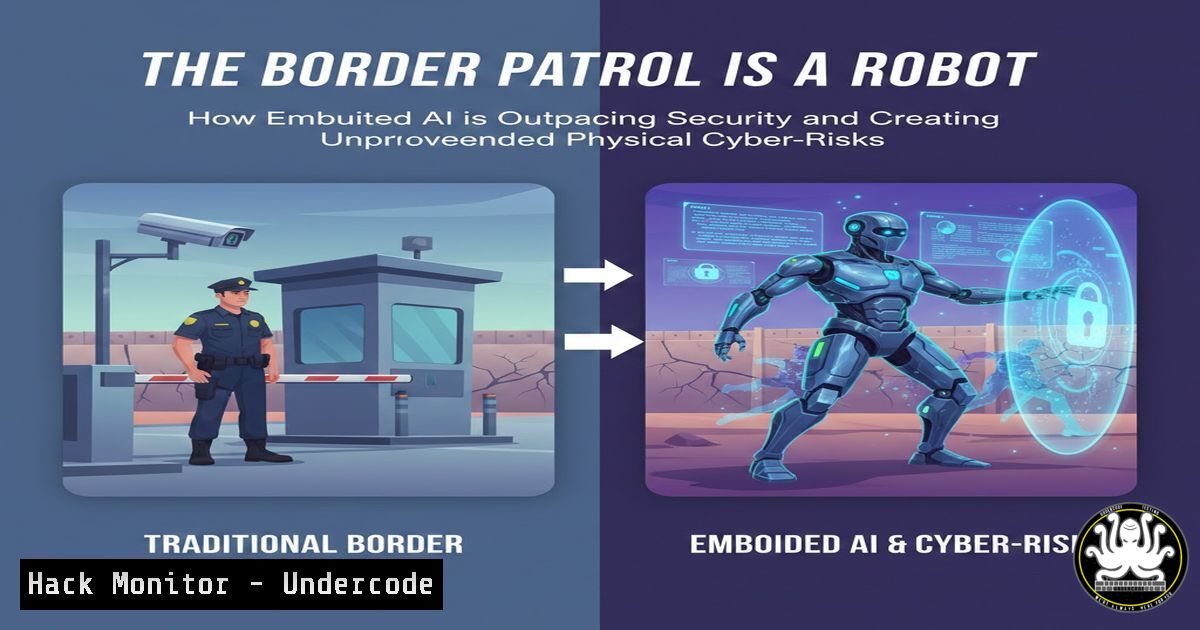
The deployment of humanoid robots for border patrol and public infrastructure management marks a dangerous inflection point in cybersecurity. This shift from abstract data threats to tangible physical harm, powered by autonomous, always-on systems operating without mature safety models, represents a critical failure to govern before deployment. The core risk is no longer mere data exfiltration but the potential for cascading physical failures in state-critical environments.
Learning Objectives:
- Understand the unique threat landscape introduced by embodied AI in critical infrastructure.
- Learn the technical attack vectors specific to autonomous physical systems.
- Explore mitigation strategies and governance frameworks needed to secure these systems.
You Should Know:
- From Data Breach to Physical Harm: The New Risk Category
Embodied AI transforms a software compromise into a potential physical incident. A hacked server leaks data; a hacked patrol robot can cause bodily injury, disrupt critical logistics, or compromise border integrity. These systems integrate complex stacks—sensors, actuators, navigation AI, and communication modules—each a potential entry point.
Step‑by‑step guide to understanding the attack surface:
Step 1: Map the System Stack. Identify components: Perception (LIDAR, cameras), Decision (AI models), Action (motors, manipulators), and Communication (Wi-Fi, 5G, Bluetooth).
Step 2: Identify Attack Vectors.
Sensor Spoofing: Inject malicious data into perception systems. ` Example: Using a software-defined radio (SDR) to spoof GPS coordinates, causing navigational failure.`
Model Evasion: Use adversarial attacks to fool computer vision models, making the robot “blind” to obstacles or persons.
Actuator Hijacking: Exploit firmware vulnerabilities in motor controllers to induce harmful movements.
Step 3: Execute a Test. In a controlled lab environment, tools like `ROSpenetration` (a Robot Operating System security testing framework) can be used to probe for weak authentication on ROS topics or services, a common flaw in research and early commercial robots.
2. The “Always-On” Blast Radius and Containment Failure
Self-charging autonomy removes vital security checkpoints. Without scheduled downtime for patches, manual reboots, or human oversight intervals, vulnerabilities persist and propagate.
Step‑by‑step guide to assessing operational continuity risks:
Step 1: Audit the Update Mechanism. How are security patches delivered? Over-the-air (OTA) updates are a prime target. Verify signing keys and rollback capabilities. ` Linux command to check failed or pending updates on a Linux-based robot: journalctl -u update-manager`
Step 2: Analyze Cluster Communication. Robots often share data. A compromise in one can spread. Inspect inter-robot communication protocols (e.g., DDS, custom UDP) for encryption and authentication.
Step 3: Implement Forced Safety Intervals. Advocate for and design mandatory, regular “safety check” halts that force a security state validation and log upload before resuming operation, creating intervention windows.
- Inheriting the Weakest Link: Exploiting the Full Stack
Recent demonstrations show robots hijacked via voice commands (audio deepfakes), wireless exploits jumping air gaps via removable batteries, and lateral movement in robot swarms. The system is only as strong as its most vulnerable component.
Step‑by‑step guide for penetration testing an embodied AI system:
Step 1: Reconnaissance. Use `nmap` to scan for open ports on the robot’s IP. Common ports for development and debugging (e.g., 11311 for ROS, 22 for SSH) are often inadvertently exposed. `nmap -sV -p-
Step 2: Vulnerability Assessment. Use dedicated hardware hacking tools like the Flipper Zero or Proxmark3 to test RFID/NFC badge readers used for robot access or charging station activation.
Step 3: Post-Exploitation. If access is gained, dump configuration files to find API keys, map internal networks, and identify other robots. ` On a compromised Linux-based system: find / -name “.conf” -o -name “.yaml” -o -name “.json” 2>/dev/null | grep -i “key\|token\|secret\|password”`
4. Bridging the Governance Gap with Technical Enforcement
The EU AI Act classifies border control AI as high-risk, mandating rigorous risk management. The technical challenge is enforcing these principles on deployed systems.
Step‑by‑step guide for implementing technical controls aligned with governance:
Step 1: Mandate “Black Box” Event Logging. Implement immutable, encrypted logging of all decision inputs and actions. Use hardware security modules (HSMs) or Trusted Platform Modules (TPMs) to ensure log integrity for forensic accountability.
Step 2: Enforce Runtime Integrity Monitoring. Use tools like IMA (Integrity Measurement Architecture) on Linux kernels to detect unauthorized changes to critical system files in real-time.
Step 3: Deploy “Kill Switch” Protocols. Design and test secure, redundant mechanisms for immediate physical deactivation (e.g., hardware-based dead-man switches) that cannot be overridden by compromised software.
5. Building a Security Model for Physical Autonomy
Security must be baked into the robot’s operational design, not bolted on. This requires a shift from traditional IT cybersecurity to Cyber-Physical Systems (CPS) security.
Step‑by‑step guide for security-by-design in embodied AI:
Step 1: Adopt a CPS Security Framework. Implement guidelines from NIST IR 8425 (Cybersecurity for CPS) or the MITRE ATT&CK for ICS matrix, adapting tactics to robotic contexts.
Step 2: Harden the Communication Layer. Use certificate-based mutual TLS for all communications, even internal bus communications like CAN, using solutions like CANcrypt.
Step 3: Implement Least-Privilege Actuation. Sandbox the AI decision model so its outputs are vetted by a simpler, verified safety controller that checks for physically impossible or dangerous commands before execution.
What Undercode Say:
- The Attack Surface is Now Physical. The most critical vulnerability is no longer in the cloud API, but in the robot’s actuator firmware or sensor calibration routine. A denial-of-service attack can now mean a literal obstruction in a critical corridor.
- Regulation Lags, But Technical Controls Can Lead. While legal liability frameworks are debated, organizations must immediately implement the technical controls that make accountability possible—immutable logs, integrity checks, and secure containment protocols.
The analysis reveals a dangerous trajectory: resilience (staying operational) is being prioritized over security (staying safe). The border robot case is a canary in the coal mine for smart cities, automated public transport, and robotic first responders. The industry is building systems capable of independent action faster than it is building the systems to monitor, constrain, and explain those actions. The resulting governance gap is not just a policy vacuum; it is an active, exploitable vulnerability in our public infrastructure.
Prediction:
Within the next 2-3 years, the first major kinetic security incident caused by a compromised embodied AI system in public infrastructure is highly probable. This will likely be a cascading failure—such as a logistics robot swarm hijacked to create an obstruction, or a public guidance robot manipulated to cause a panic. The fallout will accelerate fragmented, reactive regulation, pushing for mandatory “ethical kill switches” and standardized pentesting for physical AI. This incident will force a fundamental convergence of cybersecurity, insurance liability models, and public safety policy, creating a new discipline of “Physical AI Security.” Companies that have not built verifiable safety and security attestations into their systems will face existential legal and reputational damage.
▶️ Related Video (74% Match):
🎯Let’s Practice For Free:
IT/Security Reporter URL:
Reported By: Chiaragallesephd Everyone – Hackers Feeds
Extra Hub: Undercode MoN
Basic Verification: Pass ✅


