
Listen to this Post
Introduction:
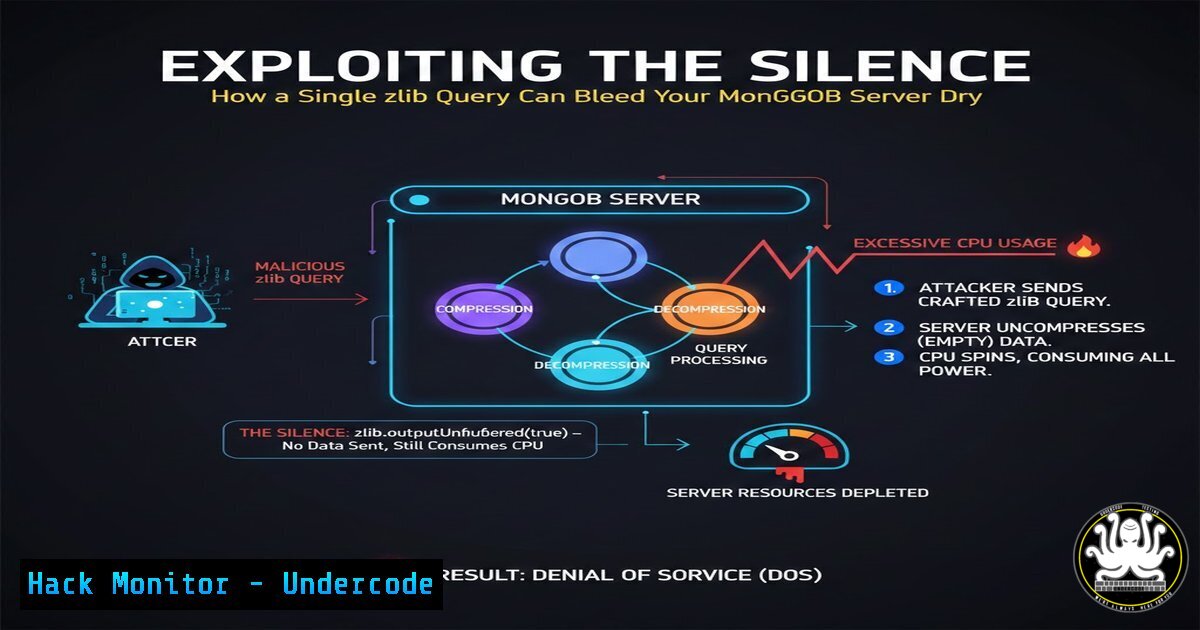
A critical vulnerability designated CVE-2025-14847 has exposed a fundamental flaw in MongoDB’s zlib decompression process, allowing unauthenticated attackers to exfiltrate sensitive server memory. This memory leak exploit, dubbed “MongoBleed,” bypasses all authentication checks, posing a severe risk to data confidentiality. Security researchers have released a proof-of-concept, transforming a theoretical weakness into an immediate and pressing operational threat.
Learning Objectives:
- Understand the mechanism of the unauthenticated zlib decompression memory leak in MongoDB.
- Learn to identify affected MongoDB versions and implement immediate mitigation steps.
- Explore defensive configurations and monitoring techniques to detect exploitation attempts.
You Should Know:
- The Core Vulnerability: Unauthenticated Memory Access via zlib
The exploit targets MongoDB’s handling of compressed data. When a client sends a maliciously crafted zlib-compressed message, a flaw in the server’s decompression logic fails to properly bound memory operations. This allows an attacker to read adjacent memory segments far beyond the intended buffer, potentially exposing session tokens, database queries, user credentials, or other application secrets residing in RAM. The attack requires no authentication, making any publicly accessible MongoDB instance a viable target.
Step-by-Step Guide to Understanding the Exploit Flow:
- Attacker Crafting: The attacker uses a tool (like the released PoC) to create a specific zlib payload designed to trigger an out-of-bounds read during decompression.
- Network Request: The payload is sent to the MongoDB server port (default 27017) within a standard network packet. No login credentials are required.
- Server Processing: The MongoDB server, upon receiving the packet, recognizes it as compressed data and passes it to its vulnerable zlib decompression routine.
- Memory Leak: The flawed routine reads excess bytes from server memory and includes this data in its response to the attacker.
- Data Exfiltration: The attacker extracts the leaked memory data from the server’s response for analysis.
2. Immediate Identification and Triage
Your first action must be to determine your exposure. The vulnerability affects a wide range of versions, from the legacy 5.0 series up to the latest 8.2 releases at the time of discovery.
Step-by-Step Guide to Check Your Version:
- Connect to your MongoDB instance using the `mongo` shell or
mongosh:mongosh "mongodb://your-hostname:27017"
- Run the version query: Once connected, execute the following command:
db.version()
- Compare the output: Check if your version string falls into any of these affected ranges:
`8.2.0` to `8.2.2`
`8.0.0` to `8.0.16`
`7.0.0` to `7.0.27`
`6.0.0` to `6.0.26`
`5.0.0` to `5.0.31`
- Inventory: Document all instances, including development, staging, and production systems, as well as any embedded services that use MongoDB.
3. Critical Mitigation: Patching and Configuration Hardening
Patching is the only complete remedy. If immediate patching is impossible, strict network controls are your essential temporary shield.
Step-by-Step Mitigation Guide:
Primary Action – Apply Patches: Upgrade to the patched versions immediately (e.g., 8.2.3, 8.0.17, 7.0.28, 6.0.27, 5.0.32 or later).
Emergency Workaround – Network Access Control:
Firewall Rule (Linux iptables example): Block all external access to MongoDB, allowing only from known application servers.
 DROP all traffic on port 27017 from non-trusted sources
sudo iptables -A INPUT -p tcp --dport 27017 -s YOUR_APP_SERVER_IP -j ACCEPT
sudo iptables -A INPUT -p tcp --dport 27017 -j DROP
MongoDB Configuration (mongod.cfg): Ensure `net.bindIp` is not set to 0.0.0.0. Specify only the necessary internal IPs or use `127.0.0.1` for local-only access.
net:
bindIp: 127.0.0.1,10.0.1.50  Explicit IPs only
port: 27017
Enable Authentication: While this flaw bypasses auth, having `security.authorization: enabled` is a critical baseline security control to limit other attack vectors.
4. Detection and Forensic Analysis
Detecting exploitation requires monitoring for unusual patterns. The exploit generates specific error logs and network traffic.
Step-by-Step Detection Guide:
- Log Monitoring: Scrutinize MongoDB logs (
/var/log/mongodb/mongod.log) for `”compression”` related error messages or warnings that are anomalous in volume or context. - Network Traffic Analysis: Use tools like `tcpdump` to capture traffic on the MongoDB port and look for patterns matching the PoC.
sudo tcpdump -i any port 27017 -w mongodb_traffic.pcap
- Analyze with Wireshark: Open the capture in Wireshark and apply a filter for
tcp.port == 27017. Look for requests that are followed by unusually large response packets from the server, which could indicate leaked memory being sent. - Host Memory Monitoring: Use OS-level tools (
top,htop,vmstat) to watch for abnormal memory usage patterns on the MongoDB host, though this exploit reads memory without necessarily changing allocation.
5. Long-Term Defensive Posture: Beyond This CVE
This vulnerability highlights systemic risks. Move beyond reactive patching to a proactive, defense-in-depth strategy.
Step-by-Step Hardening Guide:
- Adopt a Zero-Trust Network Model: Never expose database ports to the public internet. Place MongoDB within a private subnet, accessible only via a bastion host or a VPN.
- Implement Regular Patching Cycles: Establish a formal process to review and apply MongoDB security updates within a defined, short timeframe (e.g., 72 hours for critical CVEs).
- Utilize Security Tools: Deploy Intrusion Detection Systems (IDS) like Suricata or Wazuh with rules tuned to detect database exploitation patterns and memory leak anomalies.
- Conduct Penetration Tests: Regularly engage security professionals to perform authorized tests on your database infrastructure, simulating attacks like CVE-2025-14847 to find gaps before adversaries do.
What Undercode Say:
- The Perimeter is Dead for Databases. This exploit proves that relying solely on firewalls or authentication to protect databases is insufficient. A single vulnerable service listening on a port can be a direct conduit to core memory.
- Memory Safety is a Shared Responsibility. The bug resides in a widely-used library (zlib), underscoring that application security is a chain that includes all dependencies. Organizations must have visibility into and a plan for vulnerabilities in underlying components.
This incident forces a strategic reckoning. It demonstrates that even robust, modern databases are vulnerable to primitive yet devastating memory corruption bugs. The ease of unauthenticated exploitation will make this a favorite tool for automated internet scanners and ransomware groups seeking initial footholds. In the future, we predict a surge in attacks targeting similar compression and parsing libraries across different database technologies, pushing the industry towards memory-safe languages and more rigorous fuzz-testing of data deserialization pathways. Organizations that treat this as a simple patch event will be repeatedly compromised; those that use it as a catalyst to enforce strict network segmentation and adopt proactive threat hunting will build a decisive defensive advantage.
Prediction:
The successful exploitation of CVE-2025-14847 will catalyze a focused offensive research campaign against data serialization and compression components in other NoSQL and big-data platforms (like Redis, Elasticsearch, and Cassandra). Within the next 12-18 months, we anticipate the discovery of similar “Bleed”-style memory leak vulnerabilities, leading to a short-term spike in mass data breaches. This will accelerate the long-term industry shift towards implementing memory-safe languages (like Rust) for critical network-facing services and mandate hardware-assisted memory isolation (like Intel MKTME) as a standard deployment requirement for database servers in the cloud.
▶️ Related Video (80% Match):
🎯Let’s Practice For Free:
IT/Security Reporter URL:
Reported By: Saurabh B294b21aa – Hackers Feeds
Extra Hub: Undercode MoN
Basic Verification: Pass ✅


