Listen to this Post
Introduction:
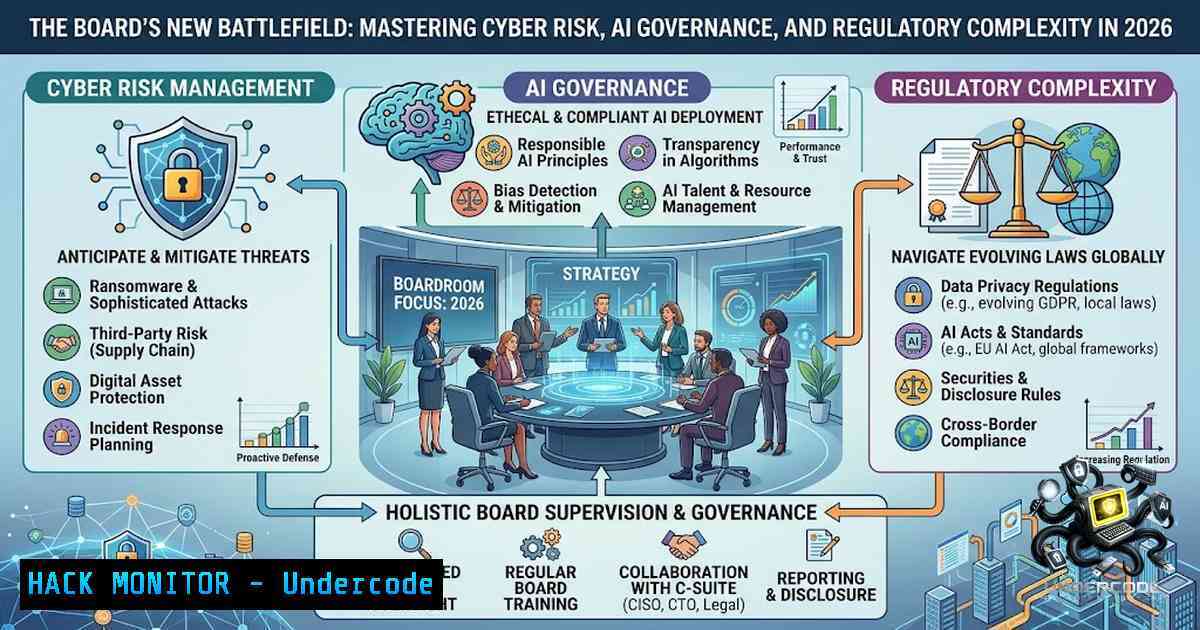
Corporate boards are navigating an unprecedented convergence of cyber threats, artificial intelligence disruption, and intensifying regulatory scrutiny—a trifecta of risks that demands a fundamental transformation in how directors exercise oversight. According to the 2025 “What Directors Think” survey conducted by Corporate Board Member, Diligent Institute, and FTI Consulting, while 76% of directors are prioritizing growth initiatives, strategy has overtaken cybersecurity as the top oversight challenge for the first time in years, yet only 25% of boards require directors to receive cyber education. This paradox—prioritizing growth without adequately equipping boards to govern the associated digital risks—represents one of the most critical governance gaps of our era.
Learning Objectives:
- Understand the evolving cyber risk landscape and board-level accountability frameworks, including NIST CSF 2.0 and emerging regulatory requirements
- Master AI governance principles that balance offensive innovation with defensive risk mitigation across tactical and strategic dimensions
- Develop practical technical competencies to assess security postures, audit AI systems, and implement compliance controls across cloud, API, and data governance domains
- Cyber Risk Governance: From Periodic Briefings to Continuous Oversight
The traditional model of quarterly cybersecurity updates from the CISO is no longer sufficient. With 71% of boards now hearing from their CISO regularly, yet only half having reviewed their disclosure and response protocols, a dangerous execution gap persists. The UK’s Cyber Security and Resilience Bill, introduced in late 2025, signals a decisive shift toward greater accountability for preparedness and board-level oversight across critical sectors.
Step-by-Step Guide: Implementing Board-Level Cyber Risk Oversight
Step 1: Establish a Cyber Risk Dashboard. Deploy a real-time security metrics dashboard that aggregates key risk indicators (KRIs) including mean time to detect (MTTD), mean time to respond (MTTR), patch cadence, and third-party risk scores. Tools like Splunk, Elastic Security, or custom Grafana dashboards can visualize this data.
Step 2: Conduct a Cyber Risk Assessment. Perform a comprehensive assessment aligned with NIST CSF 2.0’s six functions: Govern, Identify, Protect, Detect, Respond, and Recover. The December 2025 NIST Cyber AI Profile (IR 8596) extends this framework specifically to AI-related cybersecurity risks.
Step 3: Integrate Cyber into Strategy. Require that all strategic initiatives—M&A, digital transformation, cloud migration—include a mandatory cyber risk impact assessment. As FTI Consulting’s research emphasizes, cyber readiness is now a leadership credibility issue, particularly in regulated sectors such as finance, health, and infrastructure.
Step 4: Mandate Director Cyber Education. Implement annual board-level cyber training covering incident response protocols, regulatory obligations, and emerging threat vectors. Only 25% of boards currently require this—a gap that must be closed.
Step 5: Test Incident Response. Conduct tabletop exercises simulating ransomware attacks, data breaches, and supply chain compromises at least twice annually. Document lessons learned and update response playbooks accordingly.
Linux Command: Auditing System Logs for Anomalies
 Review authentication logs for failed login attempts
sudo grep "Failed password" /var/log/auth.log | awk '{print $1,$2,$3,$9,$11}' | sort | uniq -c | sort -1r

Check for unusual sudo usage
sudo grep "sudo" /var/log/auth.log | grep -v "COMMAND=/usr/bin/apt"

Monitor systemd services for unexpected failures
sudo systemctl list-units --state=failed
Windows Command: Security Event Log Analysis
 Query security logs for failed logon events (Event ID 4625)
Get-WinEvent -FilterHashtable @{LogName='Security'; ID=4625} -MaxEvents 100 |
Select-Object TimeCreated, @{N='User';E={$<em>.Properties[bash].Value}},
@{N='Source IP';E={$</em>.Properties[bash].Value}}

Check for suspicious scheduled tasks
Get-ScheduledTask | Where-Object {$<em>.State -1e 'Disabled'} |
Select-Object TaskName, State, @{N='LastRun';E={(Get-ScheduledTaskInfo $</em>.TaskName).LastRunTime}}
2. AI Governance: Playing Offense and Defense Simultaneously
AI is no longer optional—80% of companies have taken action to adopt or explore generative AI, yet board-level understanding remains uneven. As Sumeet Gupta of FTI Consulting notes, “It is no longer adequate for an organisation’s Board of Directors to focus on traditional risk vectors when it comes to AI governance. They must be equipped to understand, assess and advise on both defensive and offensive plays for creating and protecting shareholder value through AI adoption”.
Step-by-Step Guide: Building an AI Governance Framework
Step 1: Classify AI Risks into Tactical and Strategic Categories. Tactical risks include data leakage, model drift, shadow AI deployments, weak access controls, third-party model exposure, and regulatory noncompliance. Strategic risks encompass competitive disadvantage from inaction, reputational damage from AI failures, and loss of market position.
Step 2: Establish Board-Level AI Oversight. Assign AI governance responsibility to a dedicated board committee (Audit, Risk, or Technology) and ensure at least one director possesses AI/technology proficiency. Implement quarterly AI compliance reporting.
Step 3: Implement a Risk-Based AI Onboarding Process. Create a tiered approval framework: low-risk AI applications (e.g., internal productivity tools) require streamlined review; high-risk applications (e.g., customer-facing decision systems, HR automation) require full board notification and rigorous validation.
Step 4: Maintain an AI Systems Registry. Document all AI and GenAI systems in use across the organization, including vendor-supplied solutions. Track model versions, training data sources, intended use cases, and validation results.
Step 5: Enforce Human Oversight. Ensure continuous human supervision of AI systems, particularly those that learn and evolve, to identify potential malfunctions or unintended outcomes.
Code Snippet: Auditing AI Model Outputs for Bias
import pandas as pd
from sklearn.metrics import confusion_matrix

Load model predictions and ground truth
df = pd.read_csv('model_predictions.csv')

Calculate demographic parity
protected_groups = df.groupby('demographic_group')
for group, data in protected_groups:
approval_rate = data['approved'].mean()
print(f"{group}: {approval_rate:.2%}")

Check for disparate impact (80% rule)
base_rate = df['approved'].mean()
for group, data in protected_groups:
rate = data['approved'].mean()
ratio = rate / base_rate
print(f"{group} disparate impact ratio: {ratio:.2f}")
if ratio < 0.8:
print(f"WARNING: Potential disparate impact detected for {group}")
3. Cloud and API Security Hardening
As organizations accelerate cloud adoption and API-driven architectures, the attack surface expands exponentially. Boards must ensure that cloud security posture management (CSPM) and API security are embedded in governance frameworks.
Step-by-Step Guide: Cloud Security Hardening
Step 1: Implement Least Privilege Access. Audit all IAM roles and remove excessive permissions. Use AWS IAM Access Analyzer, Azure AD Privileged Identity Management, or GCP Policy Analyzer.
Step 2: Enable Comprehensive Logging. Activate CloudTrail (AWS), Azure Monitor, or Cloud Logging (GCP) with retention periods aligned to regulatory requirements (minimum 1 year for financial services).
Step 3: Deploy API Security Controls. Implement API gateways with rate limiting, authentication (OAuth 2.0/OIDC), and input validation. Use tools like Kong, AWS API Gateway, or Apigee.
Step 4: Conduct Regular Penetration Testing. Engage third-party security firms for annual penetration tests covering cloud infrastructure, APIs, and web applications.
AWS CLI Commands for Security Auditing
 List all S3 buckets with public access
aws s3api list-buckets --query 'Buckets[].Name' --output text |
xargs -I {} aws s3api get-bucket-acl --bucket {} --query 'Grants[?Grantee.URI==`http://acs.amazonaws.com/groups/global/AllUsers`]'

Check for unencrypted EBS volumes
aws ec2 describe-volumes --query 'Volumes[?Encrypted==<code>false</code>]'

Audit IAM roles with administrative policies
aws iam list-policies --scope Local --query 'Policies[?AttachmentCount>0]' |
jq '.[] | select(.DefaultVersionId) | .PolicyName'
4. Regulatory Compliance and Disclosure Readiness
The regulatory landscape is shifting rapidly. The Digital Markets, Competition and Consumers Act has expanded consumer protection enforcement powers, with investigations into online pricing practices signaling heightened scrutiny. Boards must ensure their organizations are prepared for both regulatory examinations and public disclosure requirements.
Step-by-Step Guide: Building Compliance Readiness
Step 1: Map Regulatory Obligations. Identify all applicable regulations (GDPR, CCPA, DORA, UK Cyber Security Bill, sector-specific requirements) and maintain a compliance matrix.
Step 2: Implement Continuous Monitoring. Deploy GRC (Governance, Risk, Compliance) platforms such as OneTrust, RSA Archer, or ServiceNow GRC to track compliance status in real time.
Step 3: Establish Whistleblower and Incident Reporting. Ensure clear channels for employees to report security incidents or compliance violations without fear of retaliation.
Step 4: Review Disclosure Protocols. Update SEC/regulatory disclosure protocols to include material cybersecurity incidents, AI usage, and third-party risk exposures.
5. Third-Party and Supply Chain Risk Management
With 50% of directors listing M&A as a key agenda item, third-party risk due diligence has become mission-critical. Boards must ensure that acquisition targets and key vendors undergo rigorous security and compliance assessments.
Step-by-Step Guide: Vendor Risk Assessment
Step 1: Categorize Vendors by Criticality. Classify vendors as Critical (direct access to sensitive data), High (integrated systems), or Standard (limited access).
Step 2: Conduct Due Diligence. Require SOC 2 Type II reports, ISO 27001 certification, and penetration test summaries from all Critical and High vendors.
Step 3: Monitor Vendor Security Posture. Use third-party risk platforms (BitSight, SecurityScorecard, RiskRecon) to continuously monitor vendor security ratings.
Step 4: Include Cybersecurity Representations in Contracts. Ensure all vendor contracts include cybersecurity representations, breach notification clauses, and right-to-audit provisions.
What Undercode Say:
- Key Takeaway 1: Boards must transition from passive recipients of cybersecurity updates to active governors of digital risk, requiring mandatory cyber education, real-time dashboards, and integrated risk frameworks that treat cyber as a strategic imperative rather than a technical footnote.
-
Key Takeaway 2: AI governance demands a dual mandate—playing offense to capture competitive advantage while playing defense against tactical risks like data leakage, model drift, and regulatory noncompliance. The board’s role is to set risk appetite, fortify controls, and progress from observer to integrator.
Analysis: The convergence of cyber risk, AI disruption, and regulatory complexity represents a fundamental shift in corporate governance. The 2025 “What Directors Think” data reveals a troubling paradox: while growth is back on the agenda, board-level cyber and AI competencies remain dangerously underdeveloped. Only 25% of boards mandate director cyber education, and board-level AI understanding remains uneven despite 80% of companies adopting or exploring GenAI. This gap between strategic ambition and governance capability creates systemic vulnerability. Organizations that fail to close this gap risk not only regulatory penalties and reputational damage but also strategic paralysis—the inability to confidently pursue AI-driven innovation while managing associated risks. The emerging regulatory frameworks in the UK and EU, combined with NIST’s Cyber AI Profile, provide clear roadmaps for boards to follow. The question is no longer whether boards should govern cyber and AI, but how quickly they can build the necessary capabilities.
Prediction:
- +1 Boards that mandate director cyber and AI education by 2027 will outperform peers by 15-20% in risk-adjusted returns, as regulatory scrutiny intensifies and investors demand demonstrated governance maturity.
-
-1 Organizations that fail to establish dedicated AI governance committees and comprehensive cyber oversight will face a 40% higher probability of material breach or regulatory enforcement action within 24 months, according to emerging industry benchmarks.
-
+1 The NIST Cyber AI Profile (draft December 2025) will become the de facto global standard for AI security governance, driving convergence between cybersecurity and AI risk management frameworks across jurisdictions.
-
-1 Boards that treat geopolitical risk as a secondary concern—despite 79% citing it as a threat while fewer than 10% prioritize managing it—will experience significant strategic disruption from trade fragmentation, sanctions, and supply chain volatility.
-
+1 The integration of AI-powered predictive risk scoring aligned to NIST CSF 2.0 Governance functions will enable boards to move from reactive oversight to proactive risk anticipation, transforming governance from periodic reporting to continuous intelligence.
▶️ Related Video (80% Match):
https://www.youtube.com/watch?v=1ApYCwgUFxk
🎯Let’s Practice For Free:
🎓 Live Courses & Certifications:
Join Undercode Academy for Verified Certifications
🚀 Request a Custom Project:
Secure, high-velocity infrastructure and disruptive technological engineering. Contact our engineering team for high-tier development and proprietary systems:
[email protected]
💎 Smart Architecture | 🛡️ Secure by Design | ⭐ Trusted by Thousands
IT/Security Reporter URL:
Reported By: Danielsdonahue Board – Hackers Feeds
Extra Hub: Undercode MoN
Basic Verification: Pass ✅


