Listen to this Post
Introduction:
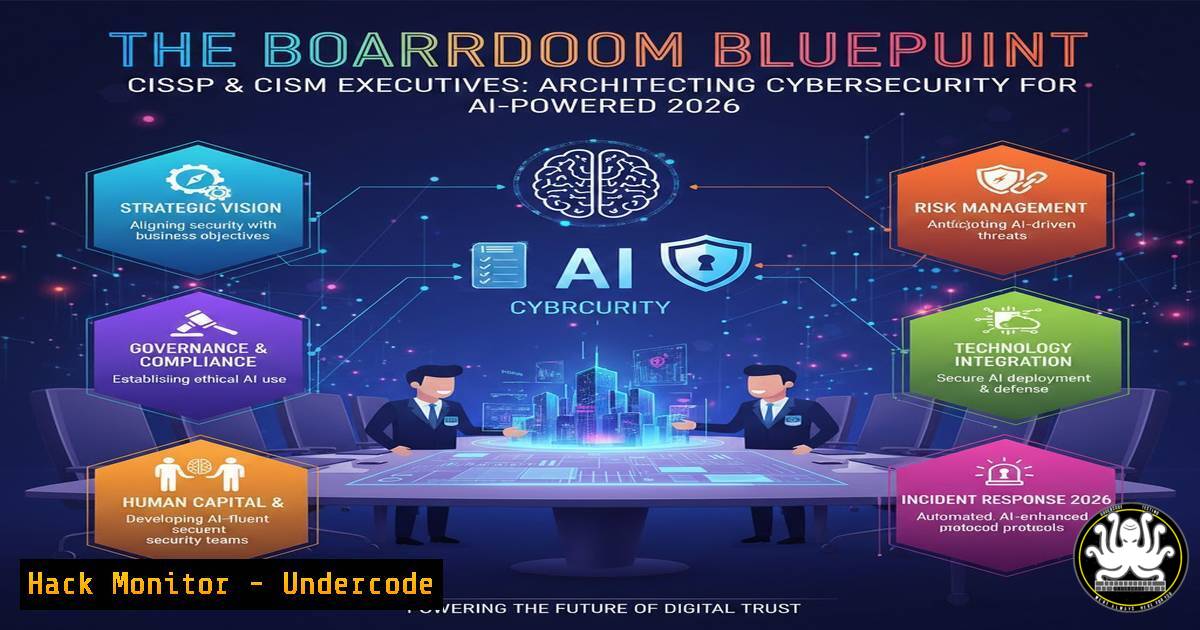
As we enter 2026, the convergence of AI innovation and escalating cyber threats has redefined the corporate battleground. Cybersecurity is no longer a technical footnote but a core boardroom imperative, demanding a strategic fusion of certified expertise—like CISSP and CISM—and proactive governance. This article decodes the executive mindset essential for building resilient organizations in this new era, moving beyond compliance to active defense.
Learning Objectives:
- Understand the strategic governance frameworks (CISM) and architectural principles (CISSP) required for modern cyber defense.
- Learn practical technical controls for API security, cloud hardening, and AI system protection.
- Develop a proactive incident response and threat-hunting posture informed by board-level risk management.
You Should Know:
1. From CISSP Domains to Cloud Security Hardening
The CISSP domain of Security Architecture and Engineering directly translates to cloud infrastructure design. A certified executive ensures architectures follow the principle of least privilege and zero trust.
Step‑by‑step guide:
- Audit IAM Policies: In AWS, use the CLI to list policies and attached entities.
aws iam list-policies --scope Local --query 'Policies[?AttachmentCount!=<code>0</code>].{PolicyName:PolicyName, Arn:Arn}' - Enforce Multi-Factor Authentication (MFA): Ensure all root and privileged IAM users have MFA enabled. In AWS, create a strict policy:
{ "Version": "2012-10-17", "Statement": [{ "Sid": "BlockMostAccessUnlessSignedInWithMFA", "Effect": "Deny", "NotAction": [ "iam:CreateVirtualMFADevice", "iam:EnableMFADevice", "iam:ListMFADevices", "iam:ListUsers" ], "Resource": "", "Condition": {"BoolIfExists": {"aws:MultiFactorAuthPresent": "false"}} }] } - Harden Network Access: Implement security groups that deny all by default and only allow specific, necessary traffic. Regularly audit open ports using `nmap` from a bastion host:
nmap -sV -p- <target_subnet>.
2. CISM-Driven Incident Response Planning
The CISM domain of Incident Management requires a rehearsed, documented process. This involves preparation, detection, containment, eradication, and recovery.
Step‑by‑step guide:
- Establish a CSIRT: Form a cross-functional Computer Security Incident Response Team with defined roles (Lead, Communications, Legal, Technical Analysts).
- Implement Centralized Logging: Aggregate logs from endpoints, servers, and network devices to a SIEM (e.g., Splunk, Elastic Stack). Use a Windows command to forward specific event IDs for lateral movement detection:
PowerShell to create a subscription for suspicious PowerShell events
wecutil qc /quiet
winrm quickconfig -q
- Create Playbooks: Develop step-by-step runbooks for common threats (e.g., ransomware, data exfiltration). A playbook should start with isolation commands:
Linux: `sudo iptables -A INPUT -s-j DROP` (or use hosts.deny).
Windows:netsh advfirewall firewall add rule name="Block Attacker" dir=in action=block remoteip=<attacker_ip>.
3. Securing AI and Machine Learning Pipelines
AI solutions, as highlighted by innovators, introduce new attack surfaces: data poisoning, model theft, and adversarial attacks.
Step‑by‑step guide:
- Secure Model Registry: Use private, access-controlled repositories (AWS SageMaker, Azure ML Registry) with role-based access. Audit access logs frequently.
- Implement Input Validation and Monitoring: Sanitize training and inference data. Use anomaly detection on inference inputs to spot adversarial samples. A simple Python check for data drift could be:
from scipy import stats
Compare training feature distribution with live data
drift_detected = stats.ks_2samp(training_feature, live_feature).pvalue < 0.01
- API Endpoint Hardening: Protect inference endpoints with strict API gateways. Enforce rate limiting, require API keys, and use mutual TLS (mTLS) for internal service communication.
4. Vulnerability Management: Exploitation and Mitigation
Proactive management involves understanding how vulnerabilities are exploited to better defend against them.
Step‑by‑step guide:
- Prioritization with EPSS: Use the Exploit Prediction Scoring System (EPSS) to prioritize patching based on real-world exploit likelihood, not just CVSS score.
- Test in a Sandbox: Before deploying mitigations, safely test exploits in a controlled lab (e.g., using Metasploit against a cloned VM). Example for a known web vulnerability:
Using msfconsole
msf6 > use exploit/multi/http/struts2_rest_xstream
msf6 exploit(...) > set RHOSTS <test_target>
msf6 exploit(...) > check
- Apply Virtual Patches: For critical, un-patchable systems, deploy virtual patches via a Web Application Firewall (WAF) ruleset to block exploit patterns.
5. Building a Human Firewall: Beyond Basic Training
The “Cybersecurity Boardroom” understands that technology is only as strong as its users. Advanced social engineering and AI-driven phishing require evolved training.
Step‑by‑step guide:
- Conduct Phishing Simulations: Use platforms to send simulated phishing emails. Tailor them to current events (like New Year’s themes) to test vigilance.
- Implement Credential Hardening: Enforce phishing-resistant MFA (FIDO2/WebAuthn security keys) for all critical access. Disable legacy authentication protocols (SMTP, POP3) in Office 365/Azure AD.
- Promote a Reporting Culture: Make it easy and blame-free for employees to report suspicious emails via a dedicated button in their email client, feeding directly into the SOC.
What Undercode Say:
Certifications are a Framework, Not a Finish Line: CISSP and CISM provide the essential governance and architectural language for the boardroom, but they must be continuously applied to evolving tech stacks like AI and cloud.
Proactive Defense is the New Standard: The era of passive, compliance-based security is over. The 2026 strategy integrates continuous threat hunting, offensive security testing, and architectural resilience from the ground up.
The executive emphasis on certified expertise signals a maturity shift. Cybersecurity leadership in 2026 is less about managing security tools and more about architecting inherently secure business processes and innovation pipelines. The fusion of strategic risk management (CISM) and deep technical design (CISSP) enables this. The comment from an AI Solutions Architect on the original post underscores the critical intersection: securing the AI that will power future business is now a primary boardroom responsibility.
Prediction:
By the end of 2026, we will see a formal bifurcation in corporate resilience. Organizations led by strategically certified cybersecurity executives will successfully integrate security into their AI and digital transformation roadmaps, treating it as a business enabler. Those that fail to elevate cybersecurity to this boardroom level will face accelerated irrelevance due to catastrophic breaches, loss of consumer trust, and inability to insure their digital assets. The role of the CISO will evolve into a true Chief Integration Security Officer, responsible for the secure convergence of AI, OT, IT, and human factors.
▶️ Related Video (78% Match):
🎯Let’s Practice For Free:
IT/Security Reporter URL:
Reported By: Bobcarver Newyear – Hackers Feeds
Extra Hub: Undercode MoN
Basic Verification: Pass ✅


