Listen to this Post
Introduction:
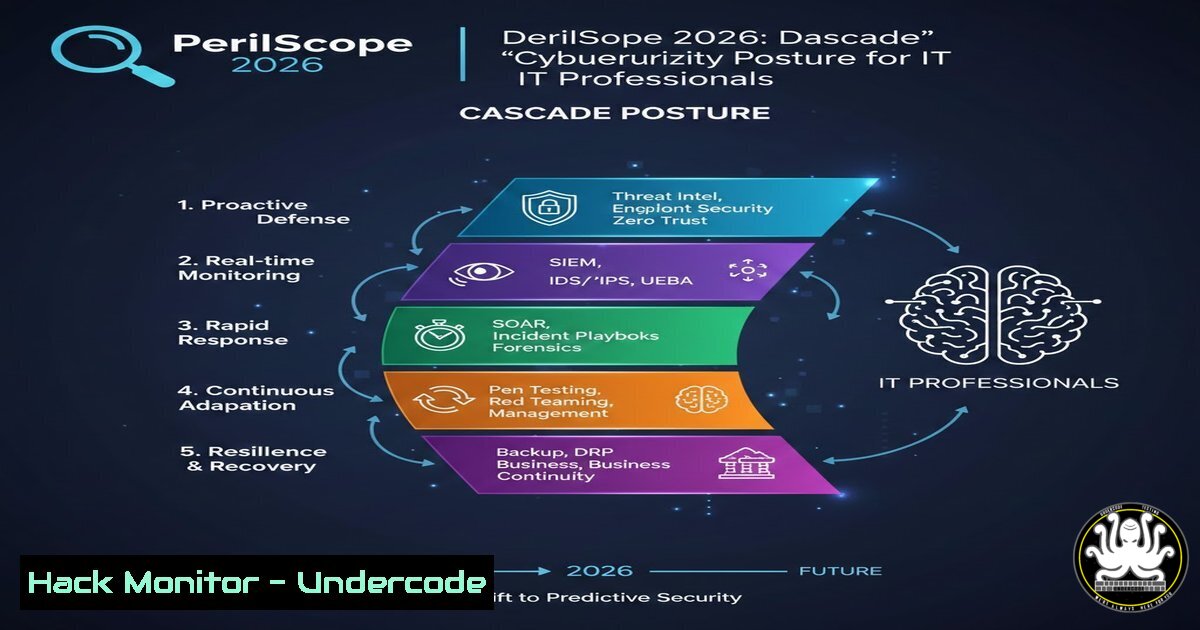
The strategic forecast for 2026, as outlined in the PerilScope® analysis, moves beyond singular catastrophic events to focus on the compounding and cascading nature of systemic risks. For cybersecurity and IT leaders, this translates to a critical shift in mindset: defending against isolated incidents is no longer sufficient. The modern threat landscape is defined by interconnected vulnerabilities where a failure in one system—be it a supply chain, a cloud API, or a governance policy—triggers a domino effect of failures across digital and physical infrastructures. Resilience must evolve from a buzzword to an embedded, operational architecture.
Learning Objectives:
- Understand the concept of “risk cascades” in a cyber-physical context and their implications for system design.
- Learn practical steps to map interdependencies and harden systems against cascading failures.
- Implement monitoring and response strategies tailored for complex, interconnected incident chains.
You Should Know:
1. Mapping Your Digital-Physical Interdependency Graph
The first step in building cascade-resilient systems is visibility. You cannot defend connections you cannot see. This involves creating a dynamic map of how your IT assets, cloud services, IoT devices, and third-party vendors interact and depend on each other.
Step‑by‑step guide:
- Asset Inventory & Tagging: Use tools like `nmap` for network discovery and AWS Config/Azure Resource Graph for cloud assets. Tag resources with metadata (e.g.,
env=prod,owner=team-alpha,vendor=critical-supplier).Example: Aggressive scan to discover live hosts and open ports sudo nmap -A -T4 192.168.1.0/24 -oN network_inventory.txt
- Dependency Mapping: Utilize infrastructure-as-code (Terraform, CloudFormation) graphs and service mesh (Istio, Linkerd) data to visualize traffic flows. For on-premise applications, tools like BloodHound can map Active Directory dependencies.
- Critical Path Analysis: Identify single points of failure (SPOF). Ask: If this API gateway fails, what downstream services are affected? If this SaaS vendor is breached, what data is exposed?
-
Hardening the Weakest Links: API and Cloud Configuration Security
APIs are the primary connectors in modern digital ecosystems and a prime vector for cascading failures. A misconfigured or compromised API can expose data and serve as a pivot point to internal networks.
Step‑by‑step guide:
- API Security Testing: Integrate OWASP ZAP or Burp Suite into your CI/CD pipeline. Focus on the OWASP API Security Top 10, especially broken object level authorization (BOLA) and excessive data exposure.
Run a baseline scan with OWASP ZAP in Docker
docker run -v $(pwd):/zap/wrk/:rw -t ghcr.io/zaproxy/zaproxy:stable zap-baseline.py -t https://your-api-endpoint.com -g gen.conf -r testreport.html
- Cloud Hardening: Enforce configuration baselines using AWS Security Hub, Azure Policy, or GCP Security Command Center. Implement guardrails to prevent public exposure of S3 buckets, SQL instances, or storage accounts.
AWS CLI command to check for publicly accessible S3 buckets
aws s3api list-buckets --query "Buckets[].Name" | xargs -I {} bash -c 'aws s3api get-bucket-acl --bucket {} | grep -q "AllUsers" && echo "{} is PUBLIC"'
3. Implementing Zero Trust to Contain Breaches
The Zero Trust model (“never trust, always verify”) is inherently designed to limit cascade propagation by segmenting networks and enforcing strict identity and device verification.
Step‑by‑step guide:
- Micro-Segmentation: Move beyond VLANs. Use host-based firewalls and identity-aware proxies. On Linux, implement strict
iptables/nftablesrules. On Windows, leverage Advanced Firewall with PowerShell.Windows: Create a rule to block all inbound traffic except from specific management subnet New-NetFirewallRule -DisplayName "Block_All_Inbound_Except_Management" -Direction Inbound -Action Block -RemoteAddress 0.0.0.0/0 New-NetFirewallRule -DisplayName "Allow_Management_Subnet" -Direction Inbound -Action Allow -RemoteAddress 10.10.1.0/24
- Identity Governance: Enforce Multi-Factor Authentication (MFA) universally and adopt Just-In-Time (JIT) privileged access management (PAM) solutions to reduce standing privileges.
4. Proactive Threat Hunting for Cascade Indicators
Waiting for alerts is a reactive posture. Proactive hunting looks for anomalies that suggest early stages of a cascading attack, such as lateral movement or unusual outbound calls to vendor systems.
Step‑by‑step guide:
- Establish a Baseline: Use SIEM (Splunk, Elastic SIEM) queries to understand normal network behavior (e.g., typical service account logon times, standard data egress volumes).
- Hunt for TTPs: Regularly run queries linked to MITRE ATT&CK techniques like `Lateral Movement (TA0008)` and
Command and Control (TA0011).-- Example Splunk query to detect potential pass-the-hash activity index=windows EventCode=4624 LogonType=3 AuthenticationPackage=NTLM | stats count by user, workstation, src_ip | where count > 5
5. Building Resilient Incident Response Playbooks
Your incident response (IR) playbooks must assume a multi-system, multi-stage incident. Standard “isolate and rebuild” may not be feasible if core infrastructure is affected.
Step‑by‑step guide:
- Scenario-Based Playbooks: Develop playbooks for scenarios like “Supply Chain Compromise” or “Cascade Ransomware.” Include steps for graceful degradation of services, not just total shutdown.
- Communication Trees: Pre-establish communication channels that operate outside your primary corporate network (e.g., satellite phones, pre-provisioned mobile hotspots) to coordinate during a network-down scenario.
- Tabletop Exercises: Conduct quarterly exercises that simulate cascading failures. Test not just technical response, but decision-making under stress and communication with external partners.
6. The Human Layer: Continuous Security Training
Governance lag, as mentioned in the forecast, is often a human and process failure. Continuous, role-specific training is essential to maintain a state of readiness.
Step‑by‑step guide:
- Move Beyond Compliance Training: Use platforms like TryHackMe or RangeForce for hands-on, gamified training. Run regular phishing simulations with immediate feedback.
- Develop Secure Coding Labs: For developers, set up internal CTF challenges focusing on the OWASP Top 10 and secure API design. Integrate findings from tools like Semgrep or SonarQube into learning paths.
7. Leveraging AI for Predictive Cascade Analysis
Artificial Intelligence can process vast datasets from your interdependency maps, logs, and external threat intel to predict potential failure chains.
Step‑by‑step guide:
- Data Aggregation: Feed normalized logs from all systems (IT, OT, cloud) into a data lake suitable for ML processing.
- Model Training (Supervised): Start by training models to identify known precursors to incidents (e.g., a specific error spike in a microservice followed by failed auth attempts on the database).
- Anomaly Detection (Unsupervised): Implement models to flag novel or subtle interaction patterns that deviate from the baseline, potentially indicating a novel attack path.
What Undercode Say:
- Resilience is an Architecture, Not a Feature: The core takeaway is that preventing cascading failures cannot be bolted on. It must be designed into the system from the ground up through principles like Zero Trust, micro-segmentation, and comprehensive observability. The “occasional ‘we’re totally prepared’ moment that ages poorly” is a direct result of checklist compliance over engineered resilience.
- Watch the Connections, Not Just the Nodes: The most significant threats in 2026 will not be to individual systems but to the trust and data flows between them. Security efforts must pivot from protecting perimeter and endpoints to securing every API call, every third-party data exchange, and every internal east-west connection. The attack surface is now a complex web, and defenders must understand its topology better than the attackers do.
Prediction:
The convergence of AI-driven offensive capabilities, fragile global supply chains, and increasingly interconnected digital infrastructure will make 2026 a pivotal year for “cascade warfare.” We predict a rise in multi-vector attacks that simultaneously target a technical vulnerability in a widely used software component, the logistics of its patch distribution, and the public confidence in the affected organizations. The most resilient organizations will be those that have moved beyond siloed security and IT ops, embracing a unified, systemic risk management posture where cybersecurity, business continuity, and physical operations are planned and exercised as one integrated discipline. The “frictions” forecast will be the new normal, and the ability to operate through them will define market leaders.
▶️ Related Video (88% Match):
🎯Let’s Practice For Free:
IT/Security Reporter URL:
Reported By: Ivan Savov – Hackers Feeds
Extra Hub: Undercode MoN
Basic Verification: Pass ✅


