Listen to this Post
Introduction:
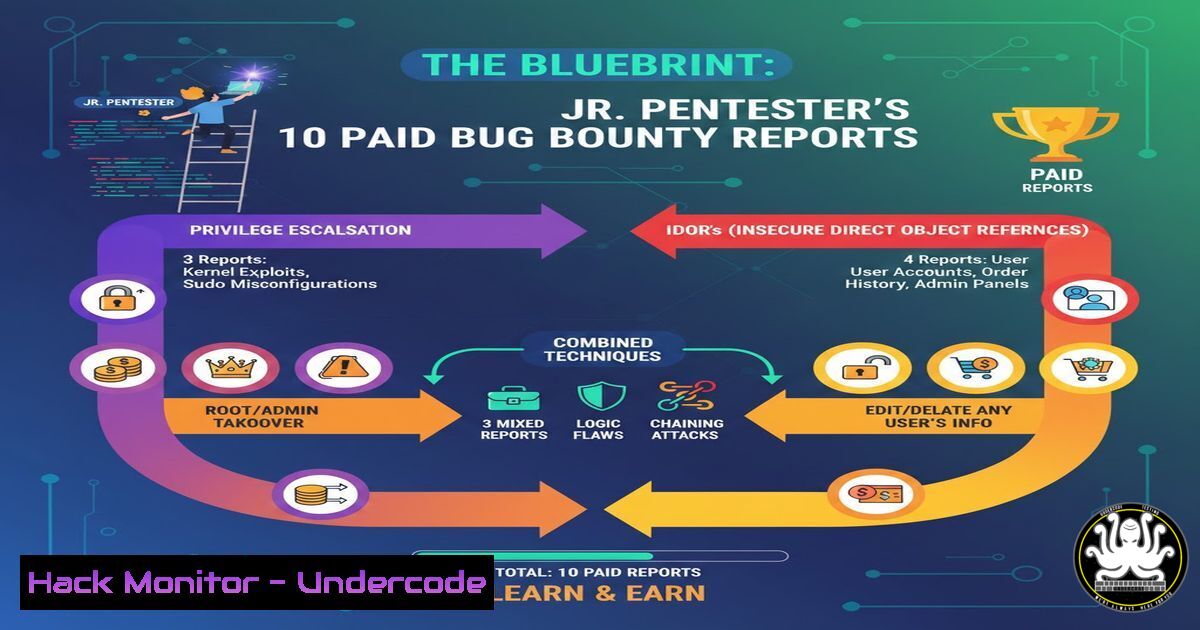
Bug bounty hunting represents a cornerstone of modern offensive security, where ethical hackers systematically probe applications for vulnerabilities before malicious actors can exploit them. A recent success story from a junior pentester, resulting in 10 paid reports including critical Privilege Escalation and IDOR flaws, provides a masterclass in foundational web application security testing. This article deconstructs the core vulnerabilities uncovered, translating them into actionable, technical guides for aspiring security researchers.
Learning Objectives:
- Understand the mechanics and impact of Insecure Direct Object References (IDOR) and Broken Access Control (BAC).
- Learn practical methodologies for discovering and testing for Privilege Escalation vectors.
- Develop a workflow for identifying Information Disclosure vulnerabilities that often lead to more severe exploits.
You Should Know:
- Insecure Direct Object Reference (IDOR): The Low-Hanging Fruit That Pays
An Insecure Direct Object Reference occurs when an application provides direct access to objects based on user-supplied input, without adequate authorization checks. This allows attackers to bypass authorization and access resources directly by modifying the value of a parameter.
Step‑by‑step guide explaining what this does and how to use it.
1. Mapping Parameters: While browsing an application (e.g., https://api.target.com/v1/user/123/profile`), identify all parameters that reference objects (IDs, usernames, file names). Use Burp Suite Proxy or browser dev tools to capture requests.1001
2. Testing for Access Control: Authenticate with a low-privilege user (e.g., `user_a` with ID). Capture a request accessinguser_a's data.
3. Manipulation: Change the object reference in the request from `user_id=1001` to `user_id=1002` (another user). Use tools like `curl` for API testing:
 Original request for own data
curl -H "Authorization: Bearer YOUR_TOKEN" https://api.target.com/user/1001
 Modified request for another user's data
curl -H "Authorization: Bearer YOUR_TOKEN" https://api.target.com/user/1002
4. Analysis: If the second request returnsuser 1002`’s data, an IDOR exists. Report it, demonstrating the ability to view/alter unauthorized data.
2. Horizontal to Vertical: The Privilege Escalation Pipeline
Privilege Escalation involves gaining access to resources or functionality intended for a higher-privileged user. It often starts with a horizontal move (accessing another user’s role-level data) that reveals a path to vertical escalation (admin access).
Step‑by‑step guide explaining what this does and how to use it.
1. Discover a Horizontal IDOR: As in the previous section, confirm you can access another standard user’s account.
2. Enumerate User Attributes: Analyze the compromised user’s profile or API response. Look for hidden parameters like "role":"user", `”account_id”:` or "is_admin":false.
3. Test for Parameter Tampering: If you can update the profile, try modifying these attributes. For example, change a POST request body from `{“name”:”Victim”}` to {"name":"Victim","role":"administrator"}.
4. Craft the Exploit: If tampering works, re-login or use the modified session to access admin-only endpoints (e.g., /admin/dashboard, /api/admin/users). Document the full chain: IDOR -> parameter tampering -> admin access.
3. Broken Access Control (BAC): Beyond Simple IDOR
BAC is a broader category (A01:2021) where access control policies are not consistently enforced. This includes accessing privileged pages via direct URL, bypassing workflow, or exploiting CORS misconfigurations.
Step‑by‑step guide explaining what this does and how to use it.
1. Direct Request Testing: Authenticate as a normal user, then directly browse to a privileged page URL (e.g., https://target.com/admin/panel`). If accessible, BAC exists./checkout/confirm
2. Post-Bypass Testing: For actions requiring a sequence (e.g., a user must submit form A before B), try accessing the final step () directly.GET
3. Method Tampering: If a normal `POST /api/user/delete` is blocked, try changing the HTTP method to,PUT, or `DELETE` usingcurl`:
curl -X PUT -H "Authorization: Bearer USER_TOKEN" https://api.target.com/api/user/delete?id=1002
4. Verify with Different Users: Always confirm the vulnerability by testing across two authenticated user sessions.
4. Information Disclosure: The Foot in the Door
Information Disclosure vulnerabilities leak system data, such as version details, user credentials, or internal paths, which can be weaponized for further attacks.
Step‑by‑step guide explaining what this does and how to use it.
1. Review Server Responses: Inspect all HTTP responses for headers like Server: Apache/2.4.7, X-Powered-By: PHP/5.3.10, or verbose error messages.
2. Analyze Source Code: View the HTML source of pages for commented-out credentials, internal IPs, or hidden endpoints.
3. Fuzz for Backup Files: Use tools like `ffuf` to find sensitive files:
ffuf -w /usr/share/seclists/Discovery/Web-Content/common.txt -u https://target.com/FUZZ -fs 404
Look for `.bak`, `.git/`, `.env`, `backup.zip` files.
- Exploit Directory Traversal: If file access is found, test for path traversal:
https://target.com/load?file=../../../etc/passwd`. A Windows equivalent test:../../../../Windows/System32/drivers/etc/hosts`. -
The Bug Hunter’s Toolkit: Essential Commands & Configurations
Efficiency in bug hunting requires a core set of tools and scripts for reconnaissance, probing, and exploitation.
Step‑by‑step guide explaining what this does and how to use it.
1. Reconnaissance with `subfinder` & httpx: Gather subdomains and find live hosts.
subfinder -d target.com -o subs.txt
httpx -l subs.txt -status-code -title -o live_targets.txt
2. Automated Initial Scanning with nuclei: Run template scans for common vulnerabilities.
nuclei -u https://target.com -t ~/nuclei-templates/ -severity medium,high,critical -o nuclei_scan.txt
3. Proxy Configuration (Burp Suite/FoxyProxy): Configure your browser to route traffic through Burp for manual testing. Set scope to `target.com` and turn Intercept on.
4. API Testing with jq: Parse and manipulate JSON responses from APIs during testing.
curl -s https://api.target.com/v1/users | jq '.[] | .id'
What Undercode Say:
- Methodology Over Tools: Success stems from a deep understanding of application logic and authorization flows, not just automated tool output.
- The Chain Reaction: Isolated low/medium flaws (like info disclosure or a single IDOR) are often chained together to demonstrate critical impact, leading to higher severity ratings and bounties.
Analysis: This case study underscores that the most lucrative and critical bugs in bug bounty programs are often logic flaws, not just technical injections. The researcher’s focus on access control—a widespread and poorly implemented defense—proved highly effective. The repeat presence of IDORs highlights a persistent development oversight: trusting client-side parameters for authorization decisions. This approach is replicable; hunters should prioritize mapping user roles, understanding API endpoints, and testing every object reference under multiple authenticated contexts. Persistence in testing parameter tampering, even when no obvious flaw exists, frequently yields privilege escalation paths.
Prediction:
The automation of business logic flaw discovery will be the next frontier in offensive AI. While current tools excel at finding technical vulnerabilities (SQLi, XSS), future machine learning models will be trained on application workflows to predict and test for flawed logic, such as IDOR and complex privilege escalation chains. This will force a paradigm shift in secure development lifecycle (SDLC), integrating more sophisticated access control unit and integration testing earlier in the CI/CD pipeline. Bug bounty platforms may soon incorporate AI-assisted logic scanners, raising the bar for hunters to find increasingly subtle and chained vulnerabilities.
▶️ Related Video (74% Match):
🎯Let’s Practice For Free:
IT/Security Reporter URL:
Reported By: Ahmed Abdelrahman – Hackers Feeds
Extra Hub: Undercode MoN
Basic Verification: Pass ✅


