Listen to this Post
Introduction:
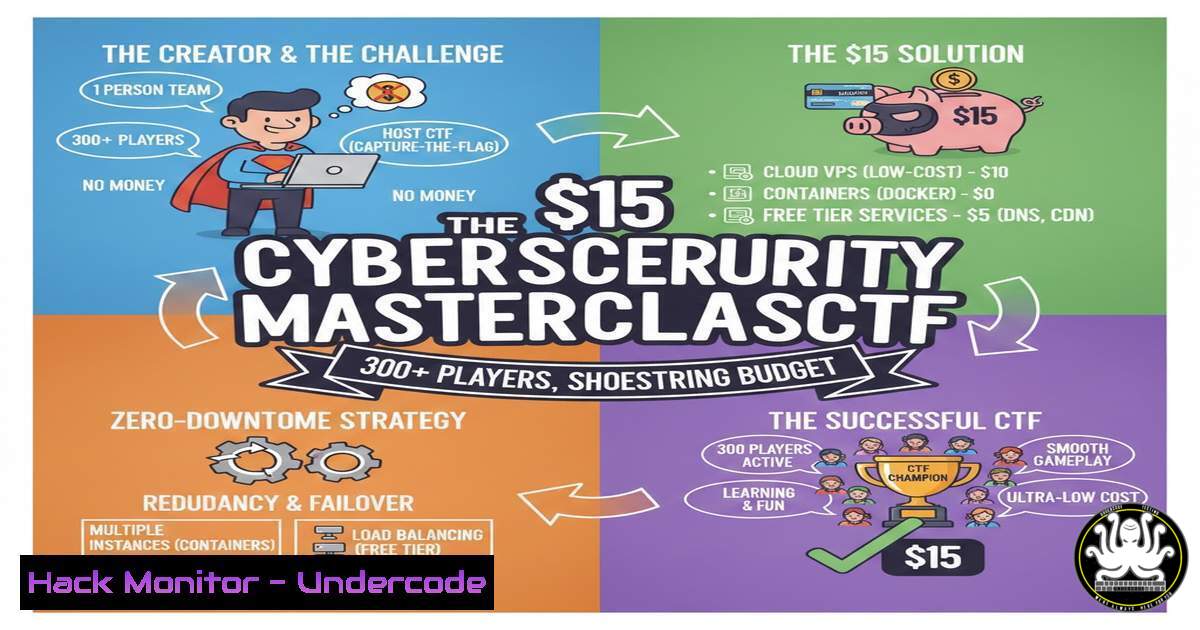
In the world of cybersecurity training, Capture The Flag (CTF) events are the ultimate proving ground, but hosting them is often seen as a complex and costly endeavor. Shakthi Vikranth’s ShaZ CTF 2025 shatters that myth, demonstrating how a strategically architected, cloud-native approach can deliver a professional, scalable event for nearly zero cost. This case study deconstructs the infrastructure, security, and operational decisions that led to 300+ registrations and flawless performance.
Learning Objectives:
- Design and deploy a scalable CTF platform using CTFd on cloud virtual machines.
- Implement a robust security and performance posture using CDN and cloud hardening techniques.
- Manage and isolate multi-category challenges (Web, Forensics, Crypto, etc.) within a stable environment.
- Leverage cloud credits and free-tier services to minimize operational costs to near zero.
- Apply fundamental Linux server administration and Docker commands to maintain CTF infrastructure.
You Should Know:
- Architecting the Core Infrastructure: CTFd on Google Cloud
The foundation was a simple yet powerful stack: the open-source CTFd platform hosted on Google Cloud Compute Engine. Two Virtual Machines (VMs) were used to isolate the main CTFd dashboard from the potentially vulnerable web challenges, preventing cross-contamination.
Step-by-Step Guide:
- Provision VMs: In Google Cloud Console, create two Compute Engine instances. The main CTFd server used a configuration of 12 vCPUs and 24 GB RAM to handle load, while the challenge VM could be smaller.
2. Install Dependencies (on CTFd VM):
 Update system and install Docker
sudo apt update && sudo apt upgrade -y
sudo apt install -y docker.io docker-compose git
sudo systemctl enable docker
3. Deploy CTFd:
 Clone the CTFd repository
git clone https://github.com/CTFd/CTFd.git
cd CTFd
 Use Docker Compose to launch (simplest deployment)
docker-compose up -d
This brings up CTFd with a PostgreSQL database. You must then configure the admin user, event title, and rules via the web interface on http://<YOUR_VM_IP>:8000.
2. Hardening Security and Performance with Cloudflare
Exposing the CTF server directly to the internet is a recipe for DDoS attacks and vulnerability scanning. Cloudflare’s free CDN tier was placed in front as a protective shield.
Step-by-Step Guide:
- Point Domain to Cloudflare: Purchase a cheap domain (e.g., on Namecheap). In Cloudflare, add your site and change the domain’s nameservers as instructed.
- Create DNS Records: In Cloudflare DNS, create an `A` record (e.g.,
ctf.yourdomain.com) pointing to the public IP address of your Google Cloud CTFd VM. Enable the orange cloud icon to proxy traffic.
3. Configure Security Settings:
- Under “SSL/TLS”: Set encryption mode to “Full” (strict if you have a valid cert on the VM).
- Under “Firewall”: Create a rule to challenge requests from countries you wish to block or set a rate limiting rule.
- Under “DDoS”: Ensure the protection is set to “Under Attack Mode” during the event if needed.
3. Isolating and Deploying Dynamic Challenges
Web and reverse engineering challenges often require custom, isolated environments to prevent players from interfering with each other or the main server. The second VM was dedicated to this purpose, often using Docker for each challenge.
Step-by-Step Guide (Deploying a Web Challenge):
- Write a Dockerfile for your vulnerable web app (e.g., a Flask app with intentional flaws).
FROM python:3.9-slim
WORKDIR /app
COPY requirements.txt .
RUN pip install -r requirements.txt
COPY . .
CMD ["python", "app.py"]
- Build and run the container on the challenges VM:
docker build -t web-challenge-1 .
docker run -d -p 3000:3000 --name wc1 web-challenge-1
- Expose via Cloudflare Tunnel (Secure Alternative): Instead of opening VM ports, use `cloudflared` to securely connect the challenge to the internet without exposing the VM’s IP.
On the challenge VM
docker run -d cloudflare/cloudflared tunnel --url http://localhost:3000
4. System Monitoring and Cost Control
Zero downtime requires proactive monitoring. Google Cloud’s Operations Suite (formerly Stackdriver) provides monitoring tools. The primary cost control was the strategic use of Google’s $300 free credits for new users, keeping the event cost at merely ₹15 (forex charges).
Step-by-Step Guide (Basic Monitoring):
- In Google Cloud Console, navigate to “Monitoring” -> “Dashboards”.
- Create a dashboard with key charts: CPU utilization, memory usage, and network ingress/egress for both VMs.
- Set up an alerting policy to notify you via email if CPU usage exceeds 85% for 5 minutes, allowing for proactive scaling.
5. Post-Event Analysis and Writeup Curation
The learning cycle completes with documented walkthroughs. Shakthi organized challenge writeups into a YouTube playlist, turning the event into a persistent educational resource.
Step-by-Step Guide (Organizing Writeups):
- Collect Solutions: Encourage top players to submit writeups, or create your own.
- Standardize Format: Use a template covering: Challenge Name, Category, Points, Description, Solution Steps, and Key Learnings.
- Publish: Host writeups on a GitHub repository or a dedicated blog. Embed the YouTube playlist link (`https://lnkd.in/gTGAbr3Y`) for video explanations.
What Undercode Say:
- Democratization of Security Training: This model proves that high-quality, hands-on offensive security training can be produced and delivered at an extremely low barrier to entry, empowering more creators and educators.
- Cloud-Native is Cost-Effective: The strategic use of free-tier services (GCP credits, Cloudflare, CTFd) and meticulous architecture eliminates the need for significant capital, shifting the focus to skill and preparation rather than budget.
- Isolation is Key to Stability: Separating the scoring platform (CTFd) from the challenge environment is a critical design pattern that ensures a player exploiting a vulnerable challenge cannot bring down the entire event.
Analysis:
Shakthi’s success stems from a clear understanding of modular, cloud-native design principles. By treating each component—platform, challenges, security—as independent, composable services, he achieved resilience and scalability. The choice of CTFd, the de facto standard open-source platform, ensured familiarity for players and ease of administration. The most critical security decision was not a specific tool, but the architectural choice to proxy all traffic through Cloudflare. This hid server IPs, absorbed DDoS attempts, and provided a layer of WAF-like protection for free. The event’s positive feedback highlights a demand for CTFs that are educational and engaging rather than purely grueling, a nuance more hosts should note.
Prediction:
This event is a blueprint for the future of accessible cybersecurity upskilling. We will see a surge in community-hosted, micro-CTFs focused on specific skill sets (e.g., API hacking, cloud forensics). The integration of AI to generate dynamic, personalized challenges or to act as an automated “help desk” for players will become commonplace. Furthermore, the low-cost model will push CTFs deeper into academic curricula as a standard lab component, moving hands-on ethical hacking from an elite hobby to a core, practical element of cybersecurity education globally. The era of the multi-thousand-dollar CTF platform license is being challenged by open-source and cloud agility.
▶️ Related Video (72% Match):
🎯Let’s Practice For Free:
IT/Security Reporter URL:
Reported By: Shakthi Vikranth – Hackers Feeds
Extra Hub: Undercode MoN
Basic Verification: Pass ✅


