Listen to this Post
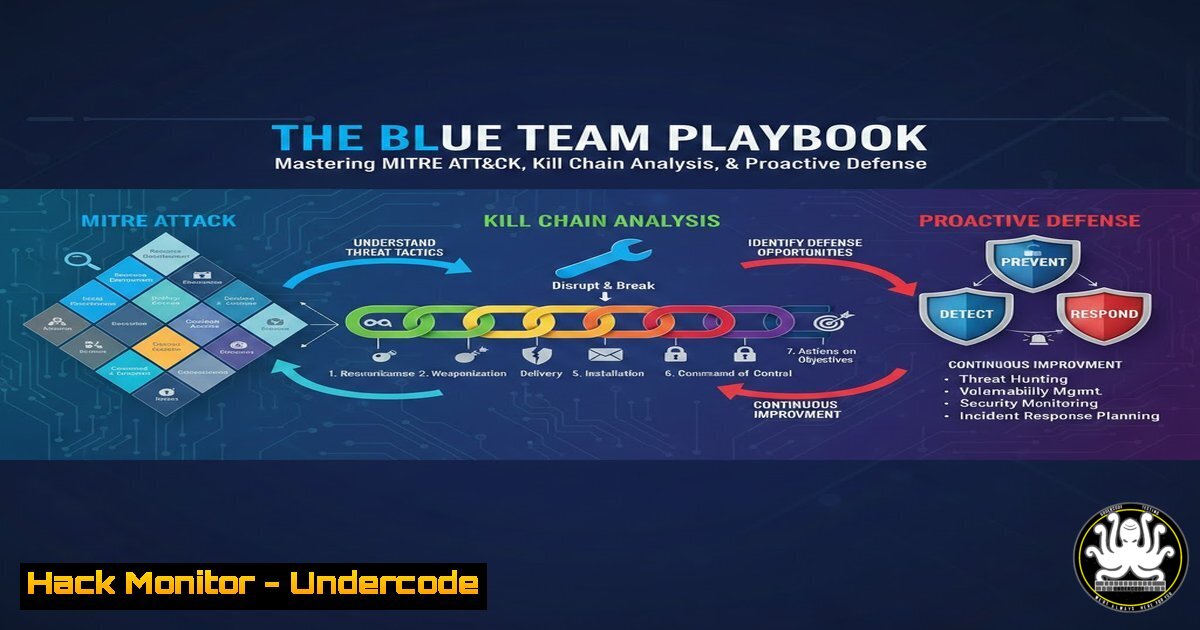
Introduction:
Modern cybersecurity is no longer about building higher walls but about understanding the adversary’s playbook to mount an effective defense. Frameworks like MITRE ATT&CK and the Cyber Kill Chain provide the foundational lexicon for mapping real-world attacker behaviors to systematic defensive actions, transforming how security teams anticipate, detect, and respond to threats.
Learning Objectives:
- Decipher and apply the MITRE ATT&CK framework for real-world threat detection and hunting.
- Conduct comprehensive Kill Chain Analysis to disrupt multi-stage cyber attacks.
- Implement defensive controls and incident response plans aligned with MITRE D3FEND and threat intelligence.
You Should Know:
1. Mapping Adversary Behavior with MITRE ATT&CK
The MITRE ATT&CK framework is a globally accessible knowledge base of adversary tactics and techniques based on real-world observations. It provides a common language for defenders to categorize attacker actions, from initial access to exfiltration and impact. By understanding these techniques, you can move from a reactive to a proactive security posture.
Step-by-step guide explaining what this does and how to use it.
Step 1: Navigate the Matrix. Familiarize yourself with the structure of the ATT&CK Matrix. The rows are tactics (the “why” of an attack, e.g., Persistence, Privilege Escalation), and the columns are specific techniques (the “how,” e.g., T1548.003 - Sudo and Sudo Caching).
Step 2: Analyze a Technique. Select a technique, such as T1059.004 - Command and Scripting Interpreter: Unix Shell. The ATT&CK page will provide a description, examples, and procedures for mitigation and detection.
Step 3: Implement Detection. Use the provided detection logic to create custom alerts in your SIEM or EDR. For example, to detect suspicious `bash` command execution, you could use a Sigma rule or a Splunk query looking for commands like `curl | bash` or execution from unusual parent processes.
Linux Command for Detection: `grep -r “curl.bash\|wget.bash” /var/log/` (Search logs for patterns of downloading and executing scripts directly).
Windows PowerShell Command for Detection: `Get-WinEvent -LogName “Microsoft-Windows-Sysmon/Operational” | Where-Object { $_.Message -like “cmd.exe” -and $_.ParentImage -like “winword.exe” }` (Detects command prompt execution spawned from Microsoft Word, a potential macro attack).
2. Deconstructing Attacks with Kill Chain Analysis
The Cyber Kill Chain, developed by Lockheed Martin, breaks down a cyber-attack into seven sequential stages: Reconnaissance, Weaponization, Delivery, Exploitation, Installation, Command & Control (C2), and Actions on Objectives. The Unified Kill Chain expands on this, providing a more granular view. The goal is to identify and break the chain at the earliest possible stage.
Step-by-step guide explaining what this does and how to use it.
Step 1: Identify the Stage. After detecting an intrusion, map the observed activity to a stage in the Kill Chain. For example, a phishing email is “Delivery,” and the subsequent execution of a malicious macro is “Exploitation.”
Step 2: Trace the Attack Path. Work backwards and forwards to understand the full scope. If you found a C2 beacon (C2 stage), how did the malware get installed (Installation)? What vulnerability was exploited (Exploitation)?
Step 3: Implement Countermeasures. For each stage, define a defensive action. To counter the “Delivery” stage, implement strict email filtering and user training. To counter “Lateral Movement” (a sub-stage in Unified Kill Chain), implement network segmentation and monitor for protocols like SMB and RDP.
Windows Command to Block Unnecessary Services: `sc config “Telnet” start= disabled` (Disables the Telnet client, often used for lateral movement).
Linux iptables Rule to Segment Network: `iptables -A FORWARD -s 192.168.1.0/24 -d 10.0.1.0/24 -j DROP` (Prevents hosts on one subnet from forwarding traffic to another, hindering lateral movement).
3. Aligning Defenses with MITRE D3FEND
MITRE D3FEND is a complementary framework to ATT&CK that provides a catalogue of defensive cybersecurity techniques. It helps answer the critical question: “Now that I know the attack techniques, what should I actually do to defend against them?”
Step-by-step guide explaining what this does and how to use it.
Step 1: Map ATT&CK to D3FEND. Find the ATT&CK technique you are concerned with, for example, T1566 - Phishing. D3FEND will map this to defensive techniques like “Network Traffic Filtering” and “User Training.”
Step 2: Select a Concrete Control. Drill down into a D3FEND technique like D3-NTF - Network Traffic Filtering. This provides a precise definition and reveals related artifacts and countermeasures, such as configuring an SMTP content filter to strip executable attachments.
Step 3: Implement and Harden. Apply the control. Configure your email security gateway to block emails with executable attachments and use tools like `spamassassin` to score and filter phishing attempts.
Linux (Postfix) Configuration Snippet: `header_checks = regexp:/etc/postfix/header_checks` and in the file, add `/^Content-Disposition:.attachment;/ FILTER mailto:[email protected]` to quarantine attachments.
4. Operationalizing Threat Intelligence with STIX/TAXII
Structured Threat Information Expression (STIX) and Trusted Automated Exchange of Intelligence Information (TAXII) are the standard languages and protocols for sharing cyber threat intelligence. They allow organizations to consume and produce machine-readable threat data about adversaries, their tools, and campaigns.
Step-by-step guide explaining what this does and how to use it.
Step 1: Set Up a TAXII Client. Use a Python library like `cti-taxii-client` to connect to a public or private TAXII server. For example, you can connect to the ATT&CK TAXII server to get the latest technique updates.
Step 2: Consume a STIX Bundle. A TAXII collection delivers data in STIX 2.x bundles. These are JSON objects containing Indicators of Compromise (IoCs), Threat Actors, Malware, and Attack Patterns, all linked together.
Step 3: Ingest into Security Tools. Parse the STIX bundle and convert the IoCs (e.g., file hashes, IP addresses) into a format your security tools can use. You can create blocklists in your firewall or detection rules in your SIEM.
Python Code Snippet to Connect to TAXII Server:
from taxii2client.v20 import Server, Collection
server = Server('https://cti-taxii.mitre.org/taxii/')
api_root = server.api_roots[bash]
collection = api_root.collections[bash]
bundle = collection.get_objects()  Returns a STIX bundle
for obj in bundle['objects']:
if obj['type'] == 'indicator':
print(f"Indicator: {obj['pattern']}")
5. Building a Proactive Incident Response Plan
An Incident Response (IR) Plan is a documented, practiced set of procedures for handling a security breach. A practical plan, informed by the frameworks above, ensures a swift, coordinated, and effective response to minimize damage.
Step-by-step guide explaining what this does and how to use it.
Step 1: Preparation. This is the most critical phase. Develop your IR policy, assemble your team, and equip them with the necessary tools (forensic software, communication systems, EDR platforms).
Step 2: Identification. Use your ATT&CK-informed detection rules to identify potential incidents. Triage alerts to determine if they constitute a real security event.
Step 3: Containment, Eradication, & Recovery. Execute your plan. Short-term containment may involve isolating a network segment. Eradication involves removing the threat (e.g., deleting malware, disabling compromised accounts). Recovery is the process of restoring systems to normal operation.
Containment Command (Windows – Isolate Host): `netsh advfirewall set allprofiles state on` (Ensures the Windows Firewall is enabled on all profiles to block unauthorized traffic).
Eradication Command (Linux – Kill Malicious Process): `ps aux | grep [bash]alicious_pattern && kill -9
What Undercode Say:
- Framework Fluency is the New Baseline. Simply knowing about MITRE ATT&CK is no longer a differentiator; the ability to operationalize its techniques into tangible detection rules and defensive actions is what separates effective blue teams from the rest.
- Intelligence Without Integration is Noise. Consuming STIX/TAXII feeds is futile if the intelligence cannot be automatically integrated into security controls. The focus must be on engineering the pipeline from intelligence consumption to enforcement.
The post highlights a crucial shift in cybersecurity education: from theoretical knowledge to applied, framework-driven defense. The value of this certification lies not in the certificate itself, but in the demonstrated ability to translate abstract attacker models into concrete security monitoring and response. This mindset is foundational for modern Security Operations Centers (SOCs) and is becoming a non-negotiable skill set for security analysts. The integration of ATT&CK, D3FEND, and Kill Chain analysis represents a holistic approach to defense, enabling organizations to speak a common language and systematically improve their security posture against evolving threats.
Prediction:
The deep integration of adversarial frameworks like MITRE ATT&CK into security operations will become fully automated by AI-driven defense platforms. We will see a future where AI agents automatically translate new ATT&CK techniques into custom EDR detection rules and orchestrate countermeasures via SOAR platforms in near real-time, fundamentally changing the speed and scale of cyber defense. This will create a dynamic “AI vs. AI” battleground, where defense systems autonomously adapt to attacker innovations documented in these shared knowledge bases.
🎯Let’s Practice For Free:
IT/Security Reporter URL:
Reported By: Aryan Pimpalikar – Hackers Feeds
Extra Hub: Undercode MoN
Basic Verification: Pass ✅


