Listen to this Post
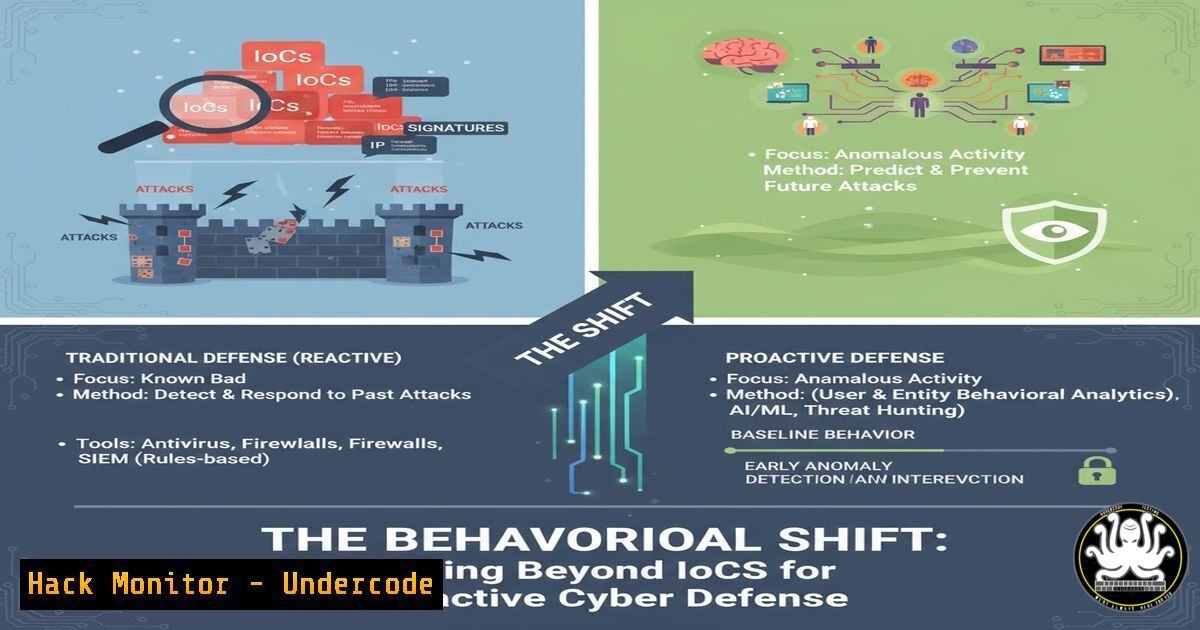
Introduction:
The digital threat landscape is evolving too rapidly for traditional Indicator of Compromise (IoC)-based defenses to keep pace. Security leaders are now advocating for a fundamental shift towards behavior-based telemetry and identity-centric context to build more resilient security postures. This approach focuses on detecting malicious actions and techniques early in the attack lifecycle, rather than relying on known-bad signatures that adversaries can easily change.
Learning Objectives:
- Understand the critical limitations of an IoC-centric security model.
- Learn how to implement behavior-based detection using common operating system telemetry.
- Develop skills to establish baselines and identify early warning signals of compromise.
You Should Know:
- From IoCs to Behavior: Hunting for Process Injection
The classic IoC might be a specific malware hash. A behavioral approach looks for the technique, such as process injection, which is a common MITRE ATT&CK (T1055) tactic.
Verified Command/Code Snippet (Windows – PowerShell):
Get-WmiObject -Namespace root\cimv2 -Class Win32_Process | Select-Object Name, ProcessId, ParentProcessId, CommandLine
Step-by-Step Guide:
This PowerShell command queries the Windows Management Instrumentation (WMI) to list all running processes, their IDs, their parent process IDs, and their command lines. To use it for behavioral analysis:
1. Open PowerShell with administrative privileges.
- Execute the command. The key is analyzing the `ParentProcessId` and `CommandLine` fields.
- Look for anomalies, such as `notepad.exe` spawning a `cmd.exe` or `powershell.exe` process, which is a common behavior in process injection attacks. By establishing a baseline of normal parent-child process relationships (e.g., `explorer.exe` spawning
notepad.exe), you can more easily spot these suspicious behaviors that IoCs would miss.
2. Establishing a Linux Baseline with Process Auditing
Kennedy T.’s comment highlights the need for clear baselines to separate signals from noise. On Linux, process execution auditing is a foundational tool for this.
Verified Command/Code Snippet (Linux – Auditd):
 To audit all commands executed by a user (e.g., 'ubuntu')
sudo auditctl -a always,exit -F arch=b64 -S execve -F auid=1000
 To search the audit logs for a specific process
sudo ausearch -sc [bash] | aureport -f -i
Step-by-Step Guide:
- Ensure `auditd` is installed and running (
sudo systemctl status auditd). - The first command adds a rule to the live audit system (
auditctl) to log every `execve` system call (which executes a program) made by the user with audit ID (auid) 1000 (replace with your target UID). - The second command pair uses `ausearch` to query the logs for a specific process and then pipes it to `aureport` for a human-readable summary of files involved.
- By consistently running this and reviewing the logs, you establish a baseline of “normal” activity for a user or service account. Deviations from this baseline become your early warning signals.
3. Detecting Lateral Movement via Network Connections
A core behavior in attacks is lateral movement, often involving network connections between internal systems.
Verified Command/Code Snippet (Windows – Command Line):
netstat -ano | findstr ESTABLISHED
Step-by-Step Guide:
1. Open Command Prompt as administrator.
- Run the `netstat -ano` command. The `-a` shows all connections, `-n` displays addresses and port numbers numerically, and `-o` shows the Process ID (PID) owning the connection.
- Piping to `findstr ESTABLISHED` filters for active connections.
- Analyze the output. Look for internal IP addresses connecting to sensitive ports (e.g., SMB port 445, RDP port 3389) on other internal machines, especially if the connection originates from a non-standard process like a user’s browser. This behavioral pattern is a key signal of lateral movement.
4. Leveraging Sysmon for Deep Behavioral Telemetry
System Monitor (Sysmon) is a Windows system service that provides detailed logging of process creations, network connections, and file changes, offering rich behavioral data.
Verified Command/Code Snippet (Sysmon Configuration Snippet – XML):
<ProcessCreate onmatch="include">
<CommandLine condition="contains">powershell -encoded</CommandLine>
<ParentImage condition="contains">outlook.exe</ParentImage>
</ProcessCreate>
Step-by-Step Guide:
1. Install Sysmon on your Windows endpoints.
- Use a configuration file (like the popular SwiftOnSecurity config) to define what behaviors to log. The provided XML snippet is an example rule for `ProcessCreate` events.
- This specific rule will log an event if a process is created with a command line containing “powershell -encoded” (a common obfuscation technique) or if the parent process is “outlook.exe” (which could indicate a malicious macro). This moves beyond a simple hash to detect the behavior of obfuscation and suspicious parent-child relationships.
5. Cloud Identity & Access Behavioral Logging
In cloud environments, identity is the new perimeter. Behavioral detection here means monitoring for anomalous API calls and permission usage.
Verified Command/Code Snippet (AWS CLI):
aws cloudtrail lookup-events --lookup-attributes AttributeKey=EventName,AttributeValue=ConsoleLogin
Step-by-Step Guide:
- Ensure AWS CloudTrail is enabled in your AWS account to log API activity.
- This CLI command looks up CloudTrail events specifically for the `ConsoleLogin` event.
- Analyze the results for behavioral anomalies, such as logins from unfamiliar geolocations, at unusual times of day, or by a root user account (which should rarely be used). This identity-centric context is critical for detecting account compromise that would not be caught by an IoC.
6. Interrogating Windows Management Instrumentation (WMI) Events
Threat actors increasingly use living-off-the-land binaries (LOLBins) like WMI for execution and persistence, making its monitoring a key behavioral control.
Verified Command/Code Snippet (PowerShell):
Get-WinEvent -FilterHashtable @{LogName='Microsoft-Windows-WMI-Activity/Operational'; ID=5861} | Format-List -Property TimeCreated, Message
Step-by-Step Guide:
- Run this PowerShell command to query the WMI-Activity operational log.
- Event ID 5861 indicates a WMI permanent event consumer was created. This is a common method for persistence.
- By proactively monitoring for these events, you can detect the behavioral pattern of an attacker establishing a foothold on a system, a technique that bypasses traditional antivirus software focused on file-based IoCs.
7. Analyzing Linux SSH Authentication for Intrusion Signals
Failed SSH login attempts are common noise, but their behavioral patterns can reveal brute-force attacks or credential stuffing.
Verified Command/Code Snippet (Linux):
sudo grep "Failed password" /var/log/auth.log | awk '{print $1, $2, $3, $9, $11}' | sort | uniq -c | sort -nr
Step-by-Step Guide:
- This command chain parses the authentication log for failed passwords.
- It then extracts the date, time, username, and IP address.
- Finally, it sorts and counts the occurrences, presenting a sorted list showing which IPs are attempting to access which usernames most frequently.
- A high count of failures for a single username from a single IP is a clear behavioral signal of a targeted attack, allowing you to block the IP before the attacker succeeds.
What Undercode Say:
- Behavior is the New Signature: Relying on IoCs is like fighting the last war. Modern defense requires a focus on the “how” (behavior/technique) rather than the “what” (specific file hash or IP).
- Context is King: As Kevin E. Greene emphasizes, identity-centric context is the wealth of data needed to make behavioral telemetry actionable. A PowerShell script running is normal; the same script running from a Microsoft Office process is highly suspicious.
The analysis from the source material and the expert comment from Kennedy T. converge on a critical point: the shift is not just technological but philosophical. The goal is to disrupt the attack chain earlier by identifying the subtle, anomalous behaviors that precede major breaches. This requires building robust telemetry and, crucially, taking the time to establish operational baselines to separate the true signals from the overwhelming noise. Alert fatigue is the enemy of this model, so automation and intelligent filtering are non-negotiable.
Prediction:
The adoption of behavior-based detection will bifurcate the security landscape. Organizations that successfully make this shift will significantly improve their mean time to detect (MTTD) and respond (MTTR), forcing attackers to become slower and more deliberate, thereby increasing their cost of operation. Conversely, organizations that remain IoC-dependent will face an ever-widening gap between their defensive capabilities and the evolving tradecraft of threat actors, leading to more frequent and severe breaches. AI and machine learning will become indispensable for correlating the vast streams of behavioral telemetry into actionable early-warning signals.
🎯Let’s Practice For Free:
IT/Security Reporter URL:
Reported By: Kevgreene Beyondiocs – Hackers Feeds
Extra Hub: Undercode MoN
Basic Verification: Pass ✅


