
Listen to this Post
Introduction:
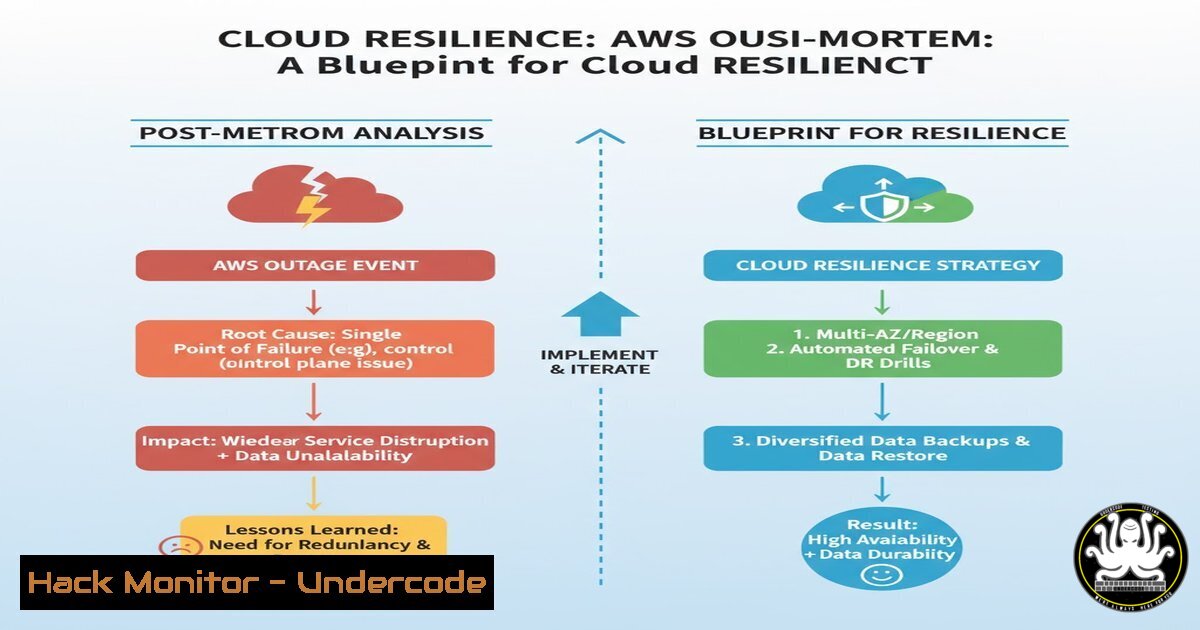
The recent AWS US-EAST-1 outage on October 20, 2025, demonstrated how single-region dependencies can cascade into global internet disruptions, affecting major services like Fortnite, Snapchat, and Coinbase. This incident, centered around DynamoDB endpoint DNS resolution failures, underscores the critical need for robust multi-region architectures and proper failure isolation strategies. Understanding these technical failure points and implementing verified resilience patterns has become non-negotiable for cloud security professionals.
Learning Objectives:
- Master multi-region deployment patterns for critical AWS services
- Implement proper retry mechanisms and circuit breaker patterns
- Develop comprehensive incident response procedures for cloud failures
You Should Know:
1. AWS Health Dashboard Monitoring
 Install and configure AWS CLI with appropriate IAM permissions
aws configure set region us-east-1
aws health describe-events --filter eventStatusCodes=open,upcoming
aws health describe-affected-entities --filter eventArns="arn:aws:health:us-east-1::event/AWS_EC2_OPERATIONAL_ISSUE"
This command sequence monitors open AWS health events and identifies affected resources. The first command configures your CLI region context, while the subsequent queries check for active incidents and their impact on your specific resources, providing early warning during regional degradation.
2. Multi-Region DynamoDB Global Tables Configuration
 Create global table across multiple regions
aws dynamodb create-global-table \
--global-table-name YourCriticalTable \
--replication-group RegionName=us-east-1 RegionName=us-west-2 RegionName=eu-west-1 \
--region us-east-1

Verify replication status
aws dynamodb describe-global-table \
--global-table-name YourCriticalTable \
--region us-east-1
This establishes a globally replicated DynamoDB table across three regions, ensuring data availability during regional outages. The verification command confirms replication health, crucial for maintaining data consistency across your disaster recovery footprint.
3. Circuit Breaker Implementation with AWS Lambda
import time
import boto3
from circuitbreaker import circuit

class DynamoDBCircuitBreaker:
def <strong>init</strong>(self):
self.failure_count = 0
self.success_threshold = 5

@circuit(failure_threshold=5, expected_exception=Exception)
def query_dynamodb(self, table_name, key):
try:
dynamodb = boto3.resource('dynamodb', region_name='us-west-2')
table = dynamodb.Table(table_name)
response = table.get_item(Key=key)
self.failure_count = 0
return response
except Exception as e:
self.failure_count += 1
if self.failure_count >= self.success_threshold:
raise CircuitBreakerException("DynamoDB circuit open - failing fast")
raise e
This Python implementation demonstrates a circuit breaker pattern that stops making requests to a failing service after consecutive failures, preventing cascading failures and allowing the system to fail gracefully while maintaining functionality through alternative paths.
4. DNS Failover Configuration with Route53
 Create primary and secondary records for failover
aws route53 change-resource-record-sets \
--hosted-zone-id Z1PA6795UKMFR9 \
--change-batch '{
"Changes": [{
"Action": "CREATE",
"ResourceRecordSet": {
"Name": "api.yourcompany.com",
"Type": "A",
"SetIdentifier": "Primary",
"Failover": "PRIMARY",
"AliasTarget": {
"HostedZoneId": "Z3AQBSTGFYJSTF",
"DNSName": "elb-us-east-1.elb.amazonaws.com",
"EvaluateTargetHealth": true
}
}
}, {
"Action": "CREATE",
"ResourceRecordSet": {
"Name": "api.yourcompany.com",
"Type": "A",
"SetIdentifier": "Secondary",
"Failover": "SECONDARY",
"AliasTarget": {
"HostedZoneId": "Z1H1FL5HABSF5",
"DNSName": "elb-us-west-2.elb.amazonaws.com",
"EvaluateTargetHealth": true
}
}
}]
}'
This Route53 configuration establishes automatic DNS failover between primary (us-east-1) and secondary (us-west-2) endpoints, routing traffic away from the affected region during outages based on health checks.
5. Exponential Backoff with Jitter Implementation
import random
import time
from botocore.config import Config

Configure retry strategy with jitter
retry_config = Config(
retries = {
'max_attempts': 10,
'mode': 'adaptive'
}
)

def exponential_backoff_with_jitter(attempt, base_delay=1, max_delay=60):
"""Calculate delay with exponential backoff and jitter"""
delay = min(max_delay, base_delay  2  attempt)
jitter = random.uniform(0, delay  0.1)  10% jitter
return delay + jitter

Usage in client configuration
client = boto3.client('dynamodb', config=retry_config)

for attempt in range(max_retries):
try:
response = client.query(params)
break
except ClientError as e:
if e.response['Error']['Code'] in ['ThrottlingException', 'ProvisionedThroughputExceeded']:
sleep_time = exponential_backoff_with_jitter(attempt)
time.sleep(sleep_time)
else:
raise
This implementation prevents retry storms during service degradation by introducing randomness (jitter) to retry timing, distributing load more evenly and preventing synchronized client retries from overwhelming recovering services.
6. Cross-Region S3 Replication for Critical Data
 Configure cross-region replication
aws s3api put-bucket-replication \
--bucket your-critical-bucket \
--replication-configuration '{
"Role": "arn:aws:iam::123456789012:role/S3ReplicationRole",
"Rules": [{
"Status": "Enabled",
"Priority": 1,
"DeleteMarkerReplication": { "Status": "Disabled" },
"Filter": { "Prefix": "" },
"Destination": {
"Bucket": "arn:aws:s3:::your-critical-bucket-dr",
"StorageClass": "STANDARD"
}
}]
}' \
--region us-east-1

Verify replication status
aws s3api get-bucket-replication \
--bucket your-critical-bucket \
--region us-east-1
This ensures critical data is replicated to a secondary region, maintaining data availability even if the primary region becomes unavailable. The verification command confirms the replication configuration is active and functioning.
7. Application Load Balancer Cross-Zone Configuration
 Enable cross-zone load balancing
aws elbv2 modify-load-balancer-attributes \
--load-balancer-arn arn:aws:elasticloadbalancing:us-east-1:123456789012:loadbalancer/app/your-alb/50dc6c495c0c9188 \
--attributes Key=load_balancing.cross_zone.enabled,Value=true

Configure health checks for rapid failure detection
aws elbv2 modify-target-group \
--target-group-arn arn:aws:elasticloadbalancing:us-east-1:123456789012:targetgroup/your-tg/73e2d6bc24d8a067 \
--health-check-protocol HTTP \
--health-check-port traffic-port \
--health-check-path /health \
--health-check-interval-seconds 10 \
--health-check-timeout-seconds 5 \
--healthy-threshold-count 2 \
--unhealthy-threshold-count 2
These configurations enhance load balancer resilience by distributing traffic across all availability zones and implementing aggressive health checks for rapid failure detection and traffic rerouting during partial outages.
What Undercode Say:
- Single-region dependencies represent the single greatest cloud architecture anti-pattern
- DNS-based failures require application-level circuit breaking as a secondary defense
- The economic cost of multi-region architecture is dwarfed by outage-related revenue loss
The AWS outage demonstrates that while cloud providers offer extensive resilience tools, the responsibility for proper implementation lies with the architect. Organizations must move beyond theoretical disaster recovery plans to actively tested multi-region deployments. The technical patterns outlined—from circuit breakers to global tables—represent minimum viable resilience rather than advanced configurations. Future incidents will increasingly punish organizations that treat multi-region as optional rather than mandatory.
Prediction:
Future cloud outages will increasingly target the control plane and DNS infrastructure, making application-level resilience patterns more critical than ever. Organizations that have implemented the multi-region strategies and circuit breaker patterns outlined will experience minutes of degradation rather than hours of outage. The economic advantage will shift to companies that treat cloud resilience as a core competitive differentiator rather than a cost center, with investors increasingly scrutinizing cloud architecture maturity as a key risk factor.
🎯Let’s Practice For Free:
IT/Security Reporter URL:
Reported By: Thomassautier Aws – Hackers Feeds
Extra Hub: Undercode MoN
Basic Verification: Pass ✅


