Listen to this Post
Introduction:
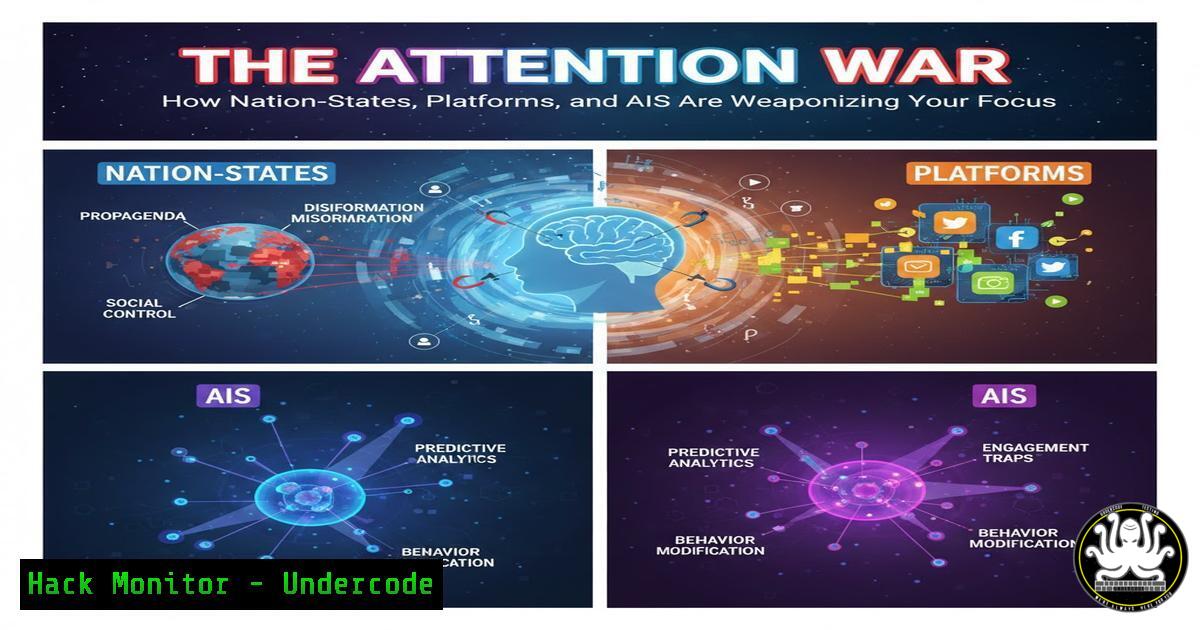
A new, silent war is being waged not for physical territory, but for the most valuable resource of the digital age: human attention. This conflict, orchestrated by states, corporations, and advanced AIs, uses information saturation and algorithmic manipulation to shape opinions, influence decisions, and induce mental fatigue. Understanding the mechanics of this “attention war” is no longer a philosophical exercise—it’s a critical cybersecurity and cognitive security imperative.
Learning Objectives:
- Understand the technical mechanisms, including algorithms and API-driven platforms, used to capture and weaponize attention.
- Learn practical steps to harden your personal and organizational digital environment against cognitive attacks.
- Develop a strategy for maintaining situational awareness and critical thinking in an intentionally distracting information ecosystem.
You Should Know:
- The Architecture of the Attention Economy: Scrolls, Feeds, and Engagement Algorithms
The core battlefield is the algorithmic feed. Platforms like LinkedIn, X, and TikTok use sophisticated AI to maximize user engagement, a metric directly tied to attention capture. These systems analyze your interactions—clicks, dwell time, likes, shares—to build a behavioral profile. Using reinforcement learning, they then curate a feed that prioritizes content most likely to keep you scrolling, regardless of its veracity or value. This isn’t just social media; it’s a continuous, large-scale A/B test on human psychology.
Step-by-step guide to understanding and mitigating feed manipulation:
Step 1: Audit Your Data Footprint: Most platforms allow you to download your data. This reveals what the AI knows about you.
Action: On LinkedIn, go to `Settings & Privacy` > `Data privacy` > Get a copy of your data. Analyze the `Ads Targeting` and `Recommendations` files to see how you are categorized.
Step 2: Actively Curate Your Feed: Don’t be passive. Actively tell the algorithm what you don’t want to see.
Action: On any platform, use the “Not interested in this post” or “Don’t recommend channel” options aggressively. Mute keywords related to distracting or inflammatory topics.
Step 3: Use RSS for Information Intake: Bypass algorithmic feeds entirely for critical information by using an RSS reader.
Action: Use an open-source tool like `FreshRSS` (self-hosted) or a commercial reader. Subscribe directly to the blogs and news sources you trust, stripping away the engagement-optimizing middleman.
- State-Sponsored Cognitive Attacks: The Weaponization of Information Saturation
Nation-states have moved beyond simple disinformation to employing “saturation attacks.” The goal is not to convince you of one narrative, but to flood the zone with so many conflicting claims, conspiracies, and events that the public becomes fatigued, cynical, and unable to discern truth. This creates a “firehose of falsehood” effect, eroding trust in all institutions and creating cognitive chaos. From a cybersecurity perspective, this is a DDoS attack on human cognition.
Step-by-step guide to building cognitive DDoS protection:
Step 1: Implement Information Diet Rules: Treat information consumption like a healthy diet. Limit your sources and intake times.
Action: Use website blockers (Cold Turkey on Windows, `SelfControl` on macOS) during work hours to block news and social media sites. Schedule specific, limited times for “information intake.”
Step 2: Verify Before Amplification: Use technical tools to verify media and claims.
Action: For images, use reverse image search (Google Lens, TinEye). For videos, use tools like `InVID` browser extension to verify provenance and check for manipulation.
Step 3: Monitor for Coordinated Inauthentic Behavior: Use open-source intelligence (OSINT) techniques to spot bot-driven campaigns.
Action: Analyze Twitter threads using a tool like `Botometer` to check for bot-like activity. Look for identical phrasing, rapid deployment from new accounts, and high volume around a single hashtag.
- The AI Accelerant: How LLMs Drive Cognitive Fragmentation
Generative AI and Large Language Models (LLMs) act as a force multiplier in the attention war. They can generate personalized, persuasive content at an unprecedented scale and speed. This leads to “cognitive fragmentation,” where micro-targeted, often contradictory, narratives are delivered to different demographic groups, preventing the formation of a shared reality. AI doesn’t just create content; it creates bespoke realities.
Step-by-step guide to identifying and countering AI-driven manipulation:
Step 1: Detect AI-Generated Text: While not perfect, detectors can provide a signal.
Action: For critical analysis, run suspicious text through tools like `GPTZero` or Originality.ai. Look for the “fluent but generic” style common in LLM output.
Step 2: Harden Your Communications: Use end-to-end encrypted platforms to reduce the surface area for AI scraping and analysis.
Action: Mandate the use of `Signal` or `Element` for sensitive organizational communications instead of WhatsApp or Telegram, which have metadata vulnerabilities.
Step 3: Prompt for Critical Thinking: When using AI assistants, force them to provide sources and reasoning.
Action: Use prompts like: “Provide a balanced analysis of
, citing verifiable sources. Also, list potential biases or counter-arguments to your own response."

<h2 style="color: yellow;">4. Digital Hygiene: Hardening Your Personal IT Environment</h2>

Your personal device ecosystem is the frontline of the attention war. Unsecured devices, permissive app settings, and constant notifications are vulnerabilities that attackers (commercial or state) exploit to gain access to your focus.

<h2 style="color: yellow;">Step-by-step guide to personal IT hardening:</h2>

Step 1: Audit and Restrict App Permissions: Mobile apps are primary attention siphoners.
 Action (Android): Go to `Settings` > `Apps` > `[App Name]` > <code>Permissions</code>. Revoke unnecessary permissions like Location, Camera, and Microphone.
 Action (iOS): Go to `Settings` > `Privacy & Security` > <code>Tracking</code>. Disable "Allow Apps to Request to Track."
 Step 2: Implement System-Wide Ad Blocking: Block the most obvious attention-grabbers: ads and trackers.
 Action: On your browser, use <code>uBlock Origin</code>. On your entire network, configure your router to use a DNS-based ad blocker like `NextDNS` or <code>Pi-hole</code>.

<h2 style="color: yellow;"> Pi-hole Command Line Setup (Simplified):</h2>

[bash]
 Install Pi-hole (on a Raspberry Pi or Linux VM)
curl -sSL https://install.pi-hole.net | bash
 Configure your router's DHCP settings to assign the Pi-hole's IP as the DNS server for all devices.
Step 3: Master Notification Control: Notifications are a primary attack vector for attention capture.
Action: On both Windows and macOS, enter “Focus Assist” or “Do Not Disturb” mode during deep work. On mobile, disable all notifications except for critical communication apps.
- Building a Lucide Mind: Strategies for Organizational and Personal Resilience
The final line of defense is cognitive. Building mental resilience involves creating structures and habits that preserve critical thinking and focus. This is a continuous process, not a one-time fix.
Step-by-step guide to building cognitive resilience:
Step 1: Practice “Source Literacy”: Don’t just evaluate information; evaluate the source’s architecture.
Action: Before trusting a website, check its `robots.txt` file (e.g., example.com/robots.txt) to see what it’s hiding from search engines. Use `whois` to check domain registration.
whois example.com
Step 2: Implement a “Cognitive Budget”: Allocate your focus intentionally.
Action: Use time-blocking in your calendar. Allocate specific, limited time for email, social media, and news, and protect the rest for deep, undistracted work.
Step 3: Conduct Regular Threat Intel Briefings (For Yourself): Stay informed about the latest manipulation tactics.
Action: Subscribe to newsletters from organizations like the Atlantic Council’s DFRLab or follow cybersecurity researchers who specialize in disinformation. Understand the “TTPs” (Tactics, Techniques, and Procedures) used in cognitive attacks.
What Undercode Say:
- The battlefield has shifted from network perimeters to the human mind, making cognitive security a non-negotiable component of modern cybersecurity.
- Victory in this war is not defined by eliminating threats, but by building personal and organizational resilience that allows for sustained focus and critical thought amidst the chaos.
The attention war represents the ultimate convergence of cybersecurity and human psychology. Defending against it requires a multi-layered approach: technical controls to harden our digital environments, procedural changes to manage our information intake, and a fundamental shift in mindset to recognize focus as a strategic resource. The entities that succeed in the coming years will not be those with the most information, but those with the clearest capacity to process it effectively and maintain strategic clarity.
Prediction:
The next five years will see the rise of “Cognitive Security” as a formal discipline within corporate and national security frameworks. We will witness the development of specialized software designed not just to block ads, but to analyze and score information streams for manipulation potential in real-time. AI models will be deployed defensively to detect and flag coordinated inauthentic behavior and narrative attacks before they reach critical mass. Furthermore, expect to see “attention audits” becoming as standard as security penetration tests, where consultants evaluate an organization’s vulnerability to cognitive overload and targeted distraction campaigns. The arms race for your focus is just beginning, and the tools on both sides will become exponentially more sophisticated.
🎯Let’s Practice For Free:
IT/Security Reporter URL:
Reported By: Geopoliteck Lundi – Hackers Feeds
Extra Hub: Undercode MoN
Basic Verification: Pass ✅


