Listen to this Post
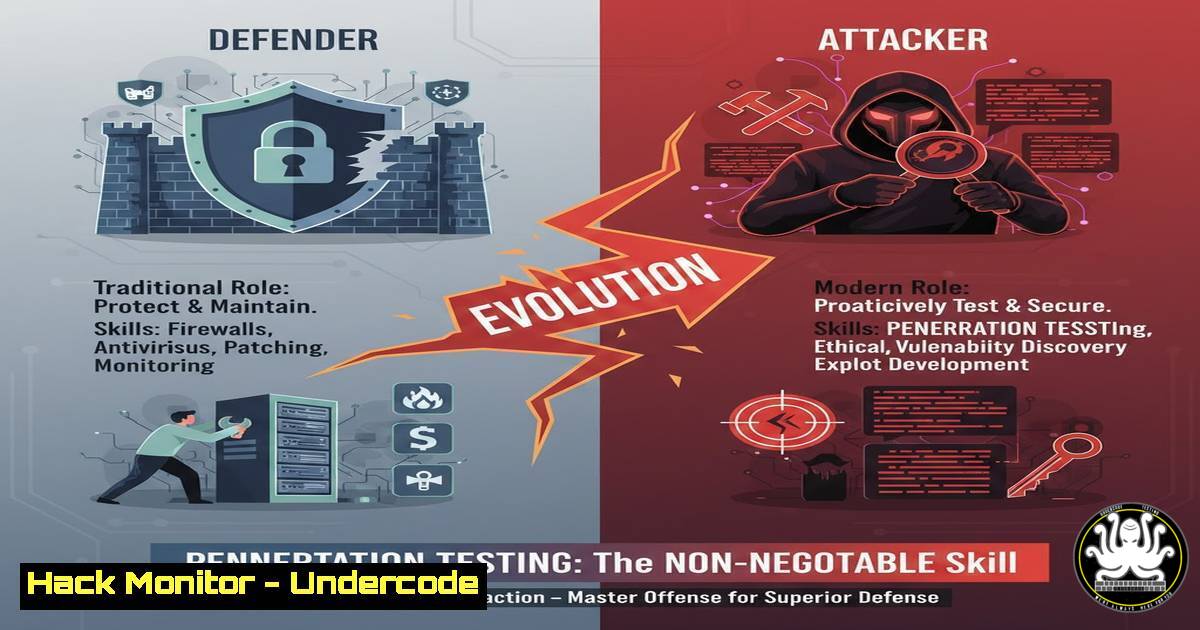
Introduction:
The traditional paradigm of cybersecurity defense, focused solely on building walls and implementing policies, is no longer sufficient in the evolving threat landscape. To effectively protect networks, especially the critical convergence of Information Technology (IT) and Operational Technology (OT), security professionals must adopt an attacker’s mindset. This article delves into the critical practice of penetration testing as the foundational discipline for building robust, detection-capable, and resilient security postures across all digital environments.
Learning Objectives:
- Understand the core principles of penetration testing and its direct application to cyber defense.
- Identify and utilize key resources like the MITRE ATT&CK framework and virtual labs for skill development.
- Execute fundamental offensive security techniques, including reconnaissance and privilege escalation, to understand their defensive countermeasures.
You Should Know:
- The Attacker’s Mindset: The Foundation of Modern Defense
The core principle is simple yet profound: you cannot defend against what you do not understand. Defenders who lack offensive knowledge operate with critical blind spots. They may deploy a security control without knowing how it can be bypassed, write a detection rule without understanding the attack signature, or design a network architecture without foreseeing its inherent weaknesses. Penetration testing formalizes this understanding by forcing you to think like an adversary, systematically probing for and exploiting vulnerabilities just as a real attacker would.
Step-by-step guide:
- Shift Your Perspective: Before touching a keyboard, change your goal from “How do I protect this?” to “How would I break into this?” This mental model is the first and most crucial step.
- Define the Scope: Identify your target. Is it a web application, a network segment, a specific user, or an entire OT system? Clearly defining the target focuses your efforts.
- Adopt a Methodology: Follow a structured approach like the Penetration Testing Execution Standard (PTES) or simply mirror the Cyber Kill Chain: Reconnaissance, Scanning, Gaining Access, Maintaining Access, and Covering Tracks.
2. Mapping the Attack with MITRE ATT&CK
MITRE ATT&CK is a globally accessible knowledge base of adversary tactics and techniques based on real-world observations. For a defender learning offense, it serves as a comprehensive menu of what they need to learn. The framework provides a common language, allowing defenders to articulate what they are defending against and understand the sequential steps of an attack beyond the initial breach. The ICS-specific ATT&CK matrix is particularly vital for understanding threats to industrial control systems.
Step-by-step guide:
- Navigate to the Framework: Visit the MITRE ATT&CK website (
https://attack.mitre.org/`) and specifically the ICS matrix (https://attack.mitre.org/matrices/enterprise/ics/`). - Study a Technique: Select a technique, such as Tactic: Persistence – Technique: Create Account (T1136). Read the description, see which groups use it, and identify procedures.
- Identify Defensive Gaps: For T1136, ask yourself: “Do we have a process to monitor for unauthorized account creation? Can our logging detect this? How quickly would we respond?” This directly translates offensive knowledge into defensive action.
3. Hands-On Skill Development in Virtual Labs
Theoretical knowledge is useless without practical application. Platforms like Hack The Box (HTB) and TryHackMe provide safe, legal environments to practice offensive techniques. They offer guided learning paths for beginners and complex, unguided machines for experts, covering everything from web application vulnerabilities to Active Directory exploitation and privilege escalation.
Step-by-step guide for a basic HTB-style machine:
- Reconnaissance: Use `nmap` to discover open ports and services on the target machine.
Command: `nmap -sC -sV -O `
This reveals the attack surface (e.g., a web server on port 80, SSH on port 22).
2. Enumeration: Dig deeper into discovered services. For a web server, use `gobuster` to find hidden directories.
Command: `gobuster dir -u http://
3. Exploitation: Use the information gathered. If you find a vulnerable WordPress site, you might use `wpscan` to find an exploit. If you find an SMB share, you might use `smbclient` to list its contents.
4. Mastering Privilege Escalation: The Attacker’s Payoff
A common initial foothold is a low-privileged user account. The real goal for an attacker is administrative or root access. Understanding Local Privilege Escalation (LPE) is therefore critical for defenders to understand the full kill chain and where it can be broken.
Step-by-step guide for Linux Privilege Escalation:
- Information Gathering: On the compromised host, run scripts like `linpeas.sh` to automatically identify potential misconfigurations, writable files, vulnerable kernel versions, and sudo rights.
- Analyze Sudo Rights: Check what commands the current user can run with elevated privileges.
Command: `sudo -l`
If a user can run `find` as root, for example, it can be leveraged for escalation.
Exploitation Command: `sudo find /etc -exec /bin/sh \;`
3. Check for SUID Binaries: Look for binaries with the SUID bit set, which execute with the owner’s privileges.
Command: `find / -perm -u=s -type f 2>/dev/null`
A misconfigured SUID binary (e.g., cp, bash) can be exploited to gain a root shell.
5. Bridging the Gap: OT/ICS-Specific Offensive Training
OT/ICS environments have unique protocols (e.g., Modbus, DNP3), legacy systems, and critical availability requirements. Attacks here can have physical consequences. Specialized virtual labs like Labshock and GRFICSv3 allow defenders to practice attacks in a simulated industrial environment, understanding how a malicious command can halt a conveyor belt or override a pressure valve.
Step-by-step guide for OT Network Reconnaissance:
- Protocol Identification: Use a tool like `nmap` with service detection to find PLCs and RTUs.
Command: `nmap -sS -sU -p- -T4 –min-rate 10000`
2. Interrogation: Use specialized tools to query industrial devices.
Using `modbus-cli` to read coils (discrete outputs) from a Modbus PLC:
Command: `modbus read –ip–port 502 –slave 1 –address 0 –count 10`
3. Understanding Impact: The defensive lesson is to monitor network traffic for unauthorized protocol interrogation and enforce strict segmentation between IT and OT networks to prevent this reconnaissance from being possible from the corporate network.
What Undercode Say:
- Proactive Defense is Offensive-Informed Defense. The most effective security programs are those where the defenders have firsthand experience in breaking systems, allowing them to anticipate and mitigate attacks before they occur.
- The Skill Gap is an Opportunity. Investing time in penetration testing training is not just for aspiring ethical hackers; it is the single most effective way for any security professional to increase their value and effectiveness, especially in the high-stakes field of OT/ICS security.
Analysis:
Mike Holcomb’s post cuts to the heart of a persistent issue in cybersecurity: the theoretical defender versus the practical attacker. His argument moves beyond common advice by explicitly linking offensive skills to specific defensive outcomes—accurate detection and effective control design. The provided resources create a clear, actionable path for skill development, from foundational frameworks (MITRE) to practical platforms (HTB, TryHackMe) and specialized OT labs. This approach demystifies penetration testing, presenting it not as a niche specialty but as a core competency for any serious defender. The emphasis on OT/ICS is particularly prescient, as these environments are increasingly connected and targeted, yet often lack defenders with this crucial adversarial understanding.
Prediction:
The convergence of IT and OT will continue to accelerate, making the hybrid defender with offensive skills the most sought-after professional in the cybersecurity labor market. Regulatory bodies will increasingly mandate penetration testing, especially for critical infrastructure, moving it from a “best practice” to a compliance requirement. Furthermore, the rise of AI-powered attacks will necessitate AI-powered defense, and the professionals who will train and manage these AI systems will be those with a deep, practical understanding of the attack lifecycle that only hands-on penetration testing can provide.
🎯Let’s Practice For Free:
IT/Security Reporter URL:
Reported By: Https: – Hackers Feeds
Extra Hub: Undercode MoN
Basic Verification: Pass ✅


