
Listen to this Post
Introduction:
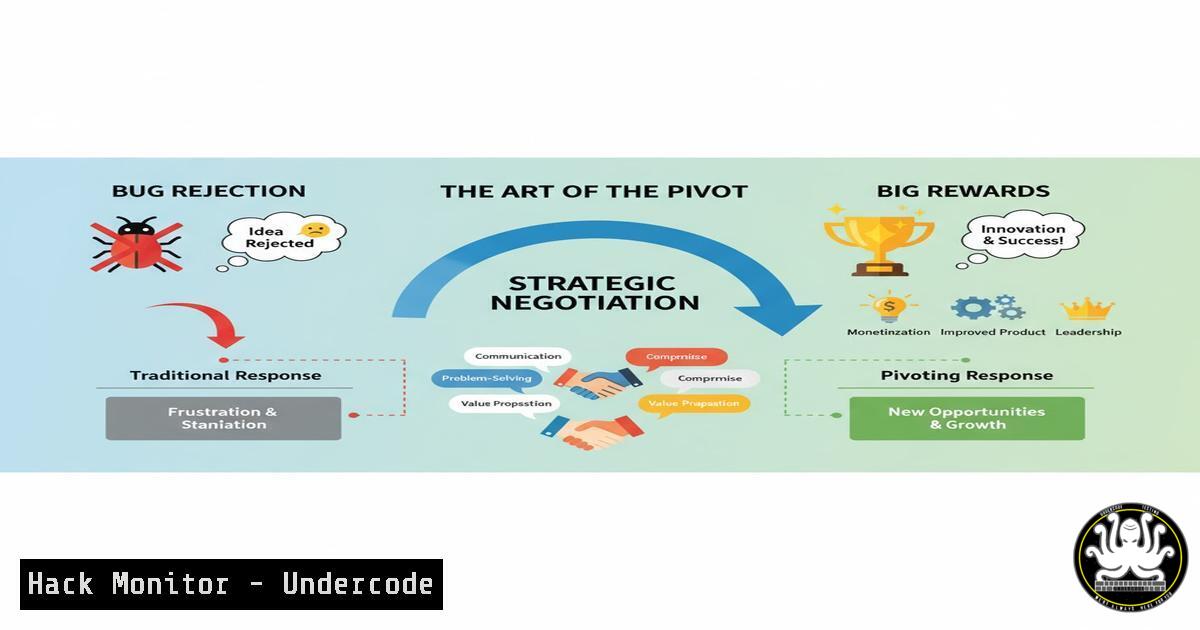
In the competitive realm of bug bounty hunting, discovering a critical vulnerability is only half the battle. The other, often more challenging half, is convincing the security team of its value and negotiating a fair reward. This article delves into the strategic pivot from having a bug report rejected to securing a bounty, transforming a “no” into a negotiated “yes” through proven communication and technical validation techniques.
Learning Objectives:
- Master the methodology of effectively documenting and presenting vulnerability impact to program owners.
- Learn to leverage AI-assisted tools to structure persuasive, professional negotiation messages.
- Develop a repeatable workflow for post-rejection follow-ups that increases the rate of successful bounty awards.
You Should Know:
1. Crafting an Irrefutable Initial Report
The most common reason for initial rejection is a failure to clearly and concisely demonstrate the business impact of a vulnerability. A report must be a self-contained, easily digestible package of evidence.
Step‑by‑step guide explaining what this does and how to use it.
Step 1: Executive Summary: Start with a single sentence stating the vulnerability class (e.g., “Broken Access Control on /api/v1/admin/users“) and its worst-case impact (e.g., “leading to full account takeover of any user”).
Step 2: Technical Proof-of-Concept (PoC): Provide a step-by-step guide to reproduce the issue. Do not assume any prior knowledge.
For Web Apps: Use cURL commands or a browser script snippet to demonstrate the flaw.
 Example cURL for an IDOR vulnerability
curl -H "Authorization: Bearer <low_priv_token>" https://target.com/api/v1/user/12345/ssn
 This returns the SSN of user 12345, even though the token is for a different user.
For Network Services: Provide a Python script or Nmap command showing the unauthorized access.
Step 3: Impact Analysis: Explicitly state the risk using the CVSS (Common Vulnerability Scoring System) calculator. Link the technical flaw to a business consequence, such as data breach, financial fraud, or reputational damage.
- The Strategic Follow-Up: Turning a ‘No’ into a Conversation
A rejection is often a test of the researcher’s conviction and professionalism. A structured, polite follow-up can reopen the dialogue.
Step‑by‑step guide explaining what this does and how to use it.
Step 1: Acknowledge and Clarify. Respond by thanking the team for their review and politely asking for specific feedback. “Thank you for the update. To help me improve my submissions, could you please clarify which aspect of the impact was not demonstrated sufficiently?”
Step 2: Reiterate and Reinforce. Rephrase your original finding, incorporating any new information. If they claimed it was “intended behavior,” explain why, from an attacker’s perspective, this behavior is dangerous.
Step 3: Escalate the Proof. If the vulnerability is complex, provide a video recording (using `ffmpeg` or a simple screen recorder) or a more detailed script.
3. Leveraging AI for Persuasive Communication
As humorously suggested in the source post, AI tools like ChatGPT can be powerful allies in drafting clear, professional, and persuasive communication.
Step‑by‑step guide explaining what this does and how to use it.
Step 1: Feed the AI Your Raw Data. Provide the AI with your technical notes, the vendor’s rejection reason, and your goal.
Prompt Example: “You are a professional bug bounty hunter. The program rejected my IDOR vulnerability report, stating ‘Insufficient evidence of impact.’ My PoC shows I can access any user’s private data by changing the `user_id` parameter. Draft a polite, professional, and technically sound email to the security team that reiterates the impact and requests reconsideration.”
Step 2: Refine the Output. The AI will generate a well-structured draft. Ensure it maintains a respectful tone, avoids accusations, and focuses on objective facts. Remove any marketing fluff or overly emotional language.
Step 3: Personalize. Add a personal touch to the AI-generated message to ensure it doesn’t sound robotic. The final product should be a hybrid of AI efficiency and human nuance.
4. Automating Evidence Collection with Scripting
Manually reproducing bugs is time-consuming. A simple script can automate evidence collection, making your report more robust and your workflow more efficient.
Step‑by‑step guide explaining what this does and how to use it.
Scenario: Automating the check for a Subdomain Takeover vulnerability.
Tool: Use `subjack` (Go-based) or a custom Python script to check a list of subdomains for takeovers.
 Install subjack
go get github.com/haccer/subjack

Run it on your subdomain list
subjack -w subdomains.txt -t 100 -timeout 30 -o results.txt -ssl
`-w subdomains.txt`: Your list of target subdomains.
`-t 100`: Number of threads.
`-timeout 30`: Timeout per request.
`-o results.txt`: Output file for vulnerable subdomains.
`-ssl`: Force SSL checks.
Including the script and its output in your report demonstrates thoroughness and leaves little room for doubt.
5. Quantifying Business Impact with CVSS 4.0
Translating a technical bug into a business risk is the key to justifying a bounty. The CVSS framework provides a standardized way to do this.
Step‑by‑step guide explaining what this does and how to use it.
Step 1: Use the CVSS Calculator. Go to the official FIRST.org CVSS calculator.
Step 2: Score the Vulnerability. Honestly assess the metrics. For an IDOR allowing access to PII:
Attack Vector (AV): Network (N)
Attack Complexity (AC): Low (L)
Privileges Required (PR): Low (L)
User Interaction (UI): None (N)
Scope (S): Unchanged (U)
Impact on Confidentiality (VC): High (H)
Step 3: Include the Vector String and Score. A score of, for example, 8.6 (High) is a powerful, objective argument for the severity of your finding. State: “This vulnerability has a CVSS v4.0 score of 8.6 (AV:N/AC:L/PR:L/UI:N/VC:H/VI:N/VA:N), indicating a high-severity risk to user data confidentiality.”
6. Building a Professional Hunter Profile
Program managers are more likely to engage seriously with researchers who have a established, professional online presence.
Step‑by‑step guide explaining what this does and how to use it.
Step 1: Create a Professional Profile. Platforms like LinkedIn, GitHub, and a personal blog act as your resume. List your validated bugs (without breaking disclosure rules), your methodology, and tools you develop.
Step 2: Contribute to the Community. Publishing write-ups, contributing to open-source security tools, or being active on platforms like HackerOne’s Hacktivity builds credibility.
Step 3: Link Your Profile. When submitting a report, especially a follow-up, you can subtly include a link to your professional profile. This subconsciously signals that you are a serious researcher, not a casual scanner user.
What Undercode Say:
- Negotiation is a Core Security Skill. The technical find is the raw material; negotiation is the process that refines it into a rewarded asset. Underestimating this skill is a primary reason for lost bounties.
- Automation and AI are Force Multipliers. The modern hunter doesn’t just automate recon; they automate evidence collection and even parts of the communication process, freeing up time for deeper technical analysis.
The original post, with its tongue-in-cheek “Bounty:100£ Bug bounty❌ beg bounty✅,” highlights a universal frustration in the community. However, it also points to the solution: a shift in strategy. The “beg” is reframed not as a plea, but as a structured, evidence-based negotiation. The suggestion to use ChatGPT, while humorous, is fundamentally sound—it’s about enhancing clarity and professionalism in communication. The collaboration mentioned underscores that success in bug bounties is often a team effort, where strategies are shared and refined. The underlying analysis is that the hunter’s technical ability must be matched by their soft skills and operational workflow to consistently succeed.
Prediction:
The future of bug bounty platforms will integrate AI-driven mediation assistants directly into their triage and communication systems. These AI agents will analyze submitted reports for completeness and potential impact, providing initial feedback to researchers and even suggesting a preliminary severity score to program owners. This will reduce human bias and friction, leading to faster and fairer reward distributions. Furthermore, we will see the rise of “Reputation Scores” for hunters, based on the quality of their reports and negotiation outcomes, which will grant top-tier researchers prioritized access to private programs and faster response times, formalizing the professional profile’s importance.
🎯Let’s Practice For Free:
IT/Security Reporter URL:
Reported By: Toshit Bharti – Hackers Feeds
Extra Hub: Undercode MoN
Basic Verification: Pass ✅


