Listen to this Post
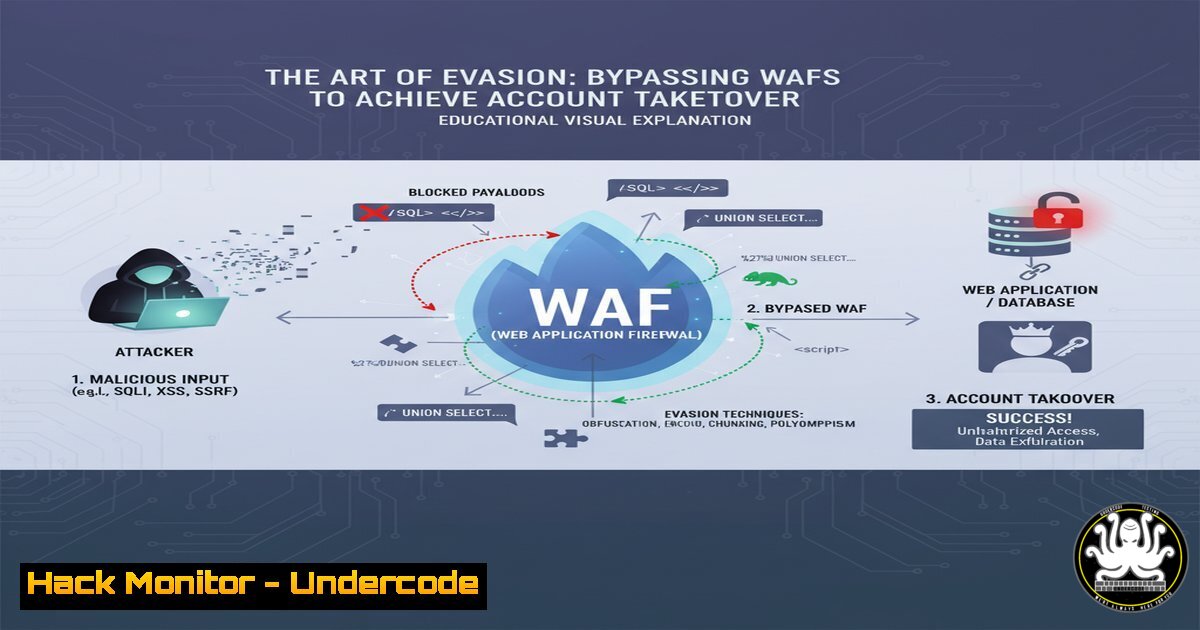
Introduction:
Web Application Firewalls (WAFs) are the first line of defense for modern web applications, but they are not impenetrable. This article delves into advanced techniques for bypassing WAF filters to exploit critical vulnerabilities like Cross-Site Scripting (XSS), ultimately leading to severe consequences such as account takeover. We will explore the mindset and technical process behind a successful evasion, as demonstrated by a real-world bug bounty hunt.
Learning Objectives:
- Understand common WAF filtering mechanisms and their weaknesses.
- Learn and apply advanced encoding techniques to obfuscate malicious payloads.
- Develop a systematic methodology for testing and bypassing security filters.
You Should Know:
1. The Power of Obfuscation: Encoding Your Payloads
Modern WAFs often blacklist specific keywords and characters like <, >, and script. Encoding is the primary method to evade these simple filters.
Verified Code Snippet: Basic HTML Encoding
`&60;script&62;alert(‘XSS’)&60;/script&62;`
Step-by-step guide: HTML encoding replaces potentially dangerous characters with their corresponding HTML entities. The WAF might see the string `&60;` but the browser will interpret it as a `<` character, successfully executing the script. Use online tools or programming language libraries (e.g., Python's html.escape()) to quickly encode your payloads.
2. Double Encoding for Deeply Filtered Systems
Some WAFs or application layers might decode input once, expecting to catch encoded attacks. Double encoding tricks this dual-layer inspection.
Verified Code Snippet: Double URL Encoding
`%253Cscript%253Ealert(‘XSS’)%253C%252Fscript%253E`
Step-by-step guide: Here, the `%` sign itself is encoded as %25. So, `%3C` (which is the URL encoding for <) becomes %253C. A WAF that decodes once might see `%3C` and allow it, while the application decodes it a second time, finally rendering it as <.
3. JavaScript String Manipulation and Obfuscation
Splitting and obfuscating the keywords that WAFs commonly block can effectively break signature-based detection.
Verified Code Snippet: String Concatenation
``
Step-by-step guide: This bypasses WAFs that look for the exact string `alert(1)` but do not perform advanced execution flow analysis. The `eval()` function then concatenates the strings and executes the resulting command.
4. Exploiting Protocol and Data State Confusion (XSS)
Leveraging alternative HTML attributes and protocols can bypass filters looking for standard `javascript:` protocols.
Verified Code Snippet: Using the `data` protocol
`
Step-by-step guide: The `data` protocol allows you to embed base64-encoded HTML directly. The base64 string `PHNjcmlwdD5hbGVydCgnWFNTJyk8L3NjcmlwdD4=` decodes to <script>alert('XSS')</script>. This often bypasses WAFs that do not decode and inspect base64 content within attributes.
5. Bypassing with Alternate Event Handlers
WAFs often have extensive blacklists for common event handlers like `onload` or onerror. Using less common handlers can be effective.
Verified Code Snippet: Using `onanimationstart`
`
test
`
Step-by-step guide: This payload uses a CSS animation event handler. Since it’s not as commonly blacklisted as `onmouseover` or onclick, it has a higher chance of slipping through the filter. It requires a CSS animation to be defined (here, x), which triggers the script.
6. External Resource Exfiltration for Account Takeover
The ultimate goal of many XSS attacks is to steal sensitive data like session cookies and exfiltrate them to an attacker-controlled server.
Verified Code Snippet: Cookie Exfiltration Payload
``
Step-by-step guide: This payload uses the JavaScript `fetch()` API to send the victim’s `document.cookie` to a remote server. For this to work, the attacker must have a listening server (e.g., using `netcat` or a simple Python HTTP server: python3 -m http.server 80). This demonstrates a critical step in achieving a complete account takeover.
7. Automating Payload Testing with Curl and Bash
Manually testing payloads is inefficient. Automating the process with command-line tools allows for rapid iteration.
Verified Linux Command Snippet: Testing with Curl
`curl -G -v “https://vulnerable-site.com/search” –data-urlencode ‘query=
Step-by-step guide: The `curl` command is used to send HTTP requests. The `-G` flag appends the `–data-urlencode` parameters to the URL as a query string. This allows you to quickly test different encoded payloads against a target endpoint and inspect the response for successful injection or WAF blocking messages.
What Undercode Say:
- Persistence is the key differentiator between a failed attempt and a critical find. The 10-hour effort described highlights that breakthrough often comes after extensive, seemingly fruitless testing.
- Never assume a single filter bypass is the end of the road. Layering encoding techniques (e.g., HTML encoding inside a JavaScript string) creates increasingly complex payloads that are more likely to evade multi-layered security controls.
The detailed account of this bug bounty success story underscores a critical evolution in offensive security. It’s no longer about known exploits but about the creative manipulation of an application’s parsing logic versus the WAF’s filtering logic. The researcher’s journey from a duplicate finding to a successful bypass by meticulously analyzing a single printed character in the response exemplifies the deep, investigative work required in modern web application testing. This shift demands that security professionals and developers alike move beyond relying solely on off-the-shelf WAF solutions and invest more heavily in secure code design and advanced threat modeling.
Prediction:
The cat-and-mouse game of WAF evasion will intensify, pushing towards the integration of AI and machine learning in WAF solutions to analyze the behavioral intent of payloads rather than relying on static signatures. However, attackers will concurrently adopt AI to automatically generate millions of uniquely obfuscated payloads, testing them at scale against targets. This arms race will make zero-day vulnerability discovery through automation more common, forcing a industry-wide pivot towards more robust secure development lifecycles (SDLC) and mandatory offensive security training for developers to build security in from the ground up.
🎯Let’s Practice For Free:
IT/Security Reporter URL:
Reported By: https://lnkd.in/p/dwmTgx3e – Hackers Feeds
Extra Hub: Undercode MoN
Basic Verification: Pass ✅


