Listen to this Post
Introduction:
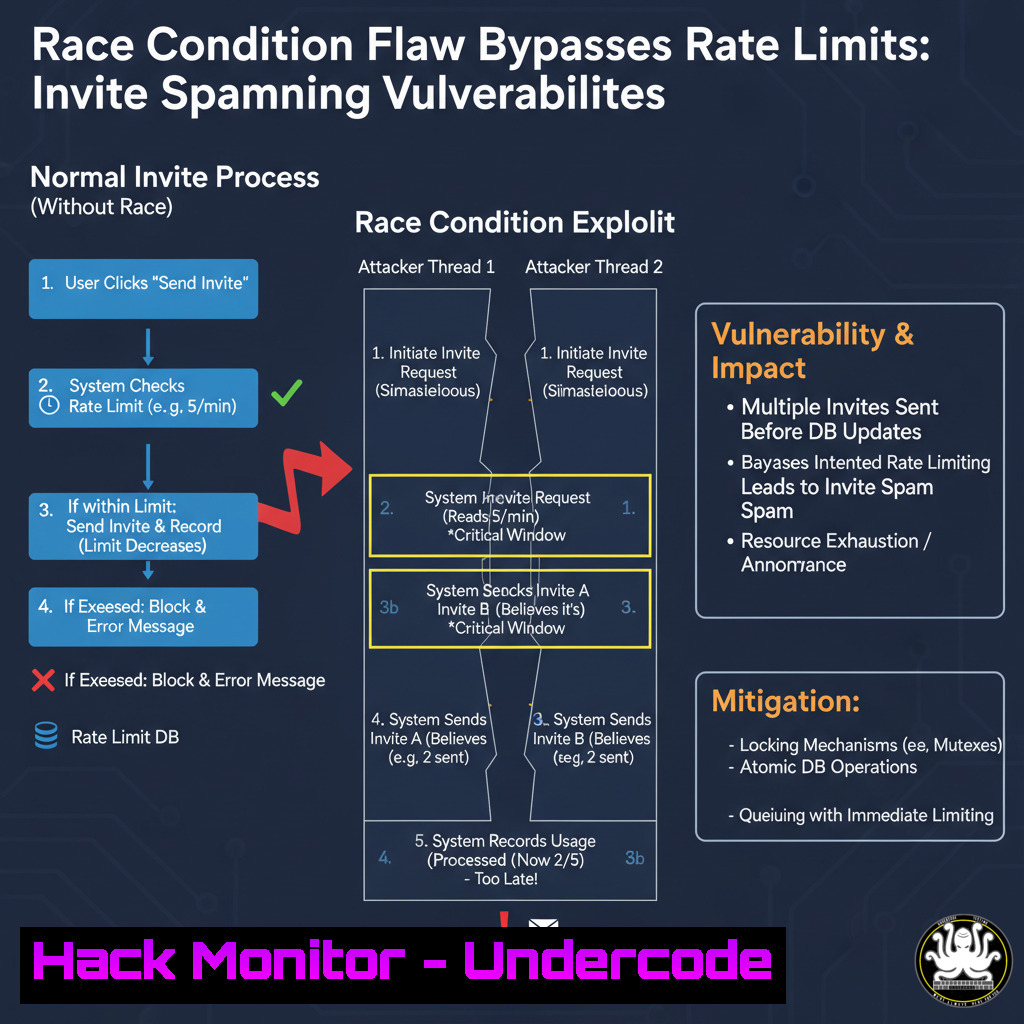
A recently disclosed security flaw demonstrates how a combination of race conditions and improper input normalization can completely bypass critical security controls. This vulnerability in a web application’s invite feature allowed an attacker to spam users by exploiting concurrency and case sensitivity, highlighting fundamental weaknesses in modern web development practices.
Learning Objectives:
- Understand how race conditions in web applications can bypass rate-limiting mechanisms.
- Learn the critical importance of input normalization, particularly for unique identifiers like email addresses.
- Identify methods for implementing atomic transactions and server-side locks to prevent concurrency flaws.
You Should Know:
1. The Anatomy of a Race Condition
Race conditions occur when a system’s output is dependent on the sequence or timing of uncontrollable events, like concurrent requests. In cybersecurity, this often manifests when multiple processes access and manipulate shared data without adequate locking mechanisms.
` Example of a vulnerable code pattern (Python/Flask-like pseudo-code)
@app.route(‘/send_invite’, methods=[‘POST’])
def send_invite():
email = request.form[’email’]
Vulnerable Check: No locking mechanism
if not Invite.query.filter_by(email=email).filter(Invite.created_at > datetime.utcnow() – timedelta(minutes=3)).first():
new_invite = Invite(email=email)
db.session.add(new_invite)
db.session.commit() Race window exists here
send_email(invite)
return “Invite sent!”
`
Step-by-step guide:
The code checks if an invite exists for an email within the last 3 minutes. However, the time between the check (filter_by) and the commit is a “race window.” If two requests for the same email are sent simultaneously, both can pass the check before either one commits the new invite to the database, resulting in duplicate entries. The fix is to make the check and the creation an atomic transaction, often achieved using database locks or unique constraints.
2. Implementing Database-Level Locking for Atomicity
The most robust fix is to enforce uniqueness at the database level, preventing the race condition from being exploitable.
`/ SQL: Creating a table with a constraint to prevent duplicate invites within a timeframe /
CREATE TABLE invites (
id INT PRIMARY KEY AUTO_INCREMENT,
email VARCHAR(255) NOT NULL,
normalized_email VARCHAR(255) NOT NULL, — Normalized version
created_at DATETIME NOT NULL,
— Compound constraint: unique normalized email within a recent timeframe is complex.
— A simpler preventative measure is a unique constraint on a token.
);
/ A more practical approach is to use a unique constraint on the email and a “token” for the time window. /
ALTER TABLE invites ADD CONSTRAINT unique_invite_token UNIQUE (normalized_email, invite_token);
— Application logic would generate an ‘invite_token’ that is constant for a given email for the duration of the rate-limit window (e.g., a timestamp rounded to 3 minutes).
`
Step-by-step guide:
This SQL snippet outlines a strategy for preventing duplicates. Instead of relying on application logic, a database constraint is used. The application would calculate a `normalized_email` (lowercase) and an `invite_token` (e.g., `floor(epoch_time / 180)` for a 3-minute window). The UNIQUE constraint on the (normalized_email, invite_token) columns ensures the database itself will reject any second insert attempt for the same email in the same time window, making the operation atomic and thread-safe.
3. Enforcing Server-Side Input Normalization
Inputs like emails must be normalized before any logic is applied. Relying on client-side normalization or raw user input is a critical flaw.
` Python: Normalizing email input before processing
import re
def normalize_email(email):
“””
Normalizes an email address.
Lowercases the local part (before @) and the domain.
Note: This is a basic example. Real-world usage requires stricter RFC compliance.
“””
try:
local_part, domain = email.strip().rsplit(‘@’, 1)
local_part = local_part.lower()
domain = domain.lower()
return f'{local_part}@{domain}’
except ValueError:
raise ValueError(“Invalid email format”)
Use this function in the invite endpoint
normalized_email = normalize_email(request.form[’email’])
Now use normalized_email for all checks and storage
`
Step-by-step guide:
This Python function takes a raw email input, splits it at the ‘@’ symbol, converts both the local part and the domain to lowercase, and rejoins them. This ensures that [email protected], [email protected], and `[email protected]` are all treated as the same identifier. This function must be called at the very beginning of any request handler that processes an email to prevent case-sensitivity bugs.
4. Testing for Race Conditions with Command-Line Tools
Security testers and developers can use simple command-line tools to test for race conditions.
` Using GNU Parallel to trigger 10 concurrent curl requests
$ echo -e “[email protected]\[email protected]” > data.txt
$ parallel -j 10 –halt now,fail=1 curl -X POST -d @data.txt https://vulnerable-site.com/send_invite ::: {1..10}
Using a simple Bash script with background processes
$ for i in {1..5}; do
curl -X POST -d “[email protected]” https://vulnerable-site.com/send_invite &
done
wait
`
Step-by-step guide:
The first command using `parallel` sends 10 concurrent POST requests (-j 10) using the data in data.txt. The second Bash script launches 5 curl processes in the background (&), sending them all at virtually the same time. The `wait` command then pauses the script until all background processes finish. Observing the server’s response will show if multiple invites were created successfully, indicating a race condition vulnerability.
5. Implementing Redis-Based Rate Limiting with Atomic Operations
For a more scalable solution than database constraints, Redis with atomic commands can be used to implement robust rate limiting.
` Python using Redis py library
import redis
import time
redis_client = redis.Redis(host=’localhost’, port=6379, db=0)
def is_rate_limited(email, time_window=180, max_requests=1):
normalized_email = normalize_email(email)
key = f”invite_rate_limit:{normalized_email}”
Use Redis transaction pipeline for atomicity
pipe = redis_client.pipeline()
pipe.incr(key) Increment the key
pipe.expire(key, time_window) Set expiry if this is the first set
request_count, _ = pipe.execute()
If it’s the first request in the window, request_count will be 1.
if request_count > max_requests:
return True Rate limited
return False Not rate limited
`
Step-by-step guide:
This function uses Redis’s `INCR` command, which is atomic. It increments a key unique to the normalized email. If the key doesn’t exist, Redis creates it and sets the value to 1. The `EXPIRE` command sets a time-to-live (TTL) on the key, automatically deleting it after the rate-limit window (e.g., 180 seconds). The entire operation is wrapped in a pipeline to ensure both commands are sent as a single atomic transaction. This prevents race conditions and provides a highly efficient way to enforce rate limits.
What Undercode Say:
- Atomicity is Non-Negotiable: Any security-critical check, especially for rate limiting or authentication, must be performed within an atomic operation. Relying on application-level logic without database or system-level enforcement is a recipe for disaster.
- Normalize Early, Normalize Often: Input normalization cannot be an afterthought. It must be the first step in processing any user-supplied data that will be used for comparison, storage, or access control. Assumptions about the format of data are a primary source of security flaws.
This vulnerability is a classic case of modern development overlooking fundamental programming principles. The focus on feature velocity often comes at the cost of secure architecture. The fix is not complex—it requires using well-understood patterns like atomic transactions and normalization—but it must be intentional. This flaw exposes a systemic issue: a lack of security-minded design during the initial coding phase, relying instead on finding and patching bugs later. This reactive approach will continue to fail until secure coding practices are integrated into the earliest stages of development.
Prediction:
This specific vulnerability pattern—bypassing controls via race conditions and input manipulation—will see a significant rise in both discovery and exploitation. As applications become more complex and distributed, the attack surface for concurrency flaws expands exponentially. Automated scanning tools will increasingly incorporate race condition testing, moving it from a manual, expert-level technique to a more common checklist item. Furthermore, as attackers become more aware of these weaknesses, we will see them weaponized in large-scale attacks against API endpoints, leading to widespread spam, credential stuffing, and denial-of-service incidents. The industry response will be a forced shift towards adopting concurrency-safe programming patterns and leveraging inherently atomic systems like Redis for state management by default.
🎯Let’s Practice For Free:
IT/Security Reporter URL:
Reported By: https://lnkd.in/p/dNKYifFF – Hackers Feeds
Extra Hub: Undercode MoN
Basic Verification: Pass ✅


