Listen to this Post
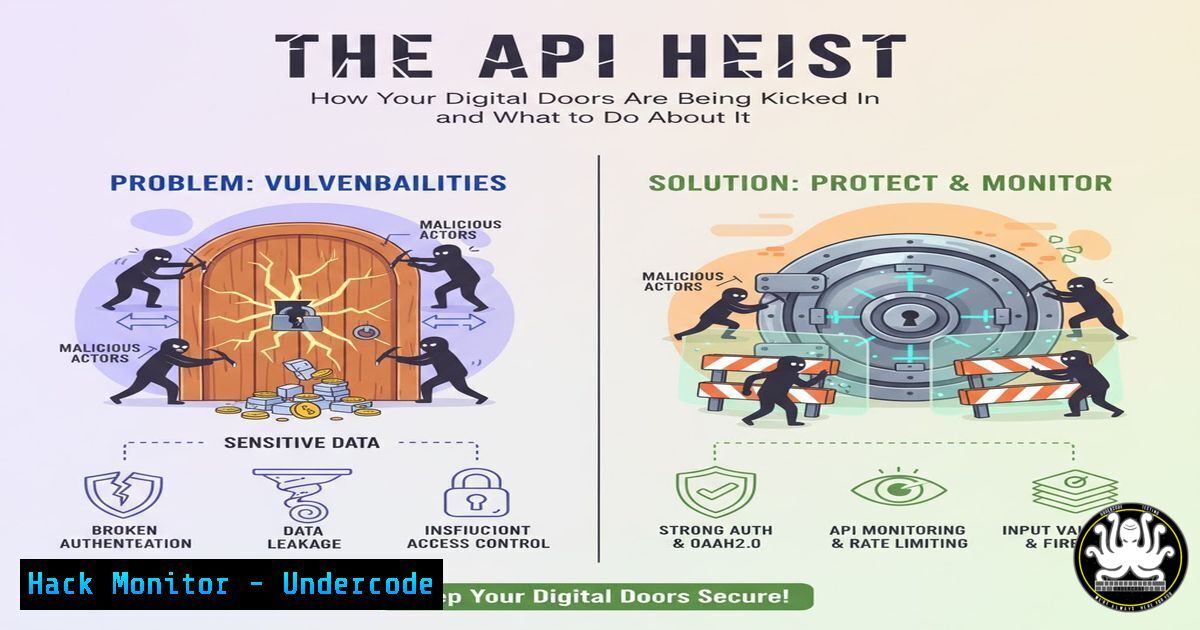
Introduction:
In the modern digital ecosystem, Application Programming Interfaces (APIs) have become the silent workhorses of connectivity, powering everything from your mobile banking app to your smart home devices. However, this pervasive reliance has turned APIs into a prime target for cybercriminals. Understanding how these attacks work is no longer a niche skill but a fundamental requirement for anyone in cybersecurity, as traditional perimeter defenses are often blind to these sophisticated incursions.
Learning Objectives:
- Understand the common techniques used to discover and exploit vulnerable API endpoints.
- Learn practical commands and methodologies for testing your own API security posture.
- Implement key mitigation strategies to harden your API infrastructure against common attacks.
You Should Know:
- The Art of API Endpoint Discovery and Reconnaissance
Before an attacker can exploit an API, they must first find it. This reconnaissance phase is critical and often leverages automated tools and public resources to map an organization’s API attack surface.
Step‑by‑step guide explaining what this does and how to use it.
Step 1: Harnessing Automation with ffuf. Tools like `ffuf` (Fuzz Faster U Fool) are used to brute-force API endpoints by testing thousands of potential paths against a target domain.
Linux/macOS Command:
ffuf -w /usr/share/wordlists/api/CommonApiEndpoints.txt -u https://target.com/FUZZ -mc all -fc 404
Explanation: This command uses a wordlist of common API endpoints (-w), replaces `FUZZ` in the URL with each word, and filters out common “404 Not Found” responses (-fc 404), revealing hidden endpoints.
Step 2: Analyzing JavaScript Files. Modern web applications often bundle API endpoints within their client-side JavaScript. Attackers will download these files and grep for patterns.
Linux/macOS Command:
curl -s https://target.com/app.js | grep -Eo "(https?://)?[a-zA-Z0-9./?=<em>-]api[a-zA-Z0-9./?=</em>-]" | sort -u
Explanation: This fetches the `app.js` file and uses a regex pattern with `grep` to extract all strings that look like API URLs, providing a direct list of potential targets.
2. Exploiting Broken Object Level Authorization (BOLA)
BOLA is the number one API security risk. It occurs when an API fails to verify that the user making a request is authorized to access the specific data object they are requesting. An attacker can simply change an ID in the request to access another user’s data.
Step‑by‑step guide explaining what this does and how to use it.
Step 1: Identify an ID Parameter. Find an API endpoint that includes an user-specific identifier, such as /api/v1/orders/12345.
Step 2: Manipulate the Request. Using a tool like `curl` or Burp Suite, change the ID value to access another record.
Linux/macOS Command (using `curl`):
 Legitimate request for your own order
curl -H "Authorization: Bearer YOUR_TOKEN" https://api.example.com/v1/orders/12345

Malicious request for another user's order
curl -H "Authorization: Bearer YOUR_TOKEN" https://api.example.com/v1/orders/12346
Explanation: If the second request returns a 200 OK status with another user’s order details, the API is vulnerable to BOLA. The server did not check if the token owner was authorized for order 12346.
3. Bypassing Rate Limiting and Anti-Brute-Force Controls
APIs without proper rate limiting are susceptible to credential stuffing and Denial-of-Service (DoS) attacks. Attackers use techniques to bypass weak controls.
Step‑by‑step guide explaining what this does and how to use it.
Step 1: Test with a Simple Script. A Python script can be used to rapidly fire requests and observe the response.
Python Script:
import requests

target_url = "https://api.example.com/v1/login"
for i in range(100):
response = requests.post(target_url, json={"username": "user", "password": "guess"})
print(f"Request {i+1}: Status Code {response.status_code}")
if response.status_code != 429:  If not "Too Many Requests"
print("Potential rate limiting bypass or weak configuration.")
Explanation: This script attempts 100 login requests. If the status code never becomes 429 (Too Many Requests), the endpoint lacks effective rate limiting.
Step 2: Rotate IP Addresses and User Agents. More advanced attackers will use proxy lists or the Tor network to rotate their source IP, making rate limiting based on IP address ineffective.
4. Hardening Your API Gateway Configuration
The first line of defense is a properly configured API Gateway. This acts as a policy enforcement point for all API traffic.
Step‑by‑step guide explaining what this does and how to use it.
Step 1: Enforce Strict Rate Limiting. Configure policies at the gateway level. For example, in AWS API Gateway, you set usage plans and rate limits per API key or IP.
Step 2: Implement Schema Validation. Define a strict JSON schema for all requests and responses. The gateway should reject any payload that does not conform, blocking many injection attacks at the edge.
Step 3: Mandate Authentication. Ensure that every endpoint, without exception, passes through an authentication check at the gateway before being routed to the backend service.
5. Implementing Robust Authorization and Input Sanitization
Gateway controls are not enough; the application logic itself must be secure.
Step‑by‑step guide explaining what this does and how to use it.
Step 1: Apply Principle of Least Privilege. Every API function should explicitly check the user’s permissions against the requested resource. Never assume authorization.
Pseudo-Code Example:
def get_user_order(order_id, current_user):
order = db.get_order(order_id)
if order.user_id != current_user.id:  Critical Authorization Check
raise PermissionDeniedError("Not authorized to view this order.")
return order
Step 2: Sanitize All Inputs. Treat all user input as untrusted. Use parameterized queries for databases to prevent SQL Injection and encode output to prevent Cross-Site Scripting (XSS).
6. Leveraging Security Tools and Continuous Testing
API security is not a one-time task. It requires continuous monitoring and testing.
Step‑by‑step guide explaining what this does and how to use it.
Step 1: Use an API Security Scanner. Integrate tools like OWASP ZAP or commercial DAST (Dynamic Application Security Testing) tools into your CI/CD pipeline to automatically scan for vulnerabilities with every build.
Step 2: Deploy a Web Application Firewall (WAF) Tuned for APIs. Modern WAFs can be configured with custom rules to detect and block anomalous API traffic patterns, such as mass enumeration attacks or specific exploit payloads targeting your API structure.
What Undercode Say:
- The API attack surface is vast and often underestimated, existing outside the view of traditional network security tools.
- The most critical vulnerabilities are often logical flaws in authorization, which cannot be patched with a simple software update but require a shift in development mindset.
Analysis:
The fundamental shift in application architecture from monolithic to microservices and SPA (Single-Page Applications) has fundamentally moved the attack surface. The “front door” of the website is no longer the only, or even primary, target. APIs represent a direct channel to backend logic and data. The tools and techniques for exploitation are accessible, making low-skill, high-impact attacks increasingly common. Defending against this requires a “shift-left” mentality, where security is baked into the API design and development phase, combined with robust runtime protection. Relying solely on perimeter defenses is a recipe for a catastrophic data breach.
Prediction:
The future of API attacks will be dominated by automation and AI. We will see the rise of AI-powered bots that can intelligently map API endpoints, understand business logic workflows, and identify complex chained vulnerabilities (e.g., exploiting a BOLA flaw to gather data for a more sophisticated business logic abuse attack). API security will become inseparable from bot management, as malicious automation becomes the standard modus operandi for credential stuffing, data scraping, and application-level Denial-of-Wervice attacks. Organizations that fail to adopt a comprehensive, intelligence-driven API security strategy will face relentless and evolving threats.
🎯Let’s Practice For Free:
IT/Security Reporter URL:
Reported By: Tolulopemichael Not – Hackers Feeds
Extra Hub: Undercode MoN
Basic Verification: Pass ✅


