Listen to this Post
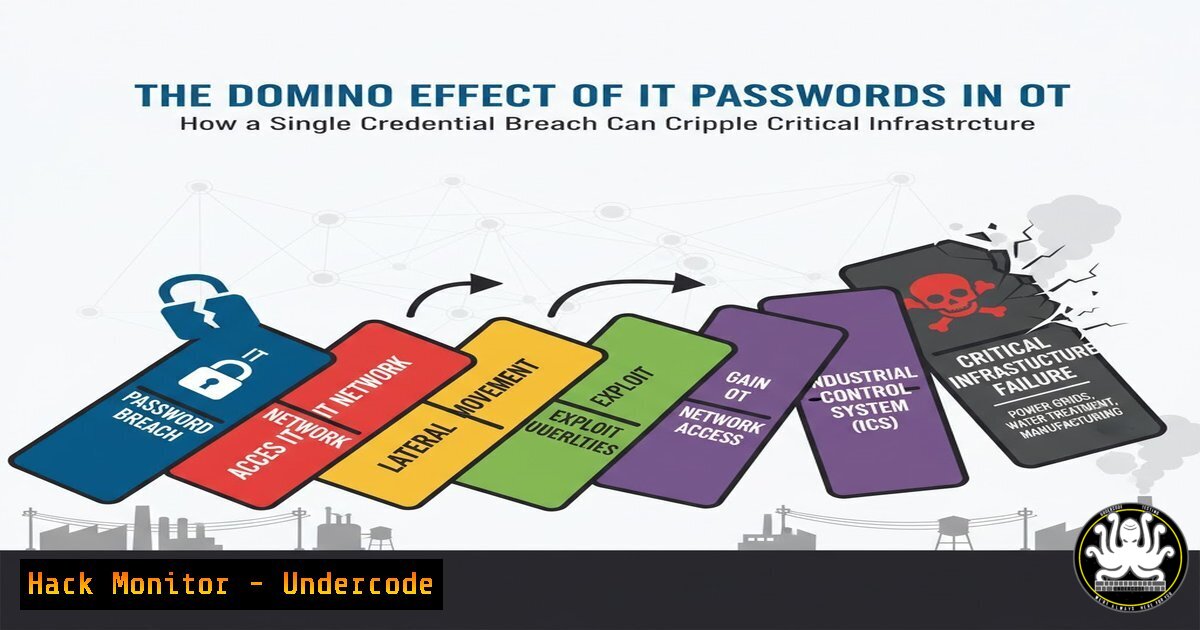
Introduction:
The convergence of Information Technology (IT) and Operational Technology (OT) networks has created a perilous security landscape where traditional IT threats can spill over into industrial control systems. A primary attack vector is the widespread reuse of IT passwords within OT environments, creating a single point of failure that can lead to catastrophic physical consequences.
Learning Objectives:
- Understand the critical risks associated with reusing IT credentials in OT environments.
- Learn how to audit and enforce credential segregation across IT/OT boundaries.
- Implement compensating controls and monitoring to detect lateral movement from IT to OT.
You Should Know:
1. The Anatomy of a Credential-Based OT Attack
When attackers compromise an IT network through phishing or other means, they harvest credentials using tools like Mimikatz on Windows or by dumping Linux shadow files. These credentials, if reused in OT, become a master key. The attack path is straightforward: breach IT -> extract passwords -> pivot to OT network -> locate and access critical assets like Programmable Logic Controllers (PLCs) and Human-Machine Interfaces (HMIs).
Step‑by‑step guide explaining what this does and how to use it.
Step 1: Initial Compromise. An employee on the IT network clicks a malicious link, granting the attacker a foothold.
Step 2: Credential Harvesting. The attacker escalates privileges and harvests password hashes from memory or the local system.
Windows (Mimikatz): `mimikatz sekurlsa::logonpasswords`
Linux: The attacker might attempt to read `/etc/shadow` if they have gained root access.
Step 3: Lateral Movement to OT. Using tools like `pth-winexe` or crackmapexec, the attacker reuses the captured hashes to authenticate to OT systems across a trust boundary.
Command Example (Pass-the-Hash): `pth-winexe -U DOMAIN/user%aad3b435b51404eeaad3b435b51404ee:NT_HASH //OT-STATION01 cmd`
2. Auditing for Password Reuse Across IT and OT
The first step in mitigation is understanding the scope of the problem. This involves auditing credential databases from both domains to identify overlaps. Specialized tools can compare password hashes without needing to store plain-text passwords.
Step‑by‑step guide explaining what this does and how to use it.
Step 1: Extract Password Hashes. Securely export the password hashes from your IT Active Directory and any OT-domain or local user databases.
Step 2: Use a Dedicated Auditing Tool. A tool like `Hascat` or a custom Python script can be used to compare the hash lists.
Conceptual Script Logic:
 Pseudo-code for hash comparison
it_hashes = load_hashes('it_domain_hashes.txt')
ot_hashes = load_hashes('ot_domain_hashes.txt')
reused_hashes = set(it_hashes).intersection(ot_hashes)
print(f"Found {len(reused_hashes)} reused password hashes.")
Step 3: Takedown and Remediate. Force a password change for all accounts identified as having reused credentials, prioritizing OT accounts with high privileges.
3. Implementing Network Segmentation and Jump Hosts
A robust network architecture is the most effective defense against lateral movement. Proper segmentation ensures that a breach in the IT network does not automatically grant access to the OT network. A securely configured jump host (or bastion host) becomes the single, heavily fortified gateway between the two zones.
Step‑by‑step guide explaining what this does and how to use it.
Step 1: Design a DMZ. Establish a Demilitarized Zone (DMZ) between the IT and OT networks. No direct traffic should flow between the two.
Step 2: Harden the Jump Host. Build a minimalist server (often Windows or Linux) in the DMZ. Harden it by:
Removing all unnecessary software and services.
Enforcing multi-factor authentication (MFA).
Implementing strict firewall rules (e.g., only allowing RDP/SSH from specific IT subnets to the jump host, and from the jump host to specific OT assets).
Step 3: Mandate its Use. All administrative access from IT to OT must flow through this jump host. Direct connections from the corporate network to OT controllers should be impossible.
4. Enforcing Multi-Factor Authentication (MFA) for OT Access
Passwords alone are insufficient. MFA adds a critical layer of security by requiring a second factor (like a physical token or biometric) to gain access. For OT, it’s vital to choose MFA solutions that do not hinder operational efficiency, especially during emergency situations.
Step‑by‑step guide explaining what this does and how to use it.
Step 1: Select an OT-Appropriate MFA Solution. Choose a solution that supports FIDO2 security keys or offline-capable OTP tokens to account for air-gapped or low-reliability networks.
Step 2: Pilot on Critical Assets. Begin by enforcing MFA on the most critical assets: engineering workstations, HMIs, and historian servers.
Step 3: Integrate with Access Control Policies. Configure MFA to be required for all remote access (VPN, jump hosts) and for local logins to high-value systems.
5. Monitoring for Anomalous Lateral Movement
Continuous monitoring can detect attackers attempting to pivot from IT to OT, even if they have valid credentials. Security Information and Event Management (SIEM) systems or OT-specific network monitoring tools can be configured with alerts for these specific behaviors.
Step‑by‑step guide explaining what this does and how to use it.
Step 1: Deploy Network Sensors. Place sensors at the IT/OT boundary to monitor all traffic.
Step 2: Create Detection Rules. Develop alerts for suspicious events, such as:
Authentication attempts from IT-subnet IP addresses to OT assets.
Use of pass-the-hash tools (detectable via command-line arguments or network signatures).
SMB or RDP connections originating from non-trusted workstations.
Step 3: Triage and Respond. Ensure your SOC or incident response team has playbooks for investigating potential IT-to-OT lateral movement.
What Undercode Say:
- Operational Continuity Trumps All: Any security control implemented in an OT environment must be evaluated against its potential impact on safety and operational reliability. A control that prevents an operator from responding to an emergency is a bad control.
- Defense in Depth is Non-Negotiable: Relying solely on password uniqueness is a flawed strategy. A resilient security posture requires a combination of architectural (segmentation), technical (MFA), and administrative (policy) controls working in concert.
The core issue highlighted by Mike Holcomb is not merely a technical oversight but a fundamental failure in risk assessment. OT systems manage physical processes where a cyber incident can equate to a safety incident. The analysis underscores that while password hygiene is a basic first step, the industry must aggressively move towards passwordless authentication and robust network segmentation to truly de-risk the IT-OT connection. The comment from Roland R. correctly points to the future, but as Holcomb replies, the transition must be pragmatic and not impede operational imperatives.
Prediction:
The future of OT security will see a rapid shift towards biometric and certificate-based passwordless authentication to fundamentally break the credential reuse attack chain. Furthermore, we will see the emergence of AI-driven Identity and Access Management (IAM) systems that continuously analyze user behavior across both IT and OT, automatically flagging and blocking anomalous access patterns that suggest lateral movement, thereby creating a dynamic and intelligent perimeter. The failure to adopt these advanced controls will leave critical infrastructure owners highly vulnerable to ransomware groups and state-sponsored actors who are already weaponizing IT-originated credentials against industrial targets.
🎯Let’s Practice For Free:
IT/Security Reporter URL:
Reported By: Mikeholcomb It – Hackers Feeds
Extra Hub: Undercode MoN
Basic Verification: Pass ✅


