Listen to this Post
Introduction
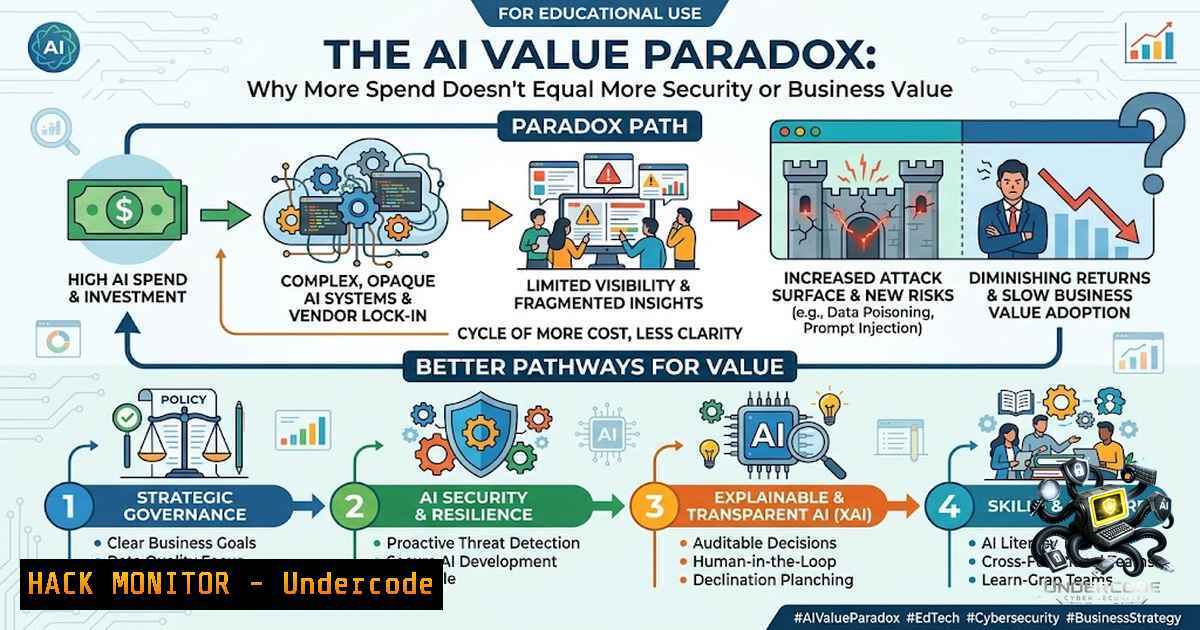
Enterprise AI spending reached $154 billion globally in 2025, yet 73% of organizations report difficulty extracting measurable business value from their AI investments. As organizations migrate from isolated AI pilots to enterprise-wide deployment, a dangerous disconnect emerges: high adoption rates, growing usage metrics, and apparent employee productivity gains often mask escalating costs and unquantified outcomes. Mary Carmichael, Field CISO for Western Canada at Bell Cyber, frames this challenge as the critical shift from “AI cost control” to “AI value governance”—a transition that demands CISOs, security architects, and IT leaders rethink how they measure, govern, and secure AI investments at scale.
Learning Objectives
- Understand the full lifecycle cost structure of enterprise AI, including hidden expenses beyond vendor token pricing, third-party dependencies, and human oversight requirements
- Implement AI value governance frameworks that connect investment and risk with measurable business outcomes rather than technology usage metrics
- Deploy technical controls for AI cost governance across cloud environments, API gateways, and security operations to prevent runaway spending
- Master practical commands and configurations for monitoring AI consumption, enforcing budget guardrails, and securing AI infrastructure across Linux and Windows environments
You Should Know
1. Deconstructing the True Cost of Enterprise AI
The assumption that AI value scales linearly with spend is one of the most dangerous myths in enterprise technology today. Carmichael’s ISACA research identifies six myths distorting AI business cases, with three critical insights standing out: AI consumption is harder to predict than organizations assume; vendor prices represent only a fraction of lifecycle costs; and greater efficiency and usage do not automatically translate into business value.
The Hidden Cost Layers:
| Cost Category | Description | Typical Impact |
||-|-|
| Token Consumption | API calls to foundation models | 40–60% of direct spend |
| Infrastructure | Compute, storage, networking for fine-tuning and inference | 20–30% |
| Data Engineering | Data preparation, labeling, pipeline maintenance | 15–25% |
| Human Oversight | Prompt engineering, validation, monitoring, compliance | 10–20% |
| Third-Party Risk | Vendor security assessments, compliance audits | 5–15% |
| Opportunity Cost | Failed projects, delayed initiatives, misallocated talent | Often unquantified |
Linux Command: Monitor AI API Consumption in Real-Time
 Track API requests and token usage across your environment
 Requires jq for JSON parsing
curl -s https://api.your-ai-gateway.com/v1/usage \
-H "Authorization: Bearer $API_KEY" \
-H "Content-Type: application/json" | jq '.usage | {total_tokens: .total_tokens, cost: .cost}'

Set up a monitoring cron job to log daily consumption
echo "0 0    /usr/bin/curl -s https://api.your-ai-gateway.com/v1/usage -H 'Authorization: Bearer $API_KEY' | jq '.' >> /var/log/ai_usage.log" | crontab -

Alert on cost thresholds using a simple bash script
!/bin/bash
DAILY_COST=$(curl -s https://api.your-ai-gateway.com/v1/usage -H "Authorization: Bearer $API_KEY" | jq '.usage.cost')
THRESHOLD=5000
if (( $(echo "$DAILY_COST > $THRESHOLD" | bc -l) )); then
echo "ALERT: Daily AI cost exceeded $THRESHOLD - Current: $DAILY_COST" | mail -s "AI Cost Alert" [email protected]
fi
Windows PowerShell: Track AI Spend Across Azure OpenAI Services
 Azure OpenAI usage monitoring
$subscriptionId = "your-subscription-id"
$resourceGroup = "your-ai-resource-group"
$accountName = "your-openai-account"

Get token usage metrics
Get-AzConsumptionUsageDetail -BillingPeriodName "202608" `
-Filter "resourceGroup eq '$resourceGroup'" | `
Where-Object {$<em>.InstanceName -like "openai"} | `
Group-Object MeterCategory | `
Select-Object Name, @{Name="TotalCost";Expression={($</em>.Group | Measure-Object PretaxCost -Sum).Sum}}
Step-by-Step Guide: Establishing an AI Cost Baseline
- Inventory all AI services across your organization—foundation model APIs, fine-tuned models, vector databases, and orchestration layers
- Map cost centers to business units using tagging strategies in cloud providers (AWS Tags, Azure Tags, GCP Labels)
- Instrument API gateways to log every request with metadata: user, department, use case, model selected, token count
- Calculate cost-per-task by dividing total monthly AI spend by completed business outcomes (e.g., tickets resolved, code generated, alerts investigated)
- Establish alerting thresholds at 80%, 100%, and 120% of projected monthly spend
Security Implication: Uncontrolled model costs create behavioral rationing of security operations. When token budgets are exhausted, SOC analysts hesitate to run enrichment queries or proactive threat hunts—directly degrading security posture during the highest-stakes moments.
- From Cost Control to Value Governance: A CISO’s Framework
Carmichael emphasizes that the fundamental question has evolved from “What does AI cost?” to “What will it cost at scale, and what improved because we spent it?” This shift demands a governance framework that connects technical controls to business outcomes rather than merely tracking usage metrics.
The AI Value Governance Maturity Model:
| Maturity Level | Focus | Key Metrics | CISO Role |
|-|-|-|–|
| Level 1: Ad Hoc | Usage tracking | Token count, API calls | Observer |
| Level 2: Cost Control | Budget management | Spend vs. forecast | Enforcer |
| Level 3: Value Measurement | Outcome tracking | Cost per outcome, ROI | Validator |
| Level 4: Value Governance | Strategic alignment | Business impact, risk-adjusted value | Strategic Partner |
Implementation Commands: Enforcing AI Cost Governance
Kubernetes Resource Quotas for AI Workloads:
 Limit AI inference pod resource consumption
apiVersion: v1
kind: ResourceQuota
metadata:
name: ai-inference-quota
namespace: ai-ml
spec:
hard:
requests.cpu: "100"
requests.memory: "200Gi"
limits.cpu: "200"
limits.memory: "400Gi"
persistentvolumeclaims: "10"
AWS Lambda Budget Guardrail:
import boto3
import os

def lambda_handler(event, context):
 Check AI service spend before allowing inference
ce = boto3.client('ce')
response = ce.get_cost_and_usage(
TimePeriod={
'Start': '2026-08-01',
'End': '2026-08-08'
},
Granularity='DAILY',
Metrics=['UnblendedCost'],
Filter={
'Dimensions': {
'Key': 'SERVICE',
'Values': ['Amazon Bedrock', 'SageMaker']
}
}
)
daily_cost = float(response['ResultsByTime'][bash]['Total']['UnblendedCost']['Amount'])
if daily_cost > float(os.environ['DAILY_THRESHOLD']):
return {'statusCode': 403, 'body': 'AI budget exceeded - request blocked'}
 Proceed with inference...
Step-by-Step Guide: Building an AI Value Governance Dashboard
- Define outcome metrics for each AI use case—not just “tasks completed” but “time saved per task,” “error reduction rate,” or “revenue generated”
- Implement OpenTelemetry instrumentation across your AI stack to capture trace data linking each inference to a business context
- Deploy a custom Prometheus exporter for AI metrics:
 prometheus_ai_exporter.py
from prometheus_client import Counter, Gauge, start_http_server
import time

ai_requests = Counter('ai_requests_total', 'Total AI requests', ['model', 'department'])
ai_cost = Gauge('ai_cost_dollars', 'Current AI spend in USD', ['department'])
ai_tokens = Counter('ai_tokens_total', 'Total tokens consumed', ['model'])

Update metrics from your API gateway logs every 60 seconds
while True:
 Parse logs, update metrics
time.sleep(60)
- Create business-unit chargeback reports that correlate AI spend with departmental outcomes
- Conduct monthly value reviews where each AI initiative must demonstrate measurable business improvement against its cost
Security Consideration: Forrester recommends CISOs push to embed AI security costs directly into enterprise AI investments, aligning funding with risk ownership and protecting foundational security programs. AI security should be treated as a business cost, not a “CISO tax”.
- The Tokenomics Trap: Why Usage-Based Pricing Fails Security
A security leader at a major retailer signed an AI contract with a fixed token allotment. Four months later, the invoice landed: half a million dollars in overages. The team hadn’t done anything unusual—they’d investigated alerts, run hunts, queried threat intel. The meter just ran faster than anyone modeled.
This “tokenomics trap” is particularly dangerous for security operations because SOC activity scales with the threat level. During an active attack, analysts will naturally consume more tokens. When the meter runs out, analysts hesitate on the extra pivot, skip the third enrichment query, defer proactive hunts. You’re rationing security decisions based on a billing model designed for cloud compute.
Linux Command: Implement Token Consumption Auditing
 Audit token consumption by security operation type
 Log enrichment queries with token counts
tail -f /var/log/ai-security.log | awk '
{
if ($0 ~ /enrichment/) {
tokens += $NF  Assuming token count is last field
enrich_count++
} else if ($0 ~ /hunt/) {
hunt_tokens += $NF
hunt_count++
}
}
END {
print "Enrichment: " enrich_count " ops, " tokens " tokens"
print "Threat Hunts: " hunt_count " ops, " hunt_tokens " tokens"
}'

Set up token budget alerts by operation type
!/bin/bash
ENRICH_TOKEN_LIMIT=1000000
CURRENT=$(grep "enrichment" /var/log/ai-security.log | awk '{sum+=$NF} END {print sum}')
if [ $CURRENT -gt $ENRICH_TOKEN_LIMIT ]; then
echo "WARNING: Enrichment token usage exceeded limit - $CURRENT tokens used" | \
logger -t ai-token-monitor -p auth.warning
fi
Windows PowerShell: Monitor Azure OpenAI Token Consumption
 Monitor Azure OpenAI token usage by deployment
$deployments = Get-AzOpenAIAccountDeployment -ResourceGroupName "ai-security" -AccountName "security-openai"

foreach ($deployment in $deployments) {
$usage = Get-AzOpenAIUsage -DeploymentId $deployment.Id -StartTime (Get-Date).AddDays(-30) -EndTime (Get-Date)
$totalTokens = ($usage | Measure-Object -Property TotalTokens -Sum).Sum
$totalCost = ($usage | Measure-Object -Property EstimatedCost -Sum).Sum

Write-Host "Deployment: $($deployment.Name)"
Write-Host " 30-Day Tokens: $totalTokens"
Write-Host " 30-Day Cost: `$$totalCost"
}
Step-by-Step Guide: Preventing the Tokenomics Trap
1. Classify security operations by criticality—tier 1 (must never be rationed), tier 2 (can use lighter models), tier 3 (can be deferred)
2. Implement model routing that directs tasks to appropriate model tiers based on classification
3. Configure auto-scaling budget alerts that trigger when consumption exceeds 70% of monthly allocation
4. Establish a “security reserve” —a separate token pool reserved exclusively for incident response
5. Negotiate fixed-fee contracts for security AI tools rather than usage-based pricing where possible
> Security Architecture Note: Most AI security platforms lock into a single model at configuration. This creates a lose-lose: pick a lightweight model and complex security tasks degrade in quality; pick a frontier model and every task, including simple ones, incurs premium costs. Implement model routing with cost-awareness as a core architectural principle.
4. Third-Party AI Risk: The Hidden Vulnerability
Carmichael’s research at Toronto Metropolitan University’s Rogers Cybersecure Catalyst focuses on third-party AI risk management, particularly in the public sector. Many organizations can articulate their AI values but have not built out the approval processes, vendor accountability structures, or monitoring frameworks that responsible adoption requires.
Key Third-Party AI Risk Categories:
| Risk Category | Description | Mitigation Strategy |
||-||
| Data Leakage | Sensitive data sent to vendor models | Data anonymization, on-premise deployment |
| Model Drift | Performance degradation over time | Continuous validation, version pinning |
| Supply Chain | Vulnerabilities in dependencies | SBOM generation, regular audits |
| Compliance Violation | GDPR, HIPAA, CCPA breaches | Vendor assessments, data residency controls |
Linux Command: Audit Third-Party AI Dependencies
 Generate SBOM for AI dependencies
pip freeze > requirements.txt
 Use OWASP Dependency-Check for vulnerability scanning
dependency-check --scan ./ --format HTML --out report.html

 Monitor outbound API calls to third-party AI services
 Using tcpdump to detect unexpected AI traffic
sudo tcpdump -i any -1 'host api.openai.com or host anthropic.com or host cohere.ai' -c 100

 Alternative: Use auditd to track AI configuration changes
sudo auditctl -w /etc/ai-config/ -p wa -k ai_config_change
Windows PowerShell: Third-Party AI Service Discovery
 Discover AI services in Azure tenant
Get-AzResource -ResourceType "Microsoft.CognitiveServices/accounts" | `
Select-Object Name, Location, Kind, Sku

Check network logs for AI API calls
Get-WinEvent -LogName "Microsoft-Windows-Sysmon/Operational" | `
Where-Object {$_.Message -match "api\.(openai|anthropic|cohere)"} | `
Select-Object TimeCreated, Message

Audit AI-related environment variables
Get-ChildItem Env: | Where-Object {$_.Name -match "AI|OPENAI|ANTHROPIC|COHERE"}
Step-by-Step Guide: Third-Party AI Risk Assessment
- Inventory all third-party AI vendors—foundation model providers, fine-tuning services, vector database vendors, and AI-powered security tools
- Require vendor security questionnaires based on SIG (Standardized Information Gathering) or CAIQ (Consensus Assessments Initiative Questionnaire)
- Conduct technical assessments including penetration testing of AI APIs and data handling practices
- Establish data handling agreements that specify data retention, deletion, and isolation requirements
- Implement continuous monitoring for vendor security incidents and model changes
5. Practical AI Security Hardening Commands
Linux: Secure AI Infrastructure
 Restrict AI API access using iptables
sudo iptables -A OUTPUT -d api.openai.com -p tcp --dport 443 -m owner --uid-owner ai-service -j ACCEPT
sudo iptables -A OUTPUT -d api.openai.com -p tcp --dport 443 -j DROP

Implement rate limiting for AI services using tc (traffic control)
sudo tc qdisc add dev eth0 root handle 1: htb default 30
sudo tc class add dev eth0 parent 1: classid 1:1 htb rate 100mbit
sudo tc class add dev eth0 parent 1:1 classid 1:10 htb rate 10mbit ceil 20mbit
sudo tc filter add dev eth0 protocol ip parent 1:0 prio 1 u32 match ip dst 104.18.0.0/16 flowid 1:10

Audit AI model files for vulnerabilities
find /models -1ame ".pt" -o -1ame ".h5" -o -1ame ".onnx" | while read model; do
echo "Checking $model"
file $model
 Check for pickle deserialization risks
strings $model | grep -E "pickle|torch.save|joblib" && echo "WARNING: Potential deserialization risk in $model"
done

Enable comprehensive logging for AI API access
sudo auditctl -w /etc/ai-api-keys.conf -p wa -k ai_keys
sudo auditctl -a always,exit -F arch=b64 -S connect -k ai_outbound_connections
Windows: Secure AI Infrastructure
 Restrict AI API access using Windows Firewall
New-1etFirewallRule -DisplayName "Block OpenAI Outbound" `
-Direction Outbound `
-RemoteAddress "104.18.0.0/16" `
-Action Block

 Monitor AI service processes
Get-Process | Where-Object {$_.ProcessName -match "python|node|dotnet"} | `
ForEach-Object {
$connections = Get-1etTCPConnection -OwningProcess $<em>.Id -ErrorAction SilentlyContinue
if ($connections.RemoteAddress -match "api.(openai|anthropic|cohere)") {
Write-Host "Process $($</em>.ProcessName) (PID: $($_.Id)) connecting to AI service"
}
}

Implement AppLocker policies for AI tools
New-AppLockerPolicy -RuleType Exe -User Everyone -Path "C:\AI-Tools\" -Action Allow
New-AppLockerPolicy -RuleType Exe -User Everyone -Path "C:\Users\AppData\Local\Programs\Python\Python311\Scripts\" -Action Deny
What Undercode Say
- AI value cannot be measured by usage alone—high adoption rates, growing token consumption, and apparent productivity gains are vanity metrics that obscure the real question: “What improved because we spent the money?” Organizations must shift from counting activities to measuring outcomes.
-
Cost governance is a security imperative, not a finance problem—when token budgets constrain security operations, analysts ration investigations during the highest-stakes moments. CISOs must treat AI cost governance as a core security control, negotiating fixed-fee contracts and establishing security reserves that cannot be depleted by routine operations.
-
The “build vs. buy” decision is more complex than it appears—while building internal AI capabilities offers cost control, the orchestration and infrastructure layer represents a multi-year engineering commitment that competes directly with core security missions. Most teams that start down the build path arrive at the same conclusion within three months: the complexity is underestimated.
-
Third-party AI risk demands continuous monitoring—periodic reviews are no longer effective in an environment where AI models evolve constantly. Organizations need continuous validation of vendor security postures, model performance, and compliance adherence.
-
The role of the CISO is evolving from technical overseer to strategic partner—as Carmichael emphasizes, the question is no longer “What does AI cost?” but “What will it cost at scale and what improved because we spent it?” This demands that security leaders understand AI economics as deeply as they understand threat vectors.
Prediction
+1 Organizations that adopt AI value governance frameworks will achieve 3–5x higher ROI from AI investments by 2028, while those that continue measuring success through usage metrics will face budget cuts and project cancellations as the AI spending reckoning intensifies.
+1 The emergence of open standards for AI economics, such as the Linux Foundation’s Tokenomics Foundation, will enable vendor-1eutral cost benchmarking and value measurement, reducing the information asymmetry that currently favors AI vendors over enterprise buyers.
-1 Security operations centers that fail to address the tokenomics trap will experience measurable degradation in threat detection and response capabilities, as analysts increasingly ration investigations based on token budgets rather than risk priorities.
-1 Organizations that delegate AI governance to IT operations without CISO involvement will face cascading failures: uncontrolled costs, data leakage through third-party models, and compliance violations that attract regulatory scrutiny and fines.
+1 The integration of AI cost governance with existing GRC frameworks will create a new specialization—the AI Value Assurance professional—combining expertise in AI economics, security, and business strategy, as foreshadowed by Carmichael’s work with ISACA’s Emerging Trends working group.
▶️ Related Video (80% Match):
🎯Let’s Practice For Free:
🎓 Live Courses & Certifications:
Join Undercode Academy for Verified Certifications
🚀 Request a Custom Project:
Secure, high-velocity infrastructure and disruptive technological engineering. Contact our engineering team for high-tier development and proprietary systems:
[email protected]
💎 Smart Architecture | 🛡️ Secure by Design | ⭐ Trusted by Thousands
IT/Security Reporter URL:
Reported By: Carmichaelmary Ai – Hackers Feeds
Extra Hub: Undercode MoN
Basic Verification: Pass ✅


