Listen to this Post
Introduction:
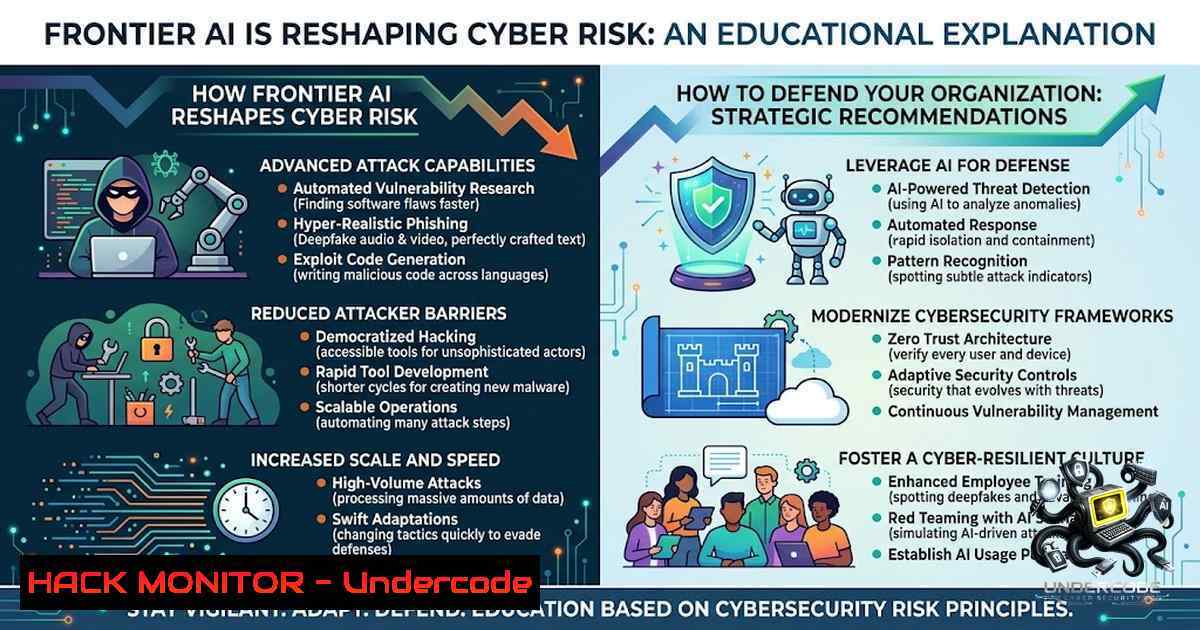
Frontier artificial intelligence models have fundamentally altered the cyber risk equation. Attackers now leverage sophisticated AI to discover vulnerabilities, automate exploits, and compress the window between exposure and weaponization from weeks to hours. Meanwhile, most organizations remain tethered to point‑in‑time assessments, manual reviews, and disconnected data sources — a posture that leaves critical systems dangerously exposed. This article distills insights from DataBee’s expert discussion on frontier AI cyber risk management and provides a practical blueprint for building resilience through continuous visibility, trusted data, and AI‑augmented decision‑making.
Learning Objectives:
- Understand how frontier AI accelerates the attack lifecycle and expands the threat surface
- Learn to transition from periodic risk assessments to continuous controls monitoring
- Master AI‑augmented defense strategies, including network detection and response (NDR), threat hunting, and exposure intelligence
- Identify the limitations of AI in security and where human judgment remains irreplaceable
- Implement practical Linux/Windows commands and configuration templates to operationalize AI‑ready security data fabrics
- The Frontier AI Threat Multiplier: From Episodic to Persistent Risk
Frontier AI models — including large language models, autonomous agents, and advanced machine learning systems — have collapsed the traditional timeline of cyber attacks. Where once attackers required days or weeks to reverse‑engineer a patch and develop an exploit, AI now enables near‑instantaneous weaponization. The threat landscape has shifted from episodic, manageable incidents to persistent, expanding risk surfaces.
Key attack vectors amplified by frontier AI include:
- Automated vulnerability discovery – AI models scan codebases, configurations, and network architectures at scale, identifying weaknesses faster than human teams can remediate
- Polymorphic and fileless malware – AI‑generated malware mutates in real time, evading signature‑based detection
- Intelligent social engineering – LLMs craft convincing phishing campaigns personalized to individual targets
- Autonomous reconnaissance – AI agents map attack surfaces, identify high‑value assets, and prioritize targets without human intervention
Defensive Imperative: Organizations must abandon the assumption that traditional perimeter defenses and periodic vulnerability scans suffice. The new baseline demands continuous monitoring, AI‑native detection, and risk‑informed prioritization.
Practical Step‑by‑Step: Building an AI‑Ready Threat Intelligence Pipeline
- Aggregate telemetry from all sources — endpoints, network flows, cloud logs, identity providers — into a unified data lake.
- Normalize and enrich data using a security data fabric to create a single source of truth.
- Deploy AI‑powered detection (e.g., machine learning‑based NDR) to identify zero‑day and fileless threats without signatures.
- Automate alert triage using LLM‑based analysis to reduce false positives and accelerate incident response.
- Feed insights back into risk scoring models to continuously refine prioritization.
-
Beyond Point‑in‑Time: Continuous Controls Monitoring as the New Standard
The fatal flaw in traditional risk management is its episodic nature. Audits happen quarterly or annually. Vulnerability scans occur on scheduled intervals. Risk registers are updated manually. In the frontier AI era, these rhythms are lethally slow.
Continuous Controls Monitoring (CCM) replaces periodic checks with real‑time, automated validation of security controls. By continuously collecting and analyzing control evidence, organizations can:
- Detect control failures within minutes, not months
- Maintain perpetual audit readiness
- Align security posture with dynamic business risk
- Provide boards and executives with decision‑ready, defensible insights
Step‑by‑Step: Implementing CCM with a Security Data Fabric
- Inventory all security controls across your environment — firewalls, IAM, endpoint protection, cloud configurations.
- Define control objectives and map them to measurable evidence sources (logs, API responses, configuration files).
- Deploy a security data fabric (e.g., DataBee) to collect, normalize, and correlate data from disparate systems.
- Automate evidence collection on a continuous basis (e.g., hourly or daily) rather than quarterly.
- Build dashboards that visualize control health, exception trends, and risk exposure in real time.
- Establish alerting for control deviations that exceed defined risk thresholds.
Sample Configuration: Continuous Log Collection with Syslog‑ng (Linux)
 Install syslog-1g for centralized log aggregation
sudo apt-get update && sudo apt-get install syslog-1g -y

Configure to forward logs to security data fabric
sudo nano /etc/syslog-1g/syslog-1g.conf
 Add: destination d_sec_fabric { tcp("192.168.1.100" port(514)); };
 Add: log { source(s_sys); destination(d_sec_fabric); };

sudo systemctl restart syslog-1g
sudo systemctl enable syslog-1g
Windows Equivalent: Forwarding Events to SIEM via Windows Event Forwarding
 Configure Windows Event Forwarding (WEF) subscription
wecutil qc
 Create a subscription to forward security logs
wecutil cs "C:\Subscriptions\SecurityEvents.xml"
- Defending with AI: Where Machine Learning Excels — and Where It Fails
AI is not a panacea. Understanding its strengths and limitations is critical to building an effective defense strategy.
Where AI Excels:
- Pattern recognition at scale – ML models detect subtle anomalies across billions of events that human analysts would miss
- Zero‑day and fileless malware detection – Patented machine learning engines analyze file content for malicious traits without relying on signatures
- Automated threat hunting – AI agents can run hypothesis‑driven hunts across telemetry, reducing analyst workload by up to 52%
- Prioritization – AI correlates vulnerability data with asset criticality and threat intelligence to surface the highest‑risk issues first
Where AI Falls Short:
- Contextual judgment – AI lacks business context; it cannot distinguish between a development server and a production critical system without explicit tagging
- Adversarial manipulation – Attackers can poison training data or craft inputs that cause AI models to misclassify
- Explainability – Many AI models are black boxes, making it difficult to defend decisions to auditors or regulators
- Over‑reliance – Teams that trust AI blindly may miss novel attack patterns that fall outside training distributions
Step‑by‑Step: Deploying AI‑Powered Network Detection and Response (NDR)
- Deploy network sensors at key aggregation points (e.g., core switches, cloud VPCs) to capture full packet payloads and metadata.
- Configure AI/ML analysis engine (e.g., DataBee BluVector) to analyze traffic for malicious traits without sandboxing.
- Set detection thresholds based on organizational risk tolerance — lower thresholds for critical assets, higher for less sensitive segments.
- Integrate NDR alerts with your SOAR platform for automated response playbooks.
- Establish a feedback loop — validate AI detections with human analysis and retrain models on false positives/negatives.
Sample Command: Querying AI‑Powered Threat Detection Logs (Linux)
 Search for AI‑flagged anomalies in system logs
grep "BLUVECTOR_ALERT" /var/log/security/ndr.log | jq '.timestamp, .src_ip, .dst_ip, .threat_score'

Parse JSON alerts for high‑severity threats
cat /var/log/security/ndr.log | jq 'select(.severity == "critical") | {time: .timestamp, src: .src_ip, dst: .dst_ip, signature: .signature}'
- The Data Foundation: Why a Security Data Fabric Is Non‑Negotiable
The single biggest obstacle to AI‑powered defense is not the absence of AI — it is the absence of trusted, unified data. Most organizations drown in security telemetry while starving for actionable insight. Critical information about vulnerabilities, assets, ownership, controls, and business impact exists across disconnected systems, making it impossible to understand where risk actually resides.
A security data fabric solves this by collecting, normalizing, and correlating cybersecurity data across the entire environment, creating a unified, queryable data layer. This foundation enables:
- AI‑ready data – Clean, normalized data that AI models can consume without extensive preprocessing
- Single source of truth – Consistent risk scores, asset inventories, and control status across security, risk, and compliance teams
- Continuous assurance – Real‑time visibility that supports always‑on audit readiness
- Faster remediation – Unified data accelerates vulnerability patching by surfacing ownership and business impact
Step‑by‑Step: Building a Security Data Fabric
- Identify all data sources — SIEM logs, cloud provider logs, CMDB, vulnerability scanners, IAM systems, endpoint detection tools.
- Define a common data model — standardize field names, data types, and timestamp formats across sources.
- Deploy data ingestion pipelines (e.g., using Kafka, Fluentd, or a purpose‑built fabric like DataBee) to collect and normalize data in real time.
- Enrich data with business context — asset criticality, data sensitivity, regulatory classification, owner contact information.
- Expose a unified query interface (e.g., SQL or GraphQL) for security analysts, risk teams, and AI models to access the data.
- Implement governance — data retention policies, access controls, and lineage tracking to ensure data trustworthiness.
Sample Linux Command: Ingesting CloudTrail Logs into a Data Fabric
 Use AWS CLI to pull CloudTrail logs and pipe to normalization script
aws s3 cp s3://my-cloudtrail-bucket/AWSLogs/ /local/cloudtrail/ --recursive --exclude "" --include ".json.gz"

Decompress and normalize
gunzip -c /local/cloudtrail/.json.gz | jq '.Records[] | {eventTime: .eventTime, eventName: .eventName, user: .userIdentity.userName, sourceIP: .sourceIPAddress, eventType: .eventType}' >> /data_fabric/cloudtrail_normalized.jsonl
- The Blueprint for Frontier AI Resilience: Visibility, Trusted Data, Continuous Monitoring, Risk‑Informed Decisions
The DataBee webinar outlines a four‑pillar blueprint for defending against frontier AI:
Pillar 1: Visibility – You cannot defend what you cannot see. Achieve comprehensive visibility across on‑premises, cloud, and OT environments. Deploy AI‑powered NDR to detect threats that evade traditional tools.
Pillar 2: Trusted Data – Build a security data fabric that normalizes and enriches telemetry from every source. Ensure data is accurate, complete, and timely enough to support AI‑driven decisions.
Pillar 3: Continuous Monitoring – Replace point‑in‑time assessments with always‑on control validation. Automate evidence collection and alerting so that control failures are detected and remediated in near real time.
Pillar 4: Risk‑Informed Decision‑Making – Use AI to correlate vulnerability data, threat intelligence, and business context. Prioritize remediation based on actual risk exposure, not severity scores alone.
Step‑by‑Step: Operationalizing the Blueprint
- Week 1–2: Conduct a data inventory — map all security data sources and identify gaps in coverage.
- Week 3–4: Deploy a security data fabric pilot, starting with 2–3 critical data sources (e.g., endpoints + cloud logs).
- Week 5–6: Implement continuous controls monitoring for a subset of high‑priority controls (e.g., MFA enforcement, patch compliance).
- Week 7–8: Integrate AI‑powered detection (NDR or ML‑based alerting) and tune thresholds.
- Week 9–10: Build risk dashboards that combine vulnerability data, asset criticality, and threat intelligence.
- Ongoing: Establish a governance cadence — weekly risk reviews, monthly control health reports, quarterly blueprint maturity assessments.
What Undercode Say:
- Key Takeaway 1: Frontier AI has transformed cyber risk from an episodic challenge into a persistent, expanding threat surface. Organizations that rely on periodic assessments are already behind.
-
Key Takeaway 2: The defense against AI‑powered attacks must be AI‑augmented — but AI is only as good as the data it consumes. A unified security data fabric is the non‑negotiable foundation for any modern cyber risk program.
Analysis: The discussion rightly emphasizes that the core problem is not a lack of security tools but a lack of data integration and continuous visibility. Many enterprises have invested heavily in point solutions — firewalls, EDR, SIEM, vulnerability scanners — yet these systems operate in silos, producing noise rather than signal. The frontier AI era demands a shift from tool‑centric to data‑centric security, where the security data fabric becomes the nervous system of the organization. This is not merely a technical upgrade; it requires cultural change — moving from periodic compliance exercises to always‑on risk management, and from reactive alert‑chasing to proactive, risk‑informed decision‑making. The blueprint offered by DataBee is pragmatic and achievable, but it requires executive commitment, cross‑functional collaboration, and a willingness to retire legacy processes that no longer serve.
Prediction:
- +1 Organizations that adopt a security data fabric and continuous controls monitoring within the next 12–18 months will achieve a measurable competitive advantage — faster incident response, lower breach costs, and stronger regulatory standing.
-
+1 AI‑powered NDR and autonomous threat hunting will become table stakes for enterprise security by 2027, rendering signature‑based detection obsolete for all but the most trivial threats.
-
-1 Enterprises that delay the transition from point‑in‑time to continuous risk management will experience a sharp increase in material breaches, as frontier AI‑enabled attackers systematically exploit the gaps between assessment cycles.
-
-1 The shortage of security professionals capable of managing AI‑augmented defenses will worsen, driving up labor costs and widening the gap between well‑resourced and under‑resourced organizations.
-
+1 Regulatory bodies (e.g., CISA, NIST) will increasingly mandate continuous controls monitoring and AI risk management frameworks, creating tailwinds for adoption and standardization.
▶️ Related Video (74% Match):
https://www.youtube.com/watch?v=2O-v4dFFEIM
🎯Let’s Practice For Free:
🎓 Live Courses & Certifications:
Join Undercode Academy for Verified Certifications
🚀 Request a Custom Project:
Secure, high-velocity infrastructure and disruptive technological engineering. Contact our engineering team for high-tier development and proprietary systems:
[email protected]
💎 Smart Architecture | 🛡️ Secure by Design | ⭐ Trusted by Thousands
IT/Security Reporter URL:
Reported By: Philip Mitten – Hackers Feeds
Extra Hub: Undercode MoN
Basic Verification: Pass ✅


